Run bigger events with a smaller team.
Event ops eat your week. Seating charts, run sheets, MC scripts, timers, name badges, post-event reports. We rebuild that work with Claude and a stack of AI tools. What took a day now takes an hour. What broke on a last-minute change now updates in seconds. Your people go back to the guest, the client, and the show.
The event goes well because your team wins a hundred small fights nobody claps for.
Guests remember the room, the food, the moment on stage. They never see the six hours someone spent reseating 200 people after a family feud, or the run sheet rebuilt at midnight because a sponsor slot moved, or the MC cues written on the back of a printout. That invisible work is where your margin and your sleep go.
C4E is an AI-first collective. We build brand, marketing, and events. On the events side, our job is narrow and useful: take the repeat work off your team and hand it to AI. Claude does the reasoning and the writing. Other tools handle the spreadsheets, the PDFs, the print, and the live pages. Your team keeps the taste, the judgment, and the client. The machine does the typing.
This page shows the exact jobs we have already rebuilt, the problems they solve, and how to start. It ends with one ask: talk to us.
The event runs on grunt work nobody sees.
The industry names the same problems every year. A small delay sets off a domino across the whole day. A lean team gets stretched thin. The admin piles up and steals the hours you needed for the guest. Here is where the time goes, and why each one hurts.
Repetitive paperwork
Seating charts, run sheets, badges, place cards, schedules, RSVP trackers. Built by hand, one guest and one table at a time. Every new event starts the whole list from zero, even though 80 percent of it is the same as the last one.
Last-minute changes break everything
A VIP swaps tables. A speaker moves slots. A sponsor gets added at 9pm. Now the chart, the badges, the run sheet, and the MC script are all wrong at once, and there is one tired person left to fix them by hand.
A team too small for the day
Understaffing is the problem you find on D-day, when it is too late to fix. The workload does not shrink to match the people you have. So the people stretch, mistakes creep in, and the good staff burn out and leave.
Vendor and run-of-show chaos
Caterer, decor, AV, stage, transport, security. All on different threads, all with their own version of the plan. One missed confirmation and the flow stalls in front of the guests, where every second is visible.
On-stage timing slips
Segments run long. The MC has no cue. The countdown lives in a producer’s head and a wristwatch. The clean schedule you built in planning never survives first contact with a live room and a chatty speaker.
Reports arrive too late to matter
The client wants numbers: attendance, spend, engagement, photos, what to change next time. Pulling that together after a 16-hour event is the last thing anyone has energy for, so it slips a week and lands cold.
Problem framing drawn from published event-industry sources, 2026:
ThemeWinter, 10 Common Event Management Challenges,
Micepad, Top Event Planning Challenges and Solutions,
Pheedloop, Emerging Event Planning Challenges in 2026.
You did not get into events to format spreadsheets.
You got in to make a room feel something and to send a client home proud. The admin is not the job. It is the tax on the job. Here is what event teams actually chase, backed by what the industry reports, and where the busywork gets in the way.
A guest experience people remember
The moment on stage. The welcome at the door. The small touch that says someone thought about them. That is your product. 92% of attendees prefer interactive experiences over standard presentations, and every hour lost to paperwork is an hour not spent building one.
Engagement, not just attendance
A full room is not a won room. 74% of organizers call engagement a key driver of success, and 39% still name it a top challenge. People want to take part, ask, and connect. Engagement gets planned, and planning takes the hours admin keeps stealing.
A show that runs to the clock
Nothing breaks a guest’s trust faster than a stage running 40 minutes late. On-time is a feeling of control the whole room can sense, and it is the first thing to slip when the timing lives in one producer’s head.
Clients who book you again
Repeat business is the whole game. 78% of organizers think they delivered a standout event, but only 60% of attendees felt it. Closing that gap wins the next booking, and a client who felt looked-after from the door to the follow-up report is a client who comes back.
Proof the event actually worked
Clients and bosses want numbers, not vibes. The bar is rising: the share of organizers who struggle to prove event ROI fell from 70% to 40% in a year. The data already exists. Someone has to turn it into a story the client can forward upward.
Costs that stay inside the plan
Margins are thin and getting thinner. 71% of event pros expect cost increases this year, and budget is named the top challenge across the industry. Doing more with the team you already have stopped being a nice-to-have. It is how you stay in business.
Figures from published 2026 event-industry research:
Remo, 70+ Event Statistics for Organizers,
EventsAir, Top Event Industry Insights and Trends,
Cvent, Event Statistics Shaping the Industry.
We do not sell you software. We do the work with you.
No new platform to learn. No annual license for seats you will not use. You send the spreadsheets and notes you already keep. We hand back finished outputs in the formats you already print, share, and present.
Find the work that repeats. Kill it with AI. Keep the humans on the human parts.
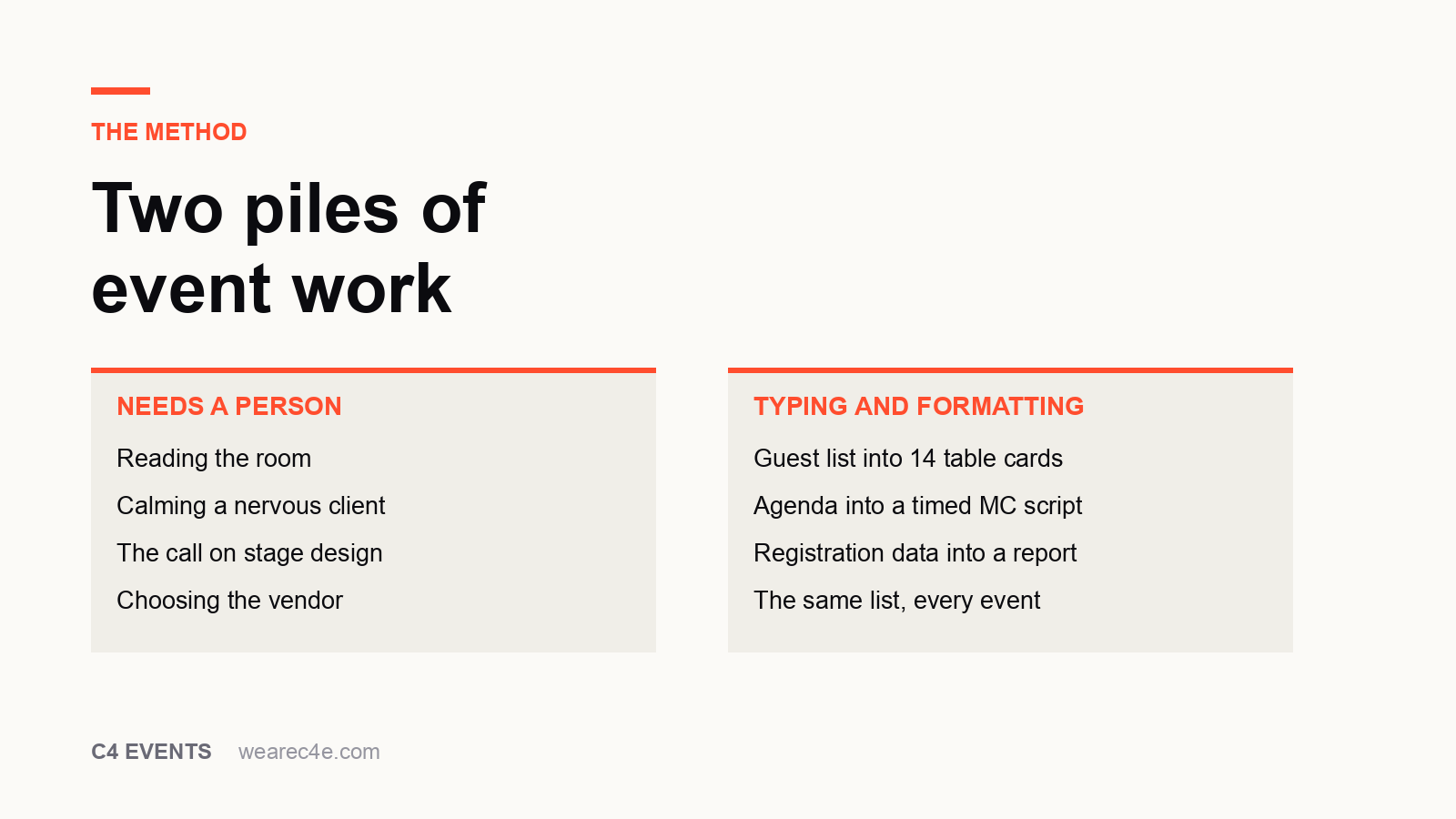
Most event work splits into two piles. One pile needs a person: reading the room, calming a nervous client, making the call on the stage design, choosing the right vendor. The other pile is typing and formatting: turning a guest list into 14 table cards, turning an agenda into a timed MC script, turning registration data into a client report. The second pile is large, it repeats, and it is exactly what AI does well.
We start by finding your second pile. On a single call we watch how a real event moves through your team and we mark every task that gets done the same way each time. Then we rebuild those tasks with Claude and the right supporting tools so they run in minutes and redo themselves when a detail changes. Nothing about your judgment gets automated. The parts that need a human stay with your humans.
We are tool-agnostic on purpose. Claude handles the reasoning, the writing, and the structure. Spreadsheet and document tools handle the data. PDF and print tools handle the physical outputs for the door and the tables. Live web pages handle the timers and status screens. We pick the shortest path to a finished output and we fit it to how your team already works, not the other way around.
The result is not a robot running your event. It is a lean team that stops losing nights to formatting, catches fewer errors on stage, and sends the client report the same evening instead of next week. You take on more events without adding headcount, and the events you run feel calmer because the paperwork stopped fighting back.
Things we have already built for events.
Real outputs from real work. Each one used to take hours. Each one now takes minutes, and rebuilds itself the moment a detail changes. This is not a roadmap. It is a menu you can start from this week.
Guest lists into print-ready tables in minutes
Feed a messy guest spreadsheet. Get a clean master sheet, one tab per table, and a print-ready PDF card for every table at the door. A guest moves? The whole set rebuilds in seconds. No re-typing, no dropped name, no card that disagrees with the chart.
Timers that keep the stage honest
Segment countdowns and a full-screen clock for the AV desk, the stage monitor, and the speaker. The room sees the time. The MC gets a cue. Sessions stop running long and the schedule holds without a producer hissing into a headset.
An MC script written to the minute
Welcome, introductions, sponsor mentions, transitions, cues, and the awkward gaps covered. Written in the tone of the event and matched to the run of show. Change the order and the script re-flows with it, so a 9pm change does not mean a midnight rewrite.
The run book the whole crew works from
Run sheets, vendor call sheets, floor notes, contact lists, and a single source of truth for the day. One change updates every version. No more three copies of the plan that quietly disagree until they collide on site.
The client report, ready that night
Attendance, budget against actual, engagement, photo highlights, and clear next steps. Built from your data while the event is fresh, not two weeks later when the client has moved on and the goodwill has cooled.
Badges, cards, invites, and broadcasts
Name badges and place cards from the same list that drives the seating. Invite and reminder copy in your brand voice. WhatsApp and email broadcasts drafted and ready to send. Dietary, access, and VIP lists pulled without a manual sort.
A one-page 101 on every VIP
Who they are, why they matter, what to say, what to avoid. Built for the client, the host, and the MC before they shake a hand. Small touch, large effect on how looked-after a guest feels.
Whatever repeats, we automate
Budget trackers, vendor comparison sheets, feedback form summaries, thank-you notes, social recaps. If your team types it twice, it is a candidate. The rule is simple and it holds across every event you run.
Three examples, start to finish.
Words like efficiency mean nothing without the receipt. Here is what the work looks like when it lands on your desk.
93 guests, 14 tables, rebuilt on demand
A client sends a guest list as a single flat spreadsheet: names, organisations, and a table number. On the old way, someone opens 14 blank documents and starts copying rows, then re-checks every one against the master so no name is dropped or doubled. Half a day, and every change starts it again.
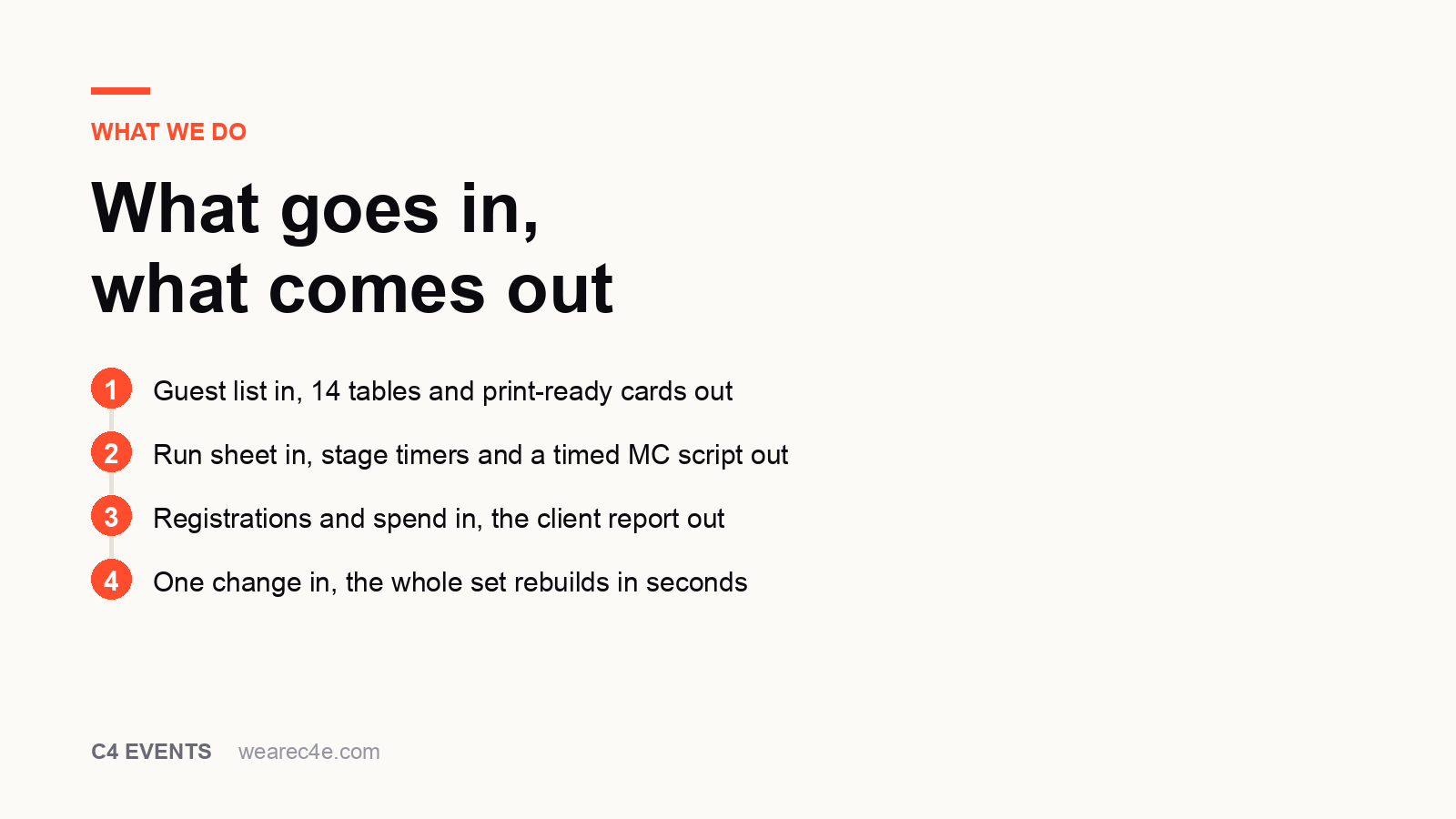
We turn that same list into a clean master sheet, a tab for each of the 14 tables, and a print-ready PDF card for every table, all in one pass. When a guest moves table or a plus-one lands the night before, the full set rebuilds in seconds and stays consistent to the last card. The person who used to do this gets their afternoon back and the door team gets cards that match the chart.
The show that starts and ends on time
Take the run of show. We generate a full-screen countdown for each segment that the AV desk and the speaker can both see, so time becomes a shared fact instead of an argument. Alongside it, we write the MC script to the minute: the welcome, the sponsor lines said the way the sponsor wants them said, the transitions, and a line to fill every gap.
When the order shifts, and it always shifts, the timers and the script re-flow together from the updated run sheet. No producer rewriting cues in a corner while the room fills. The MC walks out with a script that matches the clock on the wall.
The report that lands the same night
The event ends and the client wants to know it worked. We take your registration data, your spend, your notes, and your photo highlights and build a clean report while the numbers are still warm: who came, what it cost against budget, what drew engagement, and what to do differently next time.
Sending it that evening changes the relationship. The client reads a sharp summary while the event is still the best thing that happened to them this month, instead of a cold PDF a fortnight later. That timing is worth more than the design, and it costs your team nothing because the report built itself from data you already had.
Same team. Same calendar. Different week.
Before
- Seating charts built by hand, then rebuilt on every change
- MC cues written the night before on a printout
- Three versions of the run sheet, none of them current
- The client report slips a week and lands cold
- Your best people stay late doing data entry
- A 9pm change means a midnight scramble
After
- Guest list in, tables and cards out, in minutes
- MC script timed to the run of show and re-flowing on demand
- One run book, one source of truth, updated everywhere at once
- Client report sent the same night, while it still counts
- Your people back on the guest, the client, and the show
- A 9pm change handled before you finish your tea
Expectations up. Budgets flat. AI everywhere.
The ground is moving under every event team. Guests expect more, clients pay less, and AI went from novelty to normal in a single year. Here is the shape of it, straight from the industry’s own numbers.
The pattern is plain. More is asked of every event, less is paid for it, and the tools to close that gap are here now. The teams that win the next few years are not the biggest. They are the ones that put the repeat work on machines and their people on the guest. That is the whole idea behind C4E.
Sources:
Remo, 70+ Event Statistics for Organizers 2026,
EventsAir, Top Event Industry Insights and Trends,
Cvent, 390 Event Statistics Shaping the Industry in 2026.
Simple to start. Fast to see value.
No procurement marathon, no six-week onboarding. We prove it on one real job before you commit to anything larger.
One call
You show us a live event and the jobs that drain your team. We point to the ones AI kills fastest.
Pick one job
We take a single painful task, say seating or the run book, and rebuild it on your real event data.
You see it work
Real output in your hands, in your format. You feel the hours saved before you spend a rupee on more.
Scale across the calendar
We wire the winning jobs into how you run every event. Your team runs more with the same people.
An agency that uses these tools every day, not a vendor guessing at your job.
C4E is an AI-first collective. We use Claude and a working stack of AI tools on our own client work across brand, marketing, and events, so we are not selling you a demo. We are handing you the same machinery we run ourselves, pointed at the parts of your business that hurt.
That matters because most AI pitches to the events world are a platform with a login and a monthly bill, and a promise that you will figure out the rest. We do the opposite. We look at your actual workflow, we build the specific outputs your events need, and we fit them to the formats you already use. There is no seat to buy and no dashboard to learn. There is a person on a call and a finished output in your inbox.
We work worldwide. The work is remote and the outputs are digital and print-ready, so a time zone is not a blocker and a border is not a reason to wait. If you run events for a living, in any city, we can help you run them with fewer late nights and fewer things breaking on stage.
Built for the companies that run events for a living.
Event and MICE agencies
Running back-to-back events on lean teams. You feel every hour of admin, and every hour saved is an hour you can sell or sleep. This is the fastest place to start.
Wedding and hospitality planners
High guest counts, endless seating and RSVP churn, and last-minute family changes that arrive at the worst hour. This is the exact work AI eats first and complains about never.
Corporate and conference teams
Run sheets, speaker logistics, sponsor deliverables, and reports the client actually reads. All faster, all consistent, all in your brand and your format.
Questions you are about to ask.
Do we have to change our software?
No. We work on top of what you use. You send the same spreadsheets and notes you already keep, and we hand back better outputs in the formats you already print, share, and present. There is nothing new for your team to log into.
Is our guest and client data safe?
We treat your data as your data. We use it to build your outputs and for nothing else. We are happy to walk through exactly how it is handled, where it lives, and what gets deleted, before you share a single name.
Does this replace our team?
No. It removes the typing, not the people. Your team keeps the judgment, the taste, the vendor calls, and the client. What they lose is the night shift of data entry and the panic of a last-minute rebuild.
How fast can we see something real?
One call, then one rebuilt job on your own event. You see a real output, in your format, inside the first week. We would rather show you than tell you, because the time saved is obvious the moment you hold it.
What does it cost?
It depends on the jobs you want off your plate and how many events you run. We scope it on the call once we see the work. The first proof is small and low-risk on purpose, so you decide with a real output in hand rather than a quote in the dark.
We already use an events platform. Does this clash?
No. Platforms handle registration, ticketing, and check-in. We handle the production work around them: the seating, the run book, the MC script, the timers, and the report. We take the exports your platform already gives you and turn them into finished outputs.
Where do you work?
Worldwide. The work is remote and the outputs are digital and print-ready, so time zone and location are not blockers. If you can send a spreadsheet, we can help.
Talk to Saurabh. That is the whole ask.
No form maze, no sales sequence, no ten-touch nurture. One conversation. Bring a real event and the parts that drain your team, and we will show you what AI takes off the table. If it is useful, we keep going. If it is not, you have lost half an hour and gained a few ideas.
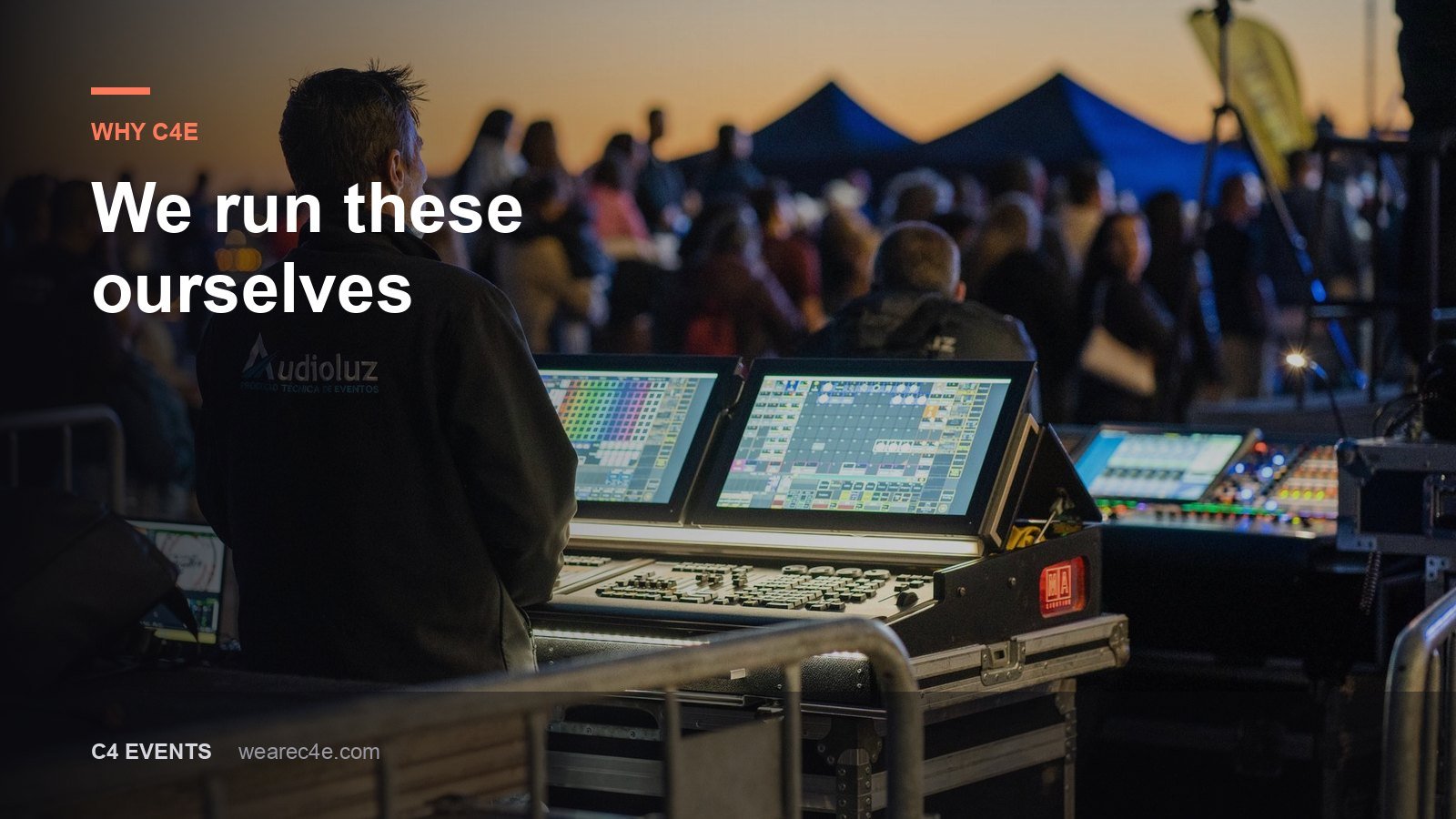
Photography by Victor Silva, via Pexels. Diagrams by C4 Events.