
A good offsite resets a team. The wrong logistics ruin it. C4E plans and runs corporate offsites and leadership retreats across Asia and beyond: Bali, Phuket, Singapore, Thailand and Vietnam. You bring the agenda. We handle the venue, travel, activities and every detail on the ground.
City or resort
This is the first decision and most teams get it backwards by starting from budget. Start from length.
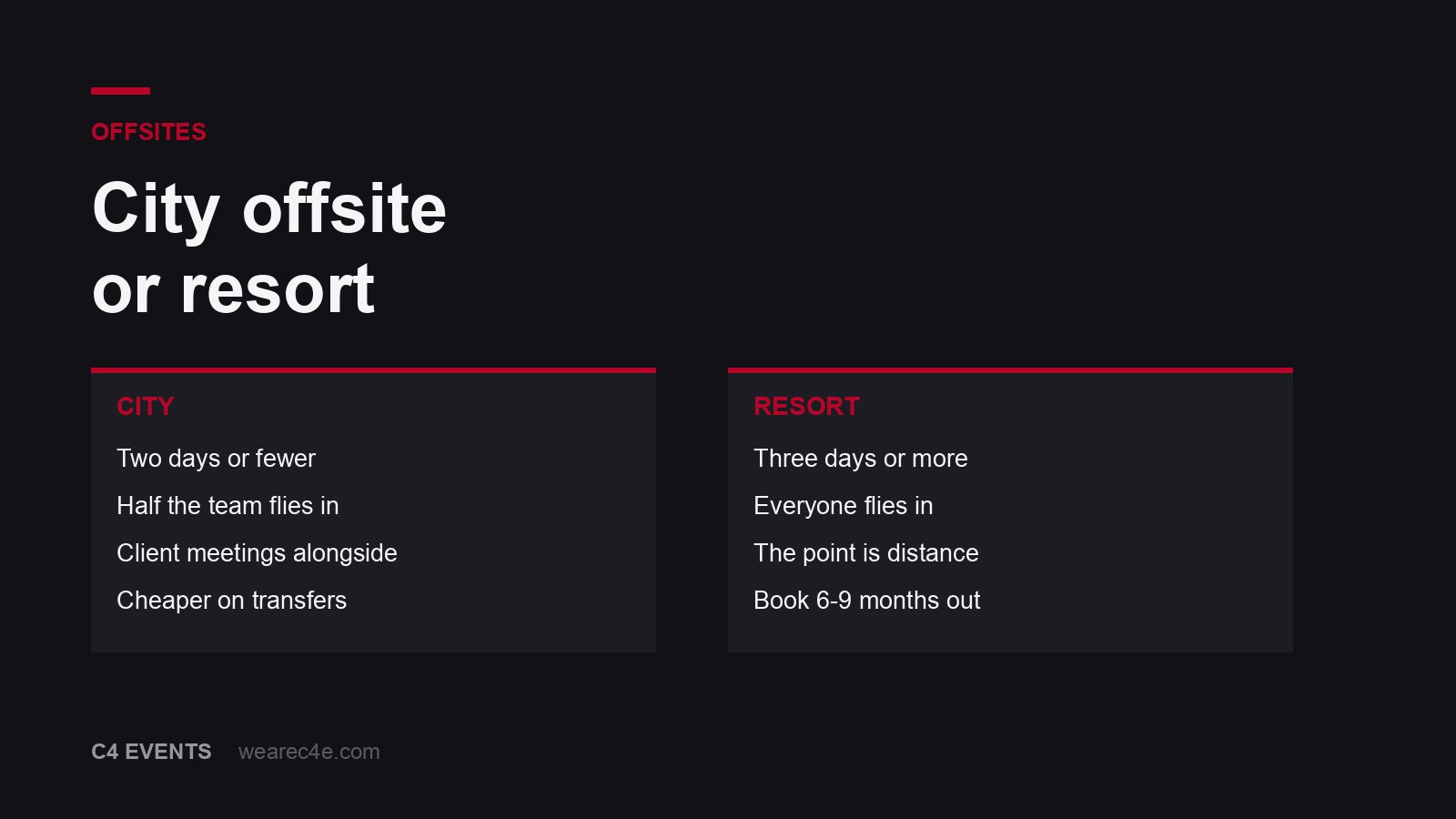
| City offsite | Resort offsite | |
|---|---|---|
| Length that fits | 1 to 2 days | 3 days or more |
| Travel | Half the team is already there | Everyone flies, and everyone transfers |
| What it is good at | Decisions, client meetings alongside | Distance, trust, the long conversation |
| What it is bad at | Getting people out of their inbox | Anything under three days |
| Book | 4 to 8 weeks out | 6 to 9 months out in peak season |
The day that produces a decision
Most offsite agendas fail the same way. Nine sessions, four facilitators, two activities, and a team that goes home with photographs and no decision. A working day holds five things.

One hard decision, put in the morning while the room is sharp. One long uninterrupted block, because the good thinking happens after 40 minutes and most agendas cut at 45. One meal that is not a working session. One activity, chosen because the team will enjoy it and not because it teaches a metaphor. One evening with no agenda at all, which is where the trust gets built.
Why run it in Asia
Resort-quality venues at real value, short-haul access across the region, and destinations that feel like a change of scene. For distributed teams in the US or Europe, an Asian offsite is also the one trip of the year where everybody is in the same room, and that is worth more than the venue.
Where we run offsites
- Bali. Ubud for retreats and quiet, Nusa Dua and Jimbaran for larger groups. The full Bali offsite guide covers area, venue, permits and the season that decides everything.
- Phuket and Krabi. Resort inventory built for groups, and a short flight from most of Asia.
- Singapore. City offsites with business access, for teams that need meetings around the agenda.
- Thailand past the beaches. Chiang Mai for character and cooler weather, Hua Hin and Pattaya for a short drive out of Bangkok.
How many people, and what that changes
| Size | What it can be | What it needs |
|---|---|---|
| 8 to 20 | A leadership team deciding something hard | One room, one table, no stage. A villa beats a hotel |
| 20 to 60 | A department resetting the year | Breakout space, and a facilitator who can hold a room |
| 60 to 150 | A function or a small company | AV, a stage, a run of the day, and named session owners |
| 150 plus | A kickoff or a company gathering | Conference production. It stopped being an offsite |
The transition at around 60 people is the one teams miss. Past it, an offsite needs a producer and a clock, and the informal version stops working.
What is included
- Venue and accommodation sourcing, contracted with terms you can live with
- Travel, transfers and the arrival wave
- Meeting space, AV and the room set that suits the session
- Team activities, sized to the group
- Dining and evening events
- Run of the day and on-site management
What an offsite costs
An offsite buys a meeting room, not a reward experience, and the budget shape follows. Rooms and flights are the two big lines. Meeting space is often included in a resort’s group rate and then charged for once you ask for a screen. Full-day delegate packages in Singapore run S$60 to S$120 per head, and the equivalent in Thailand, Bali or Vietnam runs below that for a comparable property.
Three costs surprise people. Airport transfers for a group arriving across a 12-hour window. Meeting-room AV, because the resort’s house system is built for a wedding. And the bar, which is the line nobody forecasts and everybody exceeds. Agree a bar policy before day one, in writing, and tell the team what it is.
Activities, and the one rule
Pick activities the team would choose on holiday. That is the whole rule, and it kills most of what agencies pitch. Rafting, cooking, a boat, a hike, a long lunch somewhere with a view: these work because people want to do them. Ropes courses, trust falls and anything with a debrief slide work for the person who booked them.
Make the activity optional where you can. The team member who wants three hours by the pool is not disengaged. They are tired, and they will be better in the Tuesday session for it.
The sales kickoff is a different animal
A kickoff is an offsite with a number attached, and it needs a different agenda split. Strategy and numbers, enablement and practice, recognition, and unstructured time all have to earn their hours. How to run a sales kickoff that changes the quarter has the split that works and the sessions to cut.
Planning from abroad
You set the agenda and the outcome. We build the programme around both and run it in-market, so your leaders run the room instead of chasing vendors. If you are weighing whether to hand this over at all, in-house or agency gives four tests and says out loud when to keep it.
Facilitation, and who should do it
An offsite has a facilitator whether you appoint one or not. If you do not name one, the most senior person in the room becomes it, and the room stops saying anything the senior person disagrees with.
Three options, and each has a cost. A leader who runs the room does it for free and loses the right to be challenged in it. An internal facilitator from another team knows the context and carries the politics. An external facilitator has no politics and needs a day of context to be worth the fee. For a session where the outcome is still open, pay for the external one. For a session where the decision is made and the point is alignment, say so.
What we handle is the room, the clock and the logistics that let the facilitator do their job. Sightlines, sound, temperature, breaks that happen on time, and no interruption from the venue at minute 38 of a 40-minute block.
Getting the group there
An offsite is a travel problem wearing an agenda. A team of 40 arriving from six cities produces an arrival window of eight to twelve hours, and every hour of it is a transfer, a room-ready problem and somebody eating alone.
Book the group onto as few flights as the geography allows. Hold rooms for early arrivals rather than making people wait in a lobby. And put nothing on the agenda for the first evening except a meal that people can join late.
Four things that ruin an offsite
The transfer. A group lands at 2pm and reaches the resort at 5pm. Day one is gone, and the agenda still says day one. Build the schedule from the arrival time, and put nothing important in the first evening.
The room. A hotel meeting room with no daylight, a low ceiling and a projector that washes out. People stop thinking by 11am and nobody knows why. Check the room in person, or send someone who will.
The wifi. A resort built for holidays has holiday wifi. If your offsite has one remote participant or one live document, test the bandwidth in the actual room, at the actual time of day.
The agenda. Nine sessions, because nine people each wanted one. Cut it to five and give the survivors more time. The decision you came for happens in the long block, and the long block is the first thing an overloaded agenda deletes.
How it works
- Brief. Team size, the outcome you want, budget, dates.
- Plan. Destination and venue options with a line-item budget.
- Build. Logistics, activities and the run of the day.
- Deliver. Our team runs it on site.
- Wrap. Reconciliation, reporting and what to change next time.
Why C4E
Twenty years, 40+ countries, more than 100 brands. Senior people on the ground and line-item budgets.
On an offsite that means we take the parts that steal your attention: the transfers, the room, the AV, the meals, the timing. You get to be in the session rather than outside it on the phone to a resort. That is the whole point of taking a team somewhere. See our destination events overview and our incentive travel programmes.
Talk to us
Planning a corporate offsite or leadership retreat in Asia? Tell us the team size, the number of nights and the one decision you need to walk out with. We will come back with two options, a costed plan for each, and an honest note on whether the shorter one does the job.
Email saurabh@wearec4e.com with your dates, rough group size and the outcome you want. You get a costed plan back, not a brochure.
Frequently asked questions
City or resort for a corporate offsite?
Length decides it. Two days or fewer, run it in a city where people can fly in and out the same day at each end. Three days or more, go to a resort where the distance is the point. A two-day resort offsite spends a third of itself in transit.
How much does a corporate offsite cost per person?
In Southeast Asia, a two-night resort offsite lands well inside the incentive travel band of USD 5,100 per person, because an offsite buys a meeting room instead of a reward experience. Full-day delegate packages in Singapore run S$60 to S$120 per head before rooms and travel.
How long should an offsite be?
Two nights for most teams. One night is a long meeting with a hotel bill. Three nights works for leadership groups doing real strategy work, and stops working for larger teams, who run out of reasons to be in the room by the last morning.
How far ahead do we book?
Two to four months for a team of 20 to 60. Six to nine months for a resort in peak season, because offsites compete with incentive groups for the same inventory.
What ruins an offsite?
Overloading the agenda, and underestimating the transfer. A group that lands at 2pm and reaches the resort at 5pm has lost day one, whatever the agenda says. Build the schedule from the arrival time, not from the ideal day.
Do you run the sessions?
We handle venue, travel, meeting space, AV, activities, dining and the run of the day. Facilitation is yours, or your facilitator’s. We make sure the room, the clock and the logistics let them do their job.
Should we mix the offsite with a reward trip?
Pick one and say which. A working offsite with a reward bolted on produces a team that resents the sessions and a finance department that cannot explain the invoice.