
A conference is your industry in one room. C4E plans and runs conferences and conventions across Asia, the Gulf and beyond for organisers based anywhere. You own the agenda and the content. We deliver the venue, registration, production and the whole experience on the ground.
What we manage
- Venue sourcing and contracting, including the clauses that decide what you owe if numbers move
- Delegate registration and badging, with the desk maths that keeps arrival off the critical path
- Production, AV and staging, costed line by line
- Multi-track session management and speaker logistics
- Exhibition floors and networking zones
- Gala dinners and awards nights
When to start
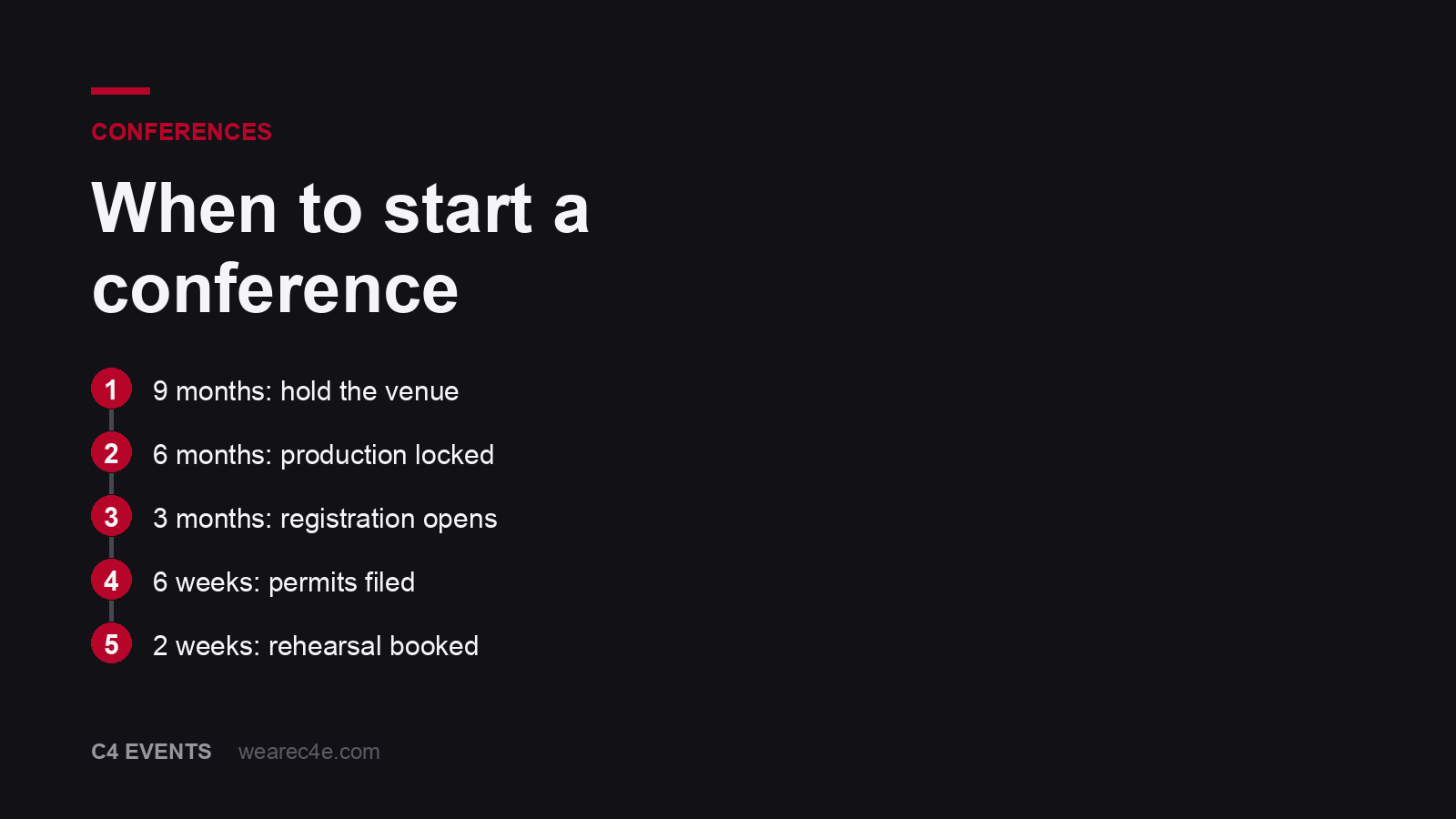
The single most expensive mistake in conference planning is starting three months late and then paying to catch up. Prime venues in peak season go nine to twelve months out. Production crews in a busy market go six months out. Neither of those is a queue you can buy your way to the front of once it has formed.
| Size and format | Realistic lead time | What breaks if you compress it |
|---|---|---|
| 150 to 300, single track, shoulder season | 3 to 4 months | Venue choice narrows to what is left |
| 300 to 800, multi-track | 6 months | Production quality, and the speaker line-up |
| 800 to 2,000, prime venue, peak season | 9 to 12 months | You do not get the venue at all |
| Any size, permits in Bali or Vietnam | Add 6 to 8 weeks | The permit becomes the critical path |
Where the production money goes
Production is the line clients understand least and cut first. It covers staging and set, screen, audio, lighting, camera and vision, rigging, power, crew and the freight that moves all of it. Two conferences of the same headcount can differ by a factor of four on this line alone, and the difference is the brief.

Two costs get missed with reliability. Freight, because the LED wall does not live in the ballroom. And the rehearsal day, because it looks like a day when nothing happens. The rehearsal day is where you find the laptop that will not switch, the presenter with a video nobody tested and the lectern that blocks the camera. Our breakdown of conference production costs works through the whole stack.
Speakers, and the content deadline nobody keeps
Every conference has the same content problem. Twenty speakers, one deadline, and a bell curve of compliance that peaks the night before. The fix is structural and not a reminder email.
- Tie the deck to the stage. No rehearsal slot without a submitted deck, and no stage without a rehearsal slot.
- Ban new files on the day. One machine, one operator, one version. A speaker with a memory stick at 8:55am is a broken session.
- Test every video. Embedded video is the single most common technical failure on a conference stage.
- Brief the timing in person. Give the finish time, show the clock, explain the colours, agree what happens at zero.
Where we run conferences
| City | ICCA 2025 meetings | The case for it | The catch |
|---|---|---|---|
| Singapore | 156, first in Asia Pacific | Credibility, English, Changi, 42,000 sqm at Suntec | The most expensive room in the region |
| Bangkok | 118 | Scale and value, 60,000 sqm column-free at IMPACT | Traffic decides your session times |
| Dubai | Outside the ICCA top 20 | 145,000 sqm at DWTC, Gulf and wider reach | May to September is indoor only |
| Seoul | 121 | Technology and pharma audiences | Language support costs real money |
| Tokyo | 119 | Depth of domestic audience | Longest lead times in the region |
ICCA counts association meetings, so it undercounts corporate demand in Gulf cities. Read it as a signal of infrastructure and air access, not as a ranking of where your conference belongs. The full ranking and what it does and does not measure is here.
The agenda decisions that cost money
Four choices in the agenda set most of the production budget, and all four get made by people who have no idea they are spending.
| Decision | The cheap version | What the expensive version buys |
|---|---|---|
| Number of tracks | One room, one stage | Each extra track is a second room, a second crew and a second AV package |
| Room set | Theatre | Cabaret and rounds cut capacity by a third, so you pay for a bigger room |
| Stage format | Lectern and a screen | Set build, LED and a camera package, for a room that reads as a broadcast |
| Hybrid | A single recorded stream | Cameras, a switcher, an encoder, redundant bandwidth and a person whose only job is the stream |
Hybrid is the one clients underestimate most. A stream is a production department and not a laptop at the back of the room. Budget it as its own line or drop it, because the half-funded version is worse than no stream at all.
Registration, and the first ninety minutes
Your conference is judged before the first session starts. A queue at the desk sets the mood for the day and pushes every hard timing back.
The maths is simple and gets ignored. Staggered arrivals need one desk per 100 delegates. A peak wave needs one desk per 50. A coach drop is a wave whatever the invitation said, so plan for the wave. Pre-print badges for everyone who registered before the cut-off, and keep on-demand printing for the rest instead of running the whole event on-demand. Delegate registration and badging has the desk ratios and the data capture that survives a privacy review.
Conferences for organisers planning from abroad
If you are running a regional conference in a city you do not operate in, we are your local team. Venue, vendors, permits, production and delivery are handled, and you get one line of reporting rather than nine.
Permits are the item that catches planners out. Lead times across Asia and the Gulf run four to eight weeks, and the requirement depends on the venue, the content and whether you are serving alcohol or amplified sound outdoors. What you need and how long it takes, market by market.
The day itself
A conference is a promise about time. The agenda is the promise. The run of show is how you keep it, and it holds hard timings apart from soft ones so the buffer sits where it is needed.
Speakers run over. All of them, given the chance. We brief every speaker on timing before they go on, put a clock where they can see it, and agree the escalation ladder in advance. There is a four-rung ladder for the moment it happens, and we built Event Timer, a free stage timer, because our own shows needed one. The briefing that prevents the problem is in how to brief a speaker on timing, and the technical half is in the AV checklist for session timing.
Four things that go wrong at conferences
The keynote arrives with a new deck. On the morning, in a format nobody tested, with an embedded video. The fix is a content deadline with a named owner and a rehearsal slot the speaker has to attend to get on stage.
The room is the wrong shape. A hall that seats 800 theatre seats 500 in rounds. Fix the room set before you contract the hall, not after the invitations go out.
Freight clears late. The set, the LED and the print all travel, and customs does not care about your load-in. Build in-market where the build is buildable in-market, and where it is not, ship two weeks earlier than feels sensible.
Nobody owns the clock. The chair is on stage, the client is in the room and the producer is in comms. Name the person, tell the chair who it is, and give them the authority before the first session, when nobody is under pressure.
After the conference
The wrap is where a conference either becomes evidence or becomes a memory. Reconcile against the line-item budget within three weeks, while the vendors still answer. Pull the session-level attendance from the badge scans rather than the room count. Then read the outcome at 30, 60 and 90 days against a group who did not attend, because a spike in the week after an event is enthusiasm and not pipeline.
How it works
- Brief. Audience, format, budget, dates.
- Plan. Venue and production plan with a line-item budget.
- Build. Registration, logistics, permits, run of show.
- Deliver. Our team runs the event on site.
- Wrap. Reconciliation, reporting and the 30, 60 and 90 day read.
Why C4E
Twenty years, 40+ countries, more than 100 brands. Senior people on the ground, line-item budgets and one point of accountability.
On a conference that means the producer who scoped your show is the producer in comms on the day, and the person who owns the clock has run the room before. See our destination events overview and our MICE programmes.
Talk to us
Planning a conference or convention in Asia or the Gulf? Tell us the audience, the month and the number, and we will tell you which cities can still take it and what each one costs.
Email saurabh@wearec4e.com with your dates, rough group size and the outcome you want. You get a costed plan back, not a brochure.
Frequently asked questions
Can you organise a conference in Asia for a company based in the US or Europe?
Yes. That is the standard C4E brief. We manage venue, registration, production, speaker logistics, AV and on-site delivery. You own the agenda and the content.
Which Asian cities are best for conferences and conventions?
Singapore for a flagship event that has to signal seriousness, and it held first place in Asia Pacific in the ICCA 2025 rankings with 156 meetings. Bangkok for scale at lower cost, with 118 meetings in the same table and 60,000 square metres of column-free hall at IMPACT. Dubai for the Gulf, where DWTC holds 145,000 square metres of event space. Seoul, Tokyo and Hong Kong all rank inside the ICCA top 20.
How early should we plan a convention?
Nine months to hold a specific venue in peak season, six months to lock production, three months to open registration. A single-track conference for 200 people in a shoulder month can be done in three months. A 2,000-delegate convention in a prime hall in February cannot.
What does conference production cost?
Production is the widest line in the budget because it is the only one where the brief can double the number. Staging, screen, audio, lighting, camera, crew, power and rigging all scale with room size and ambition. The line most budgets miss is freight, and the second is the rehearsal day.
Do you handle delegate registration and badging?
Yes. Registration, badging, on-demand badge printing, data capture and the desk ratios that decide whether your first session starts on time. Plan one desk per 50 delegates when arrivals come in a wave, such as a coach drop.
Can you manage multi-day, multi-track events?
Yes, including parallel sessions, exhibition floors, networking zones, gala dinners and the run of show that holds them together.
Who owns the clock on the day?
One person, named in advance, and it is not the client. A run of show is a promise about time, and someone has to be allowed to enforce it when a speaker runs over.