
MICE stands for meetings, incentives, conventions and exhibitions: the four formats that move a business forward when you get your people, partners and customers in one room. C4E plans and runs MICE programmes across Asia, the Gulf and beyond for companies based anywhere. You set the objective. We deliver it on the ground.
The four letters, and who buys each one
MICE is a procurement category, not a description of an event. The four formats have different audiences, different budget holders and almost no shared operational logic. Understanding that is the difference between a programme with one owner and a programme with four.
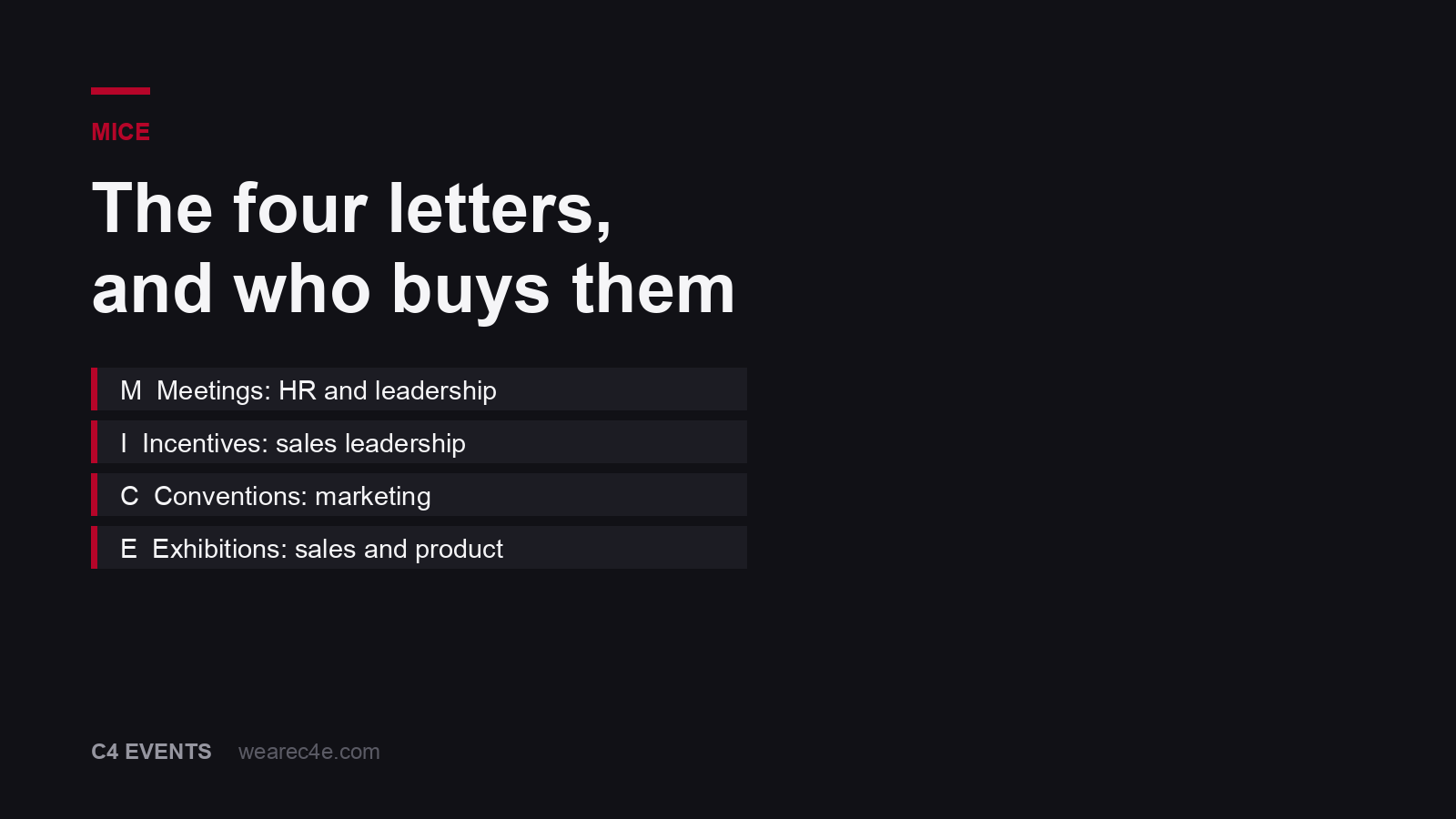
| Letter | What it is | Who buys it | What decides the budget |
|---|---|---|---|
| Meetings | Leadership offsites, sales kickoffs, board and partner meetings | HR and leadership | Headcount and nights |
| Incentives | Reward trips for top performers and channel partners | Sales leadership | Per-person spend, USD 5,100 on average |
| Conventions | Multi-day, multi-track conferences with full production | Marketing | Venue and production |
| Exhibitions | Stand design, build and on-stand management at trade shows | Sales and product | Space rental and build, then everything after |
What the market looks like
Mordor Intelligence sizes the Asia Pacific MICE tourism market at USD 231.49 billion in 2026, reaching USD 352.25 billion by 2031. That is 8.75 percent compound annual growth, with Southeast Asia the fastest sub-region at 12.41 percent. Meetings account for 41.62 percent of revenue. Convention and exhibition centres take 44.85 percent of venue share, and large enterprises account for 58.15 percent of spend.
Those numbers explain a market where prime halls in peak season are gone twelve months out and hybrid production has stopped being an upsell. They also explain the competition for crew. A growing market runs out of experienced showcallers, riggers and vision engineers before it runs out of halls, and the shortage shows up as a price you pay in the last six weeks.
Where MICE programmes run in Asia

The ICCA 2025 rankings, published in May 2026, count association meetings by city. Singapore took first place in Asia Pacific for the twenty-third year with 156 meetings, up 8 percent. Seoul, Tokyo, Bangkok and Hong Kong follow. Europe holds 14 of the global top 20 and Asia Pacific holds 5.
ICCA counts associations, so it says nothing about corporate demand, which is why Dubai does not appear. Read it as a proxy for air access, hall inventory and a city’s experience of hosting international delegates. The full ranking, and what it does and does not measure.
| Market | Strongest for | Anchor venue |
|---|---|---|
| Singapore | Conventions, credibility, regional HQ audiences | Suntec, 42,000 sqm, 10 to 10,000 guests |
| Thailand | Scale at value, dealer meets, incentives | IMPACT Challenger, 60,000 sqm column-free |
| Dubai | Exhibitions, Gulf and South Asia reach | DWTC, 145,000 sqm of event space |
| Bali | Incentives and resort conventions | BNDCC, up to 10,000 delegates |
| Vietnam | Cost-led programmes and new destinations | Da Nang, Ho Chi Minh City and Hanoi compared |
MICE for companies planning from abroad
If your team sits in the US or Europe and the programme is in Asia, you face time zones, language, unfamiliar vendors, permits and payments. C4E absorbs all of it. You brief us once and get one line of reporting, instead of managing a dozen suppliers across a twelve-hour gap.
Running two formats as one programme
The most requested shape in the region is a convention in Singapore or Bangkok with an incentive leg in Phuket or Bali. It works, and it breaks at the handover: the transfer between legs, the delegates who join one leg and not the other, and the two budgets that stop reconciling in week three.
Plan it as one budget, one manifest and one run of show. That is the whole trick, and it is why the two-leg programme belongs with one partner.
| The handover risk | What it looks like | The fix |
|---|---|---|
| The manifest | Two lists, and eleven people on one of them | One manifest, with a leg flag per delegate |
| The transfer | A four-hour gap at an airport nobody planned for | Book the internal flights before the venues |
| The budget | Two currencies, two agencies, no total | One budget, one reconciliation, one owner |
| The tone | A working conference that ends in a hangover | Put the working leg first. Always |
Buying MICE without buying four things
MICE gets bought in pieces because it gets budgeted in pieces. HR owns the offsite, sales owns the incentive, marketing owns the convention, product owns the stand. Four buyers, four procurement processes, four agencies and four sets of vendor terms in the same city in the same year.
Consolidating is worth real money, and the saving is not the discount. It is the second time your partner works in that venue, with those vendors, under those permits. The learning curve is the cost, and paying it four times is the waste.
If you are running a tender across the four, the twelve RFP questions that decide your budget will get you bids you can line up side by side.
The exhibition letter, which behaves unlike the other three
An exhibition stand is the one MICE format where you are a guest at somebody else’s event, on their floor plan, under their rules, on their load-in schedule. That changes everything about how it is budgeted.
The build is the number everyone quotes and it is seldom the biggest one. Space rental comes first. Then electrics and rigging, priced by the organiser with no competition. Then staffing and travel, because a stand is people and a good one runs two shifts. Then AV, furniture, cleaning, wifi and storage, each ordered from a single approved supplier at a price you cannot shop.
Build in-market when the market can build to your spec, and ship when it cannot. Either way, decide by month three, because freight and customs sit on the critical path and nobody has ever recovered a shipment by shouting at it. Exhibition stands in Asia: build, freight, staffing and what returns.
Hybrid, and what a real stream costs
Hybrid stopped being a feature and became a line item. Clients expect a stream, and a stream that works is cameras, a switcher, an encoder, redundant bandwidth and a person whose only job is the stream. That is a production department.
The half-funded version is worse than nothing. A single locked-off camera on hotel wifi produces a recording nobody watches and a remote audience that feels like an afterthought. Fund it as its own line or take it out of the brief.
What is included
Venue sourcing and contracting, delegate registration and badging, content and production, AV and staging, food and beverage, accommodation and transport, flights and visas, permits, line-item budgeting, and post-event reporting. For the exhibition leg: stand build, freight, staffing and what returns.
Reporting a MICE programme so it survives the review
A MICE programme gets questioned by people who were not there, six weeks later, in a budget meeting. What survives that meeting is a line-item reconciliation, an attendance number pulled from badge scans, and one metric that was chosen before the programme started.
What does not survive is a satisfaction score. It measures the catering, and everybody in the room knows it. Pick the metric first, find a comparison group, and read the outcome at 30, 60 and 90 days. How to measure event ROI without lying to yourself has the method and the control-group trick that makes the number defensible.
Lead times, by leg
| Leg | Start | The binding constraint |
|---|---|---|
| Convention in a prime hall | 9 to 12 months | The hall, and the week |
| Incentive leg in peak season | 6 to 12 months | Resort inventory for a whole group |
| Exhibition stand | 6 months | Space allocation, then freight |
| Meeting or offsite leg | 2 to 4 months | Flights, once the dates are fixed |
How it works
- Brief and objective. One owner, one budget.
- Plan. Destination, venue and format plan with a line-item budget.
- Build. Contracts, vendors, registration, logistics.
- Deliver. Our team runs it on site.
- Wrap. Reconciliation and reporting you can defend.
Why C4E
Twenty years, 40+ countries, more than 100 brands. Senior people on the ground, line-item budgets and a single point of accountability.
On a MICE programme that means one owner across every leg, one budget that reconciles, and one team that has already worked in the venue you are about to book. The second event in a market costs less than the first, and it costs less because somebody learned the market the expensive way and stayed.
We are channel and media agnostic, so the recommendation is the one that fits the brief and not the one we earn on. See our destination events overview, and the twelve RFP questions if you are about to go to tender.
Talk to us
Planning a MICE programme in Asia? Tell us which of the four letters you are buying, and whether anyone inside the company is already buying one of the others. Half the value in a MICE programme is found in that second question, and almost nobody asks it before the tender goes out.
Email saurabh@wearec4e.com with your dates, rough group size and the outcome you want. You get a costed plan back, not a brochure.
Frequently asked questions
What does MICE stand for?
Meetings, incentives, conventions and exhibitions. It is a procurement category and not a description of an event, and the four letters share almost no operational logic. What they share is that they all put people in a room in a city, which is why one partner can run them.
How big is the MICE market in Asia Pacific?
Mordor Intelligence sizes the Asia Pacific MICE tourism market at USD 231.49 billion in 2026, reaching USD 352.25 billion by 2031, an 8.75 percent compound annual growth rate. Southeast Asia is the fastest sub-region at 12.41 percent. Meetings are 41.62 percent of revenue and large enterprises are 58.15 percent of spend.
Which Asian city is the top MICE destination?
Singapore, on the measure most of the industry uses. It held first place in Asia Pacific in the ICCA 2025 rankings with 156 meetings, its twenty-third consecutive year, and MICE receipts reached S$2.3 billion, up 35 percent on 2024. Bangkok, Seoul, Tokyo and Hong Kong all sit inside the ICCA global top 20.
Can you run a MICE programme across two countries?
Yes. A Singapore convention with an incentive leg in Phuket or Bali is the most common two-country shape in the region. We plan it as one budget and one run of show, because the handover between legs is where these programmes break.
Do you handle exhibitions and stands?
Yes: design, build, freight, electrics, rigging, staffing and on-stand management at regional trade shows. The stand build is seldom the biggest number on the invoice. Space rental, electrics, rigging, staffing and travel together outweigh it on most stands.
How far ahead should a MICE programme be planned?
Six to twelve months for anything that combines two formats, because the two legs compete for different inventory in different peak seasons.
Who should own the MICE budget inside the company?
One person. The four letters get bought by four different departments, and a programme split across HR, sales and marketing budgets is a programme with four briefs and no owner.