
Planning an event in a country where you have no office is hard. Time zones, language, vendor trust, permits and payments all sit between you and a clean delivery. C4E closes that distance. We plan and run corporate events, conferences, conventions, MICE programs and dealer meets across Asia, the Gulf and beyond. You own the brief. We own the ground.
What is destination event management?
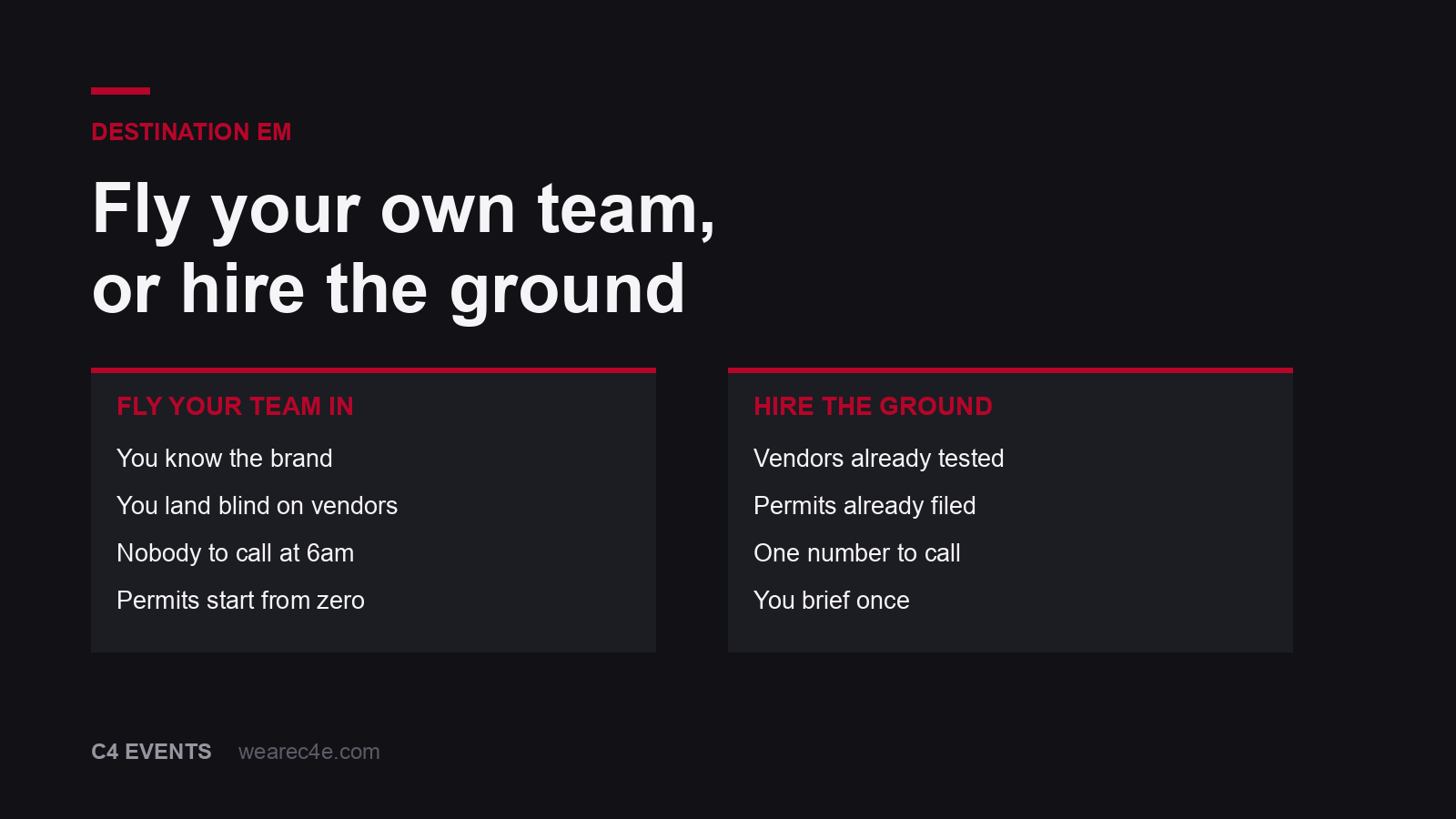
Destination event management is hiring a specialist to plan and run your event in a market you do not operate in. Instead of flying a team in blind or trusting a vendor you have never met, you get a partner in the city who sources venues, tests suppliers, files permits, books logistics and delivers the event on site.
The distinction that matters is the one between an operator and a broker. A broker forwards your brief to a local company and adds a margin. An operator holds the contract, the crew and the blame. Our guide on how to choose a destination event management company has the ground-team test and the reference call that separate the two in one meeting.
Six things that go wrong without a partner in the market
- Time zones. Your vendor is asleep when the problem surfaces, and awake when you are not.
- Language. The contract is in English. The load-in brief to the crew is not.
- Vendor trust. Three quotes, no way to know which of the three has ever delivered a show your size.
- Permits. Local rules you do not know exist until they stop you. Lead times run four to eight weeks across the region, and Bali and Vietnam sit at the long end. The detail is in our guide to event permits across Asia and the Gulf.
- Payments. Moving advances to suppliers across a currency and a tax regime, on their timetable.
- Accountability. Ten vendors and no single owner is not a plan. It is a list of people to call after it has gone wrong.
What an event in Asia costs
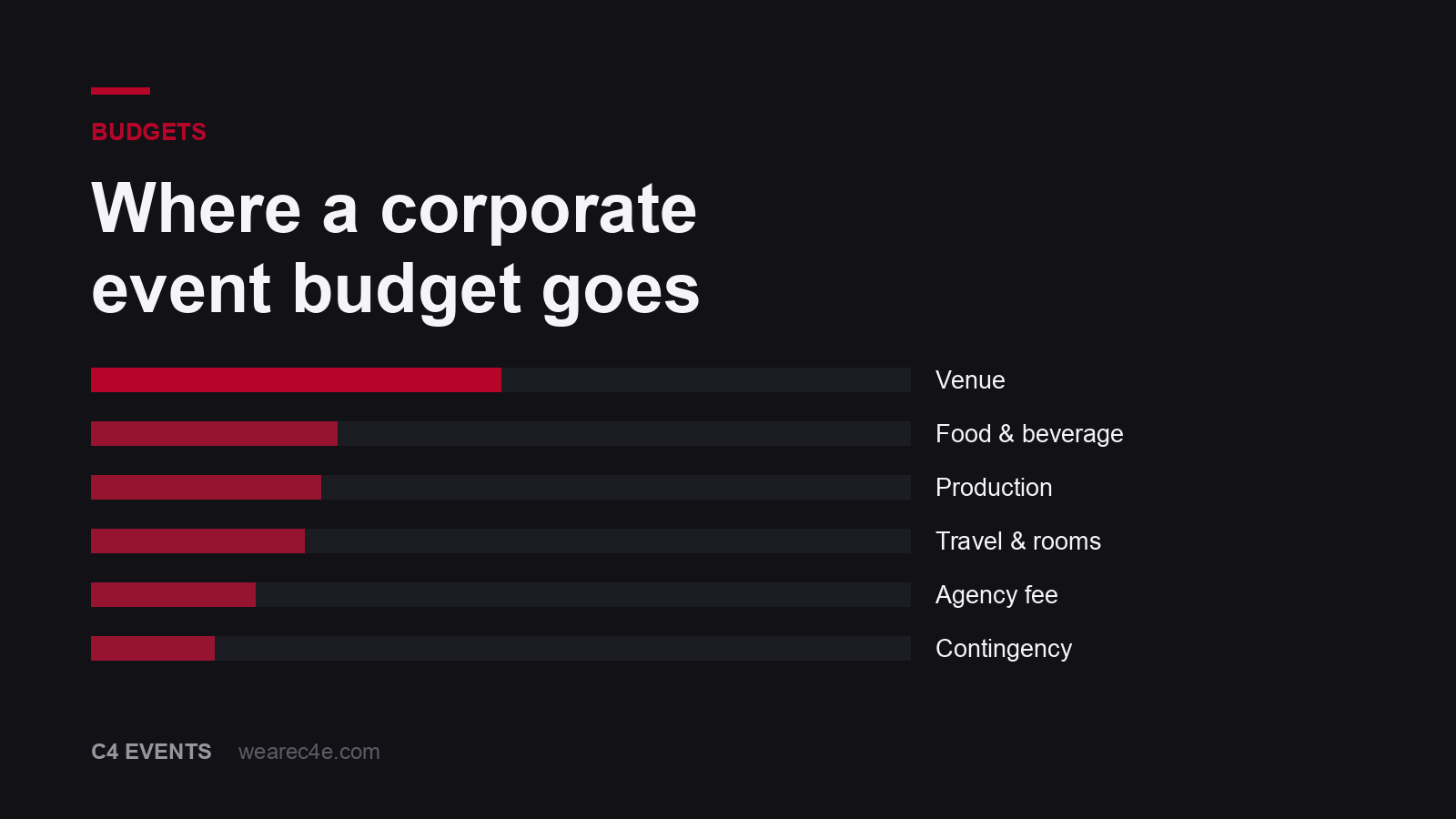
Budgets vary by city, format and headcount. The shape of the budget does not. Venue takes 30 to 50 percent. Food and beverage takes the next slice. Production is the line that moves most, because it is the only one where a client can choose between a screen and a stadium.
Anchors that hold across the region: full-day delegate packages in Singapore run S$60 to S$120 per head. In the proposals we see, management fees run 12 to 20 percent of budget. Incentive travel averages USD 5,100 per person, per the Incentive Travel Index 2025. A dealer meet in India runs from about ₹20 lakh for a city meet to ₹1.5 crore and beyond for a destination conference.
The line-by-line version is in what a corporate event in Asia costs, and the six places budgets leak are named there.
How agencies charge, and which model to insist on
There are two models in this market and the difference decides whether your agency wants you to spend more.
| Percentage of spend | Stated fee, costs at cost | |
|---|---|---|
| How it reads | One number, fast to quote | Line items, then a fee |
| Typical level | 12 to 20% of budget, in the proposals we see | The same money, named |
| When you cut scope | The agency earns less | The agency earns the same |
| Under procurement | Hard to defend | Survives the review |
| Where margin can hide | Inside the blended number | Nowhere |
Ask for the second one. An agency that will not show you line items is telling you something about the line items. The clause-level version of this argument sits in attrition, force majeure and cancellation, the three clauses that decide what you owe when headcount or the world moves.
What one partner holds
The value of a ground partner is concentrated in five things, and none of them appear in a mood board.
- The vendor contracts. We sign them, so a vendor failure is our problem to solve and not yours to discover.
- The permits. Filed on our timeline, with the venue’s process and the city’s process kept apart.
- The money. Advances move to suppliers in local currency on their schedule, and reconcile to one statement at the end.
- The crew. The same producer and showcaller who scoped the event stand in the room on the day.
- The clock. One named person owns the run of show, and is allowed to enforce it.
What we do not do
We do not run consumer festivals, ticketed public events or weddings. We do not build registration platforms or ticketing systems, because good ones exist and we buy them. We do not take a media commission on your production spend.
We do build tools when the market has a hole in it. The tools we built for our own shows covers what we made and what we buy.
Which format fits your brief
| Format | What it is for | Typical size | Lead time |
|---|---|---|---|
| Conference or convention | Your industry or your customers in one room, with content as the product | 200 to 5,000 | 6 to 9 months |
| Dealer or channel meet | Aligning and rewarding the network that sells for you | 100 to 800 | 3 to 6 months |
| Incentive travel | Rewarding the top performers you want to keep | 20 to 300 | 6 to 12 months |
| Offsite or retreat | Getting one team to decide something away from the inbox | 15 to 200 | 2 to 4 months |
| MICE programme | Two or more of the above, run as one budget | Any | 6 to 12 months |
If the honest answer is that your team can run it, run it. Our guide on running the event in-house against hiring an agency gives four tests and a real cost comparison, and it says out loud when to keep the money.
Who we work with
Most of our clients are regional or global teams with no office in the market where the event happens. Marketing teams running a customer conference in a city they visit twice a year. Sales leadership taking a network to a destination. HR bringing a distributed team together once. Product teams exhibiting at a show where the stand is the whole quarter’s pipeline.
What they share is a brief that has to work in a market they cannot walk into. That is the problem we solve.
Where we run events
- Thailand. Bangkok for conferences and dealer meets at scale, Phuket and Krabi for incentives and offsites.
- Singapore. The top Asia-Pacific meeting city in the ICCA rankings for the twenty-third year running, and the market for a flagship event that has to look serious.
- Dubai and the UAE. Conferences, exhibitions, gala dinners and launches across the Gulf.
- Bali and Indonesia. Offsites, incentives and reward trips, built around the island.
Beyond those four: Vietnam, India, Malaysia, Japan and Saudi Arabia. If you are choosing between markets, the best MICE destinations in Asia ranks them on ICCA meeting counts and market data instead of brochure copy.
How it works
- Brief. Goal, audience, budget and dates. We tell you what those four buy, and where they fight each other.
- Plan. Venue options, format, production design, run of show and a line-item budget.
- Ground work. Contracts, vendors, permits, transport, accommodation and travel.
- Delivery. Our team runs the event on site, start to finish.
- Wrap. Reconciliation, reporting and the read at 30, 60 and 90 days.
Step one is where most of the value is. If you are writing the brief now, the twelve questions that decide your budget will get you comparable bids instead of three documents you cannot line up.
Why C4E
Twenty years. 40+ countries. More than 100 brands. We are lean and senior, so the people who pitch are the people on site. We are channel and media agnostic, so we solve the problem in front of us and do not sell you a package we happen to own.
We also build our own tools when the market does not have what a show needs. Event Timer is a free stage timer we built for our own conferences and released for anyone to use.
Three things that go wrong, and what we do about them
The headcount moves. It always moves. Contracts get signed on a number that nobody will hit, and the attrition clause turns the gap into an invoice. We hold room blocks in tranches with review dates written in, so the release happens before the penalty does.
The venue changes the load-in. A hall gets sold to a bigger show, and your six-hour build becomes three. The fix is a production plan that has a three-hour version, decided in advance and not at 2am with a crew on the clock.
The speaker runs over. Every conference, every time. There is a four-rung escalation ladder for that moment, agreed with the chair before the session starts.
Start the conversation
Tell us where you want to gather your people. We will tell you what the date, the budget and the city can carry, and where those three fight each other.
Email saurabh@wearec4e.com with your dates, rough group size and the outcome you want. You get a costed plan back, not a brochure.
Frequently asked questions
What is destination event management?
Destination event management is hiring a specialist to plan and run your event in a market where you have no office. The partner sources and contracts the venue, tests and manages local vendors, files permits, books travel and accommodation, and delivers the event on site. You keep the brief, the content and the budget approval.
How much does an event management company charge in Asia?
In the proposals we see, management fees run 12 to 20 percent of total budget across the region, and 10 to 20 percent in Dubai. The fee model matters more than the number. A percentage of spend shrinks when you cut scope, which puts your agency’s income on the wrong side of your budget discipline. A stated fee with costs passed through at cost survives procurement and survives a scope cut.
How far ahead should we start planning?
Nine months for a conference that needs a specific venue in a peak season. Six months for a destination incentive or a 300-plus dealer meet. Three months for a single-city meet of 100 to 200 people. Six weeks is the floor, and at six weeks you pay for the venue and the crew that happen to be free.
Do you work with companies that have no team in the market?
That is the whole business. Most C4E clients run the event from New York, London, Frankfurt, Sydney or Mumbai and have nobody in Bangkok, Bali or Dubai. We are the team on the ground.
Which countries do you cover?
C4E has run events in 40+ countries. Asia and the Gulf are the densest markets: Thailand, Singapore, Indonesia, Vietnam, India, the UAE and Saudi Arabia. We run programmes well beyond both regions.
Can you run one programme across two countries?
Yes, and it is common. A Singapore conference with an incentive leg in Phuket or Bali is one of the most requested shapes in the region. We plan it as one budget and one run of show so the handover between legs does not become the weak point.
What happens if the event is cancelled?
That depends on three clauses you sign months earlier: attrition, force majeure and cancellation. Read them before the deposit goes out, and pass the venue’s terms through to your own client or business unit rather than absorbing them.