Bali’s areas are further apart than the map suggests. Nusa Dua to Ubud is 90 minutes on a good day and well past two hours on a bad one. That single fact decides more Bali offsites than any venue photograph, and it is the thing most first-time planners get wrong.
Bali works. It delivers five-star resorts, dramatic settings and genuine value, with a hospitality scene used to hosting international groups. For teams flying from Europe, the US or across Asia, it feels like a reward and still respects the budget. Our Bali events page covers the formats we run there.
This is the practical version: which area, what it costs, what paperwork you need, and the season that decides everything.
Pick the area from the outcome, not the photograph
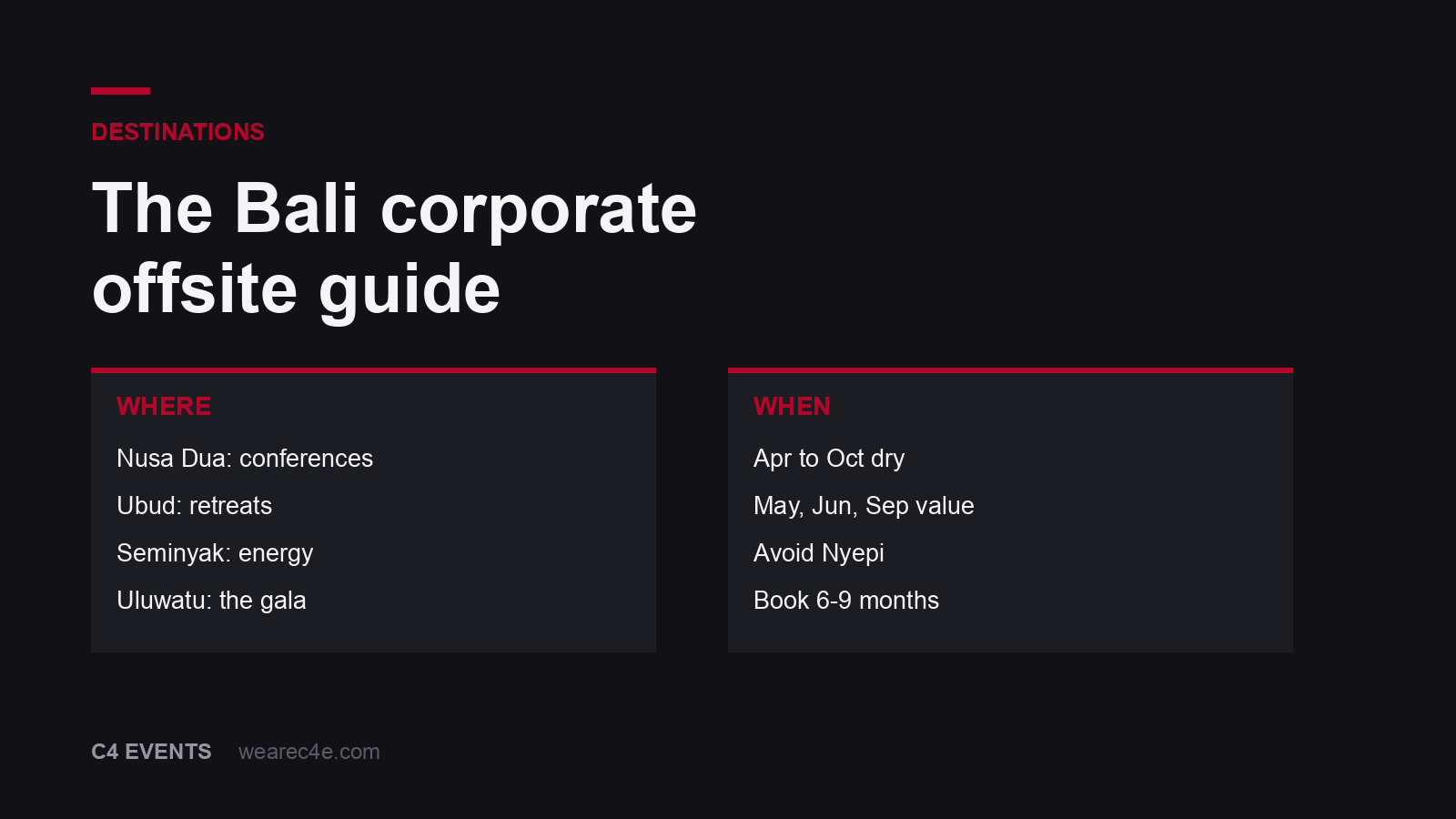
Nusa Dua. The conference answer. Purpose-built resort enclave, large properties sitting side by side, ballrooms that hold 500 and up, and a security posture that makes risk teams comfortable. Fifteen minutes from the airport. If your offsite has a real business agenda and a large headcount, start here.
Ubud. The retreat answer. Jungle, rice terraces, quiet. The place a leadership team goes to have a hard conversation without the beach pulling attention. Properties are smaller, so a group over about 120 starts splitting across hotels. Budget the transfer time in both directions.
Seminyak and Canggu. Energy, restaurants, beach clubs, a younger feel. Good for teams where the social programme carries as much weight as the sessions. Meeting space is thinner and traffic is real.
Uluwatu. The gala answer. Cliff-top venues with an ocean drop behind the stage that no ballroom can compete with. Most groups stay elsewhere and come here for one night. That night is the one they will describe afterwards.
The mistake is booking a hotel in one area and a signature venue in another without driving the route. Do the drive, at the time of day the coaches will do it, before you sign.
Season, and the two dates to know
April to October is the dry season. It is the window for outdoor venues, cliff-top dinners and anything where rain is a single point of failure. It is also the busiest and most expensive stretch of the year.
May, June and September are the sweet spot: dry-season weather without the July and August peak. Rates soften, and the properties that are impossible in August have availability.
Two dates to put in the calendar before anything else. Nyepi, the Balinese day of silence, when the whole island stops. No flights, no traffic, no lights, no going outside. The airport closes for 24 hours. Guests stay inside the hotel. It moves each year with the Balinese calendar, and an event booked across it is an event that does not happen. Galungan and Kuningan, which affect staffing, traffic and temple access for several days.
What it costs, and what drives the number
Bali is the strongest value-to-memory ratio in Asia, and the gap widens at the luxury end. A villa or cliff-top venue that would be out of reach in most markets sits inside a mid-market programme here.
What drives your number is airfare, not ground cost. A group flying from Singapore or Jakarta is a short hop. The same group flying from Frankfurt is most of the budget before anyone checks in. Before you compare Bali against alternatives, compare origins. The full arithmetic is in what an incentive programme costs per person.
Three cost notes specific to Bali:
- Villas price by the villa, not the room. For a leadership group of 12 to 20 this often beats a hotel block, and it buys privacy a resort cannot.
- Outdoor venues carry a wet-weather plan, and it is a real cost. Marquee, flooring, and a second set of logistics you hope never to use. Budget it in the dry season too.
- Transfer time is a cost. Coaches, drivers and a coordinator per vehicle, across an island where 25 kilometres can take 90 minutes.
Permits, visas and the paperwork
For a programme that stays inside a hotel, the venue holds most of what is needed. You need your own paperwork once you step outside that.
Beach and public-land events need local permissions, and in Bali that often includes the local village authority alongside the formal one. Start six weeks out.
Drones need clearance, and near the airport they are a non-starter.
Fireworks and open flame need approval and a licensed operator.
Foreign performers and entertainers need work documentation. A band flown in without it is a band that gets stopped.
Imported branded material goes through customs like any other freight. Backdrops, gifts and product all count. Build in-market where you can. Read what each market in Asia and the Gulf requires for the wider picture.
On visas: check the current rule for every passport in your group rather than for most of them. Groups get caught by the two people whose nationality carries a different requirement, and that check is a spreadsheet column, not a phone call on the day.
Designing the agenda around the island
Bali punishes over-programming more than a city does. The environment is doing work for you, and a schedule that fills every hour throws that away.
A shape that holds: sessions in the morning while the room is fresh and the heat is manageable, a long open afternoon, and evenings that carry the social weight. One signature night, not three. Half a day free, which the team will use to talk to each other, which is the point of an offsite.
Three rules. 1/ No session after 4pm on arrival day, because the group is jet-lagged and pretending otherwise. 2/ One venue change maximum per day, given the transfer times. 3/ The final night is the signature night, not the first, because the first night is when half the group is still travelling.
Villa or resort
Bali offers a choice most destinations do not, and the decision changes the whole feel of a programme.
A villa prices by the property rather than the room, which for a group of 12 to 20 often beats a hotel block. You get exclusivity, a private pool, a kitchen and staff, and no other guests in the background. For a leadership retreat or a top-tier incentive, that privacy is the product. What you give up: meeting infrastructure, and the ability to grow the group late.
A resort gives you meeting space, a business centre, medical cover, multiple food outlets and the ability to absorb a headcount that moves. For anything above 40 people or anything with a working agenda, this is the answer.
A villa estate sits between them: several villas under one operator, sharing a central pavilion that works as meeting space. For a group of 30 to 60 wanting privacy with a bit of structure, this is Bali’s best-kept option and it is under-asked-for.
One practical note. Villas seldom have generator backup at resort standard, and Bali’s power is not flawless. If your programme has a session that cannot fail, ask the question before you sign.
Where we got it wrong
We built a programme with the working sessions in Ubud and the closing dinner in Uluwatu, because both venues were right for their jobs. On paper it worked. On the day the transfer ran to two hours and twenty minutes in Friday traffic, the group arrived flat, and a dinner that should have been the high point started 40 minutes behind with half the room checking phones.
Nobody complained. It still cost us the ending. We now plan Bali programmes around one base and treat every area change as a whole afternoon rather than a transfer, and we drive the route at the real time of day during the site visit.
One last note on the ceremony side. Bali is a working Hindu island and its temples, offerings and processions are part of daily life rather than a display. Groups are welcome at most sites with a sarong and reasonable behaviour. A partner who briefs your group on that before the first temple visit saves you the moment where somebody photographs a ceremony they should have walked around.
And build in a buffer at the end. Bali’s airport gets congested at peak departure times and the road to it does too. A group that leaves the resort with 90 minutes to spare is a group that makes its flight.
Three things to decide first
1/ The area, from the outcome. Conference means Nusa Dua. Reflection means Ubud. Everything else follows.
2/ The season, against Nyepi. May, June and September give you the weather without the peak.
3/ One base. Move for one night if the venue earns it. Do not build a touring programme on an island with this traffic.
See how we run corporate offsites and retreats across Asia, or compare Bali against Thailand in Phuket versus Bali.
Tell us the team size and the outcome and we will come back with areas, venues and a costed plan.
What would you add? Lemme know what you think.
Frequently asked questions
What is the best area of Bali for a corporate offsite?
Nusa Dua for resort conferences and large groups, because the properties are built for it and sit together. Ubud for leadership retreats and anything reflective. Seminyak and Canggu for energy, dining and younger teams. Uluwatu for a cliff-top gala dinner. Match the area to the outcome, because Bali’s areas are further apart in feel and in traffic than a map suggests.
When is the best time to hold an event in Bali?
April to October is the dry season and the window for outdoor venues. It is also the busiest and most expensive. May, June and September give you the weather without the peak of July and August. Avoid Nyepi, the Balinese day of silence, when the island shuts down and the airport closes.
Do I need a permit for a corporate event in Bali?
For most hotel-based programmes the venue holds what is needed. You need paperwork of your own once you go outside that: a beach or public-land event, drones, fireworks, foreign performers or entertainers, and imported branded material through customs. Build four to six weeks into the plan for anything in that list.
How much does a corporate offsite in Bali cost?
Less per head than a comparable programme in Singapore or Dubai, and the gap widens at the luxury end. The variable that decides your number is airfare, not ground cost. A group flying in from Singapore or Jakarta and a group flying from Europe are different budgets with the same itinerary.
How long should a Bali offsite be?
Three nights minimum once anyone is flying more than five hours, because two nights means a team that arrives tired and leaves before the work lands. Four to five nights for a leadership retreat. Anything shorter and you have paid long-haul airfare for a day and a half of usable time.