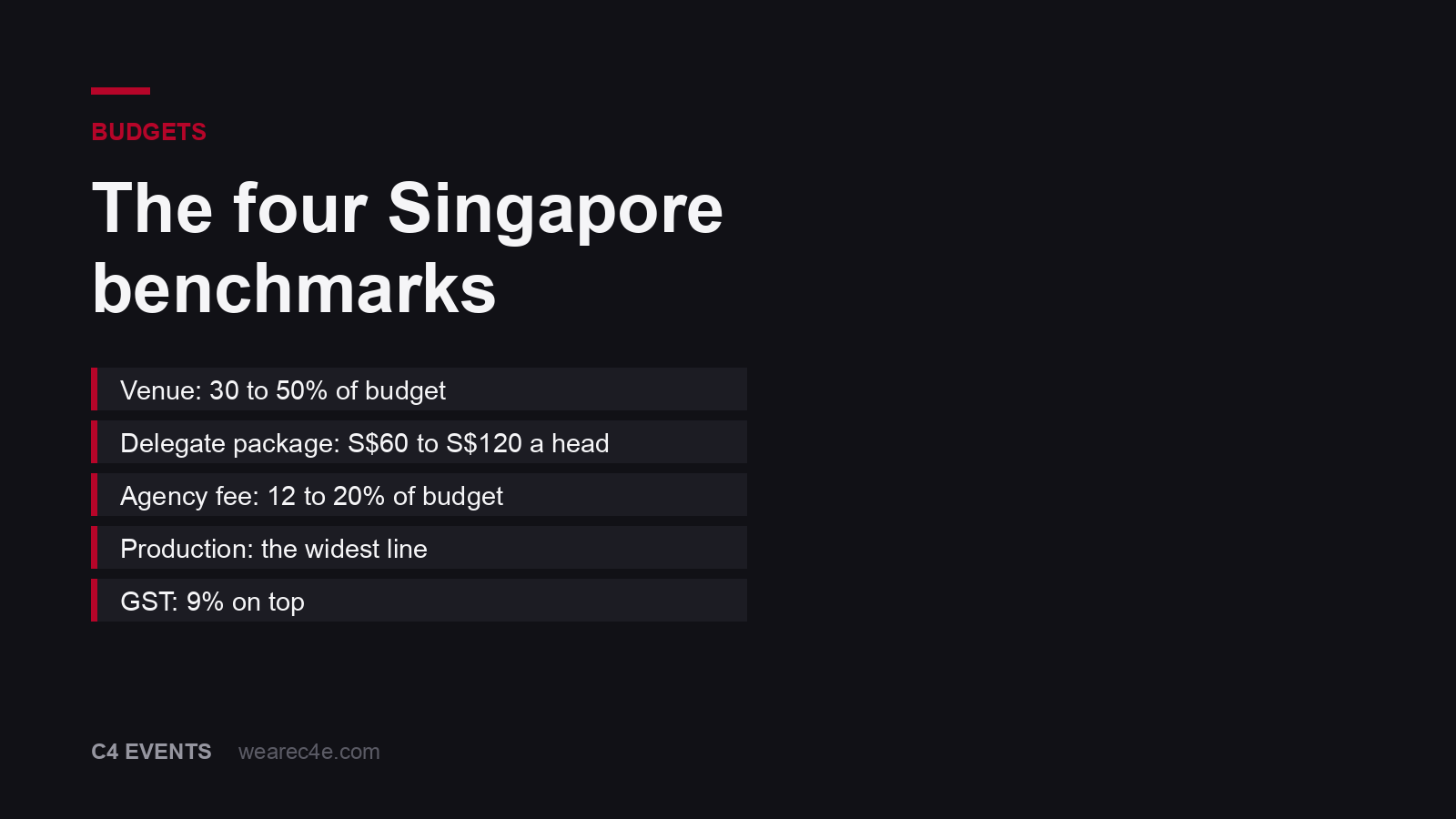
An agency fee of 12 to 20 percent, the band in the proposals we see, looks like a lot of money when you are staring at a budget line. It looks like nothing at all at 11pm on the night before, when a truck is at the wrong dock and the person who knows the venue’s night manager works for you.
The in-house-or-agency question gets argued as a cost question. It is a risk and capacity question that shows up on a cost line. Here is how to answer it.
| In-house | Freelance producer | Agency | |
|---|---|---|---|
| Best fit | Home market, under 150 people, a format your team has delivered before | One event, home market, real production, no travel programme | Cross-border, scale, production risk, a travel and logistics load |
| What you pay | Your own people’s loaded hours across three months | A rate over eight to twelve weeks | 12 to 20 percent of budget in the proposals we see, or a flat project fee |
| Supplier rates | You buy once, at list | One person’s skill, not a firm’s book | A firm booking that hotel eleven times a year buys on different terms |
| Cover if the lead drops out | Whoever is free that week | None. One person, no bench | A bench, and a named second |
| Who owns the message | You | You | You. Hand out the machinery, keep the message |
| Where it breaks | Distance, and the twelfth small thing at four in the morning | Anything cross-border, and anything needing buying power | Paying a fee for coordination your own EA was doing well |
| The tail | Lands on your team six weeks after the event | Out of scope once the show ends | Reconciliation and supplier disputes sit with them |
The four tests
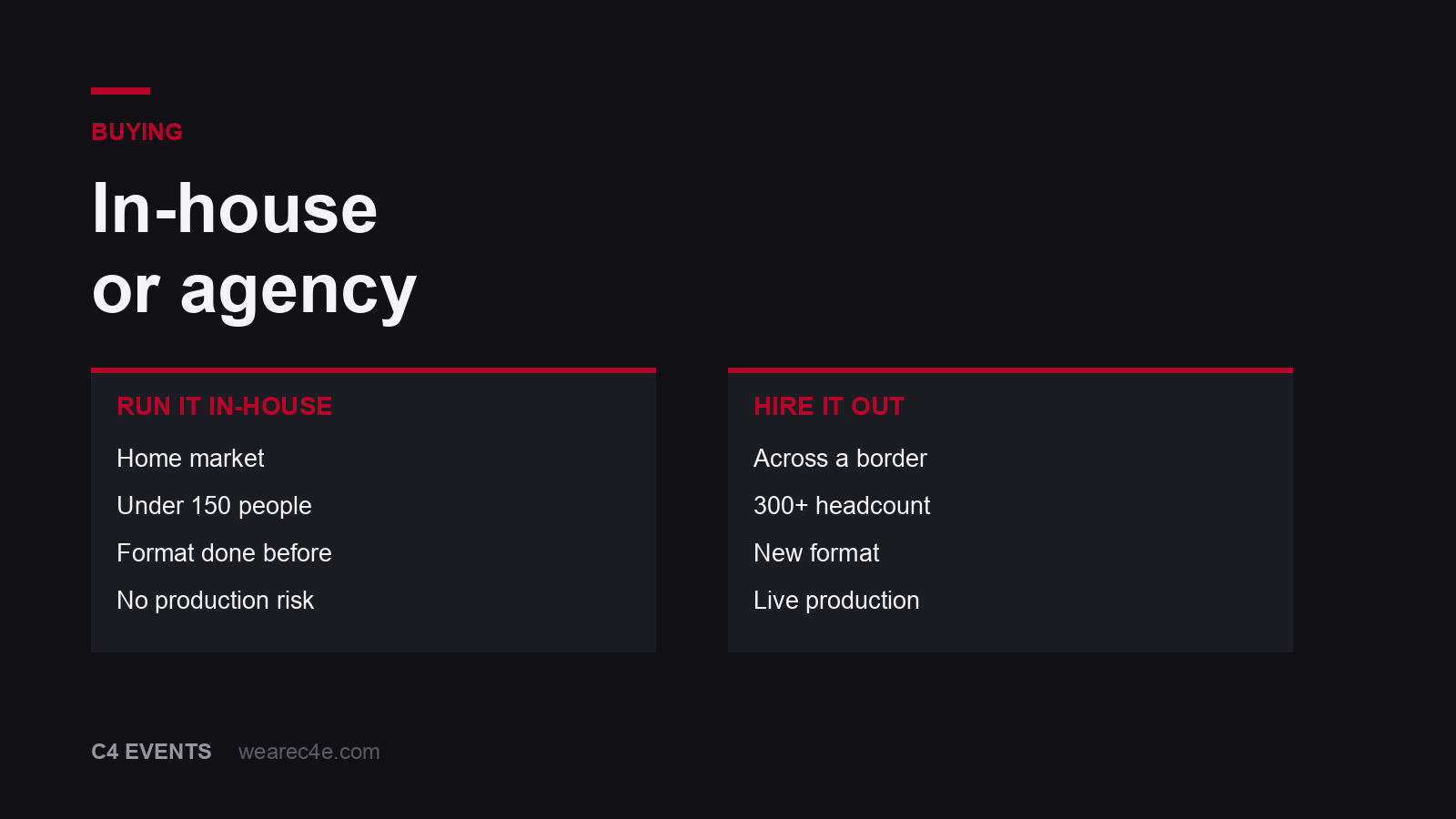
Run the event in-house when all four of these are true. Hire out when any one of them is false.
1/ It is in your home market. You can visit the venue, you know the suppliers, you speak the language, and the permit office is a bus ride away. This is the heaviest of the four. Distance breaks more in-house events than scale does.
2/ It is under about 150 people. Above that, the logistics stop being a list and become a system. Registration queues, transport waves, food service timing, breakout turnarounds. All of it becomes somebody’s whole job.
3/ Your team has delivered this format before. Not a similar one. This one. A team that has run three town halls can run a fourth. That same team running its first product launch with a live reveal is doing something new under a deadline.
4/ There is no production risk. One stage, one screen, one microphone, no broadcast, no reveal, no multi-track. The moment a real production sits in the middle of the event, you need someone whose profession this is.
Four out of four, run it yourself and keep the fee. Three out of four, look hard at which one failed.
The cost comparison people do not do
The in-house case most often goes: the agency wants 15 percent, we have a team, we will save the 15 percent.
Here is the arithmetic that is missing.
Your people’s time. A 300-person offsite in another country takes a project manager close to full time for three months, plus two or three colleagues at a fifth of their time, plus on-site staff. Price those hours at loaded cost and compare them to the fee. In most mid-size programmes the numbers land close, and the in-house version comes with the cost of whatever those people were not doing instead.
Supplier rates. An agency booking that hotel eleven times a year buys on different terms from a company booking it once. The same is true of AV, transport and crew. Part of the fee returns as rate.
The mistakes. A first-time buyer signs an attrition clause they do not understand, misses that the venue holds AV exclusivity, or books a build window across a public holiday. Any one of those costs more than the fee. See the three clauses that decide what you owe.
The tail. Reconciliation, supplier disputes, tax treatment of cross-border invoices. This lands on your team six weeks after the event, when they have gone back to their real jobs.
What in-house teams are better at
This is not an argument that agencies should own everything. There are things you will always do better, and handing them over is a mistake I have watched cost companies real money.
The message. Nobody outside your company can write the strategy session. An agency writing your CEO’s address produces something polished and generic, and the room can tell.
The politics. Who speaks, in what order, for how long, and who will be offended by the answer. That is internal knowledge and it decides more of the agenda than any producer will admit.
The relationships. Your people know which dealer is unhappy, which client needs handling and which VP wants a private word. No supplier can carry that.
The hybrid most teams settle into
The split that works, and the one large corporate teams arrive at after a few cycles:
You keep: objective, message, content, speaker selection, managing the people with a stake in it, the guest list, and the decision on what success means.
The agency takes: venue sourcing and contracting, supplier management, production, travel and logistics, permits, on-site delivery, and the reconciliation afterwards.
One named person on each side owns the whole thing. Not a committee. One name, each way. This is the single structural decision that predicts whether a programme runs well.
The split teams get wrong is the reverse: handing out the content and keeping the logistics. It feels safer, because logistics feels controllable and content feels personal. It produces an event that sounds like a brochure and runs like a first attempt.
The signals that it is time to hire out
Watch for these. Each one has preceded a difficult event.
- The person running it has a day job and this is on top of it
- Nobody on the team has been to the venue
- The words “we will figure that out closer to the date” have been said about production
- The headcount has moved twice and nobody has re-forecast the budget
- There is no run of show, three weeks out. Our run of show template is the test
- The build window includes a public holiday nobody checked
Two or more of these, and the question is no longer whether to bring help in. It is whether there is still time to.
Where I have seen this go wrong in both directions
The over-hiring version: a company brings in an agency for a 90-person leadership offsite in their own city, pays a fee for work their own EA was doing well, and adds a layer between the CEO and the room. That is a waste and I have told buyers so and lost the work. It was still the right answer.
The under-hiring version is more expensive. A team runs a 400-person dealer meet abroad because they ran a 200-person one at home last year. The two are not the same event. What breaks is never the big thing. It is the twelfth small thing on a day when everyone has been awake since four and nobody has authority to spend.
Our own gap in this, since I am asking you to be honest about yours: we have taken on work we should have told the client to run themselves. It went fine. They paid a fee for coordination they had the capacity to do. We now say so in the first call when we see it, and it has cost us a few projects and won us better ones.
The middle option most buyers miss
The choice is presented as in-house or agency. There is a third answer that suits more teams than either: hire a freelance producer.
An experienced event producer, engaged for eight to twelve weeks, gives you the professional judgement without the full agency scope. They write the run of show, hold the production suppliers to account, run the technical rehearsal and manage the floor on the day. Your team keeps sourcing, budget and content.
Where this works: a single event, in your home market, with real production but no travel programme. A 300-person conference in your own city is close to the ideal case.
Where it does not: anything cross-border, anything with a travel and logistics load, and anything where you need a firm’s buying power rather than one person’s skill. A freelancer cannot negotiate a hotel block the way a firm booking that property eleven times a year can.
The other caution is single-point risk. One person, no bench. If they are ill in the final week, you have nobody. Agree in advance who backs them up, and meet that person.
Whatever you choose, write the scope down. The most expensive arguments in this business are about who was supposed to do the thing nobody did, and they are all preventable with one shared document written before anyone starts.
One more signal worth watching. If the person who would run this in-house is relieved when you mention hiring help, you have your answer. People who can do a job say so. People who are about to be crushed by one go quiet and start using the word “manageable”.
And whichever way you go, name the single decision-maker on your side before the work starts. Suppliers can absorb a difficult brief. What they cannot absorb is four people with different views and no way to tell which one is final, because that turns every question into a week.
Three rules
1/ Distance beats scale. A 400-person event at home is more manageable than a 150-person event in a city you have never visited.
2/ Price your own hours before you compare fees. Loaded cost, three months, everyone involved.
3/ Keep the message, hand out the machinery. That is the line, and it holds at every size.
Want a straight answer on which side of the line your event sits? Describe it to us. If you should run it yourself, we will say so.
And that, ladies and gents, is the decision. Do you agree?
Frequently asked questions
Should I hire an event management company or run it in-house?
Run it in-house when the event is in your home market, under about 150 people, repeats a format your team has delivered before, and carries no production risk. Hire out when any one of those four is false. A single unfamiliar element, above all an unfamiliar city, is enough to change the answer.
Is it cheaper to run an event in-house?
Not once you count the hours. An agency fee of 12 to 20 percent, the band in the proposals we see, looks like pure cost until you price four people at a third of their time for three months, plus the supplier rates you will not get as a one-time buyer. In your own city at small scale, in-house wins. Across a border at scale, it seldom does.
What can an in-house team keep even when an agency runs the event?
Content, message and the relationships in the room. Those are yours and should stay yours. Hand out venue sourcing, supplier contracting, production, logistics and on-site delivery. The split most teams get wrong is giving away the content and keeping the logistics, which is backwards.
How many people does it take to run a corporate event in-house?
For a 150-person single-day event in your own city, one experienced owner plus two people for the last fortnight. For a 300-person multi-day event in another country, you are looking at a project manager close to full time for three months, plus on-site staff, plus someone who can hold a production conversation.
What is the hybrid model?
You keep strategy, content and managing the people with a stake in it. The agency takes sourcing, contracting, production, logistics and delivery. One named person on each side owns the whole thing. This is the model most large corporate teams settle into, because it keeps the parts only you can do and hands out the parts that need scale and local presence.