Singapore does not have a cheap season, a shoulder month or a quiet quarter. That is the first thing to understand about budgeting an event here, and it changes how you plan.
In Dubai or Bangkok, the calendar is a lever: move the date and the venue line moves with it. In Singapore the calendar affects availability far more than it affects price. The room costs about the same in March as in August. What changes is whether you can have it.
So a Singapore budget gets built in a different order. Less negotiating the season, more deciding what the event is for and whether the premium is buying you something.
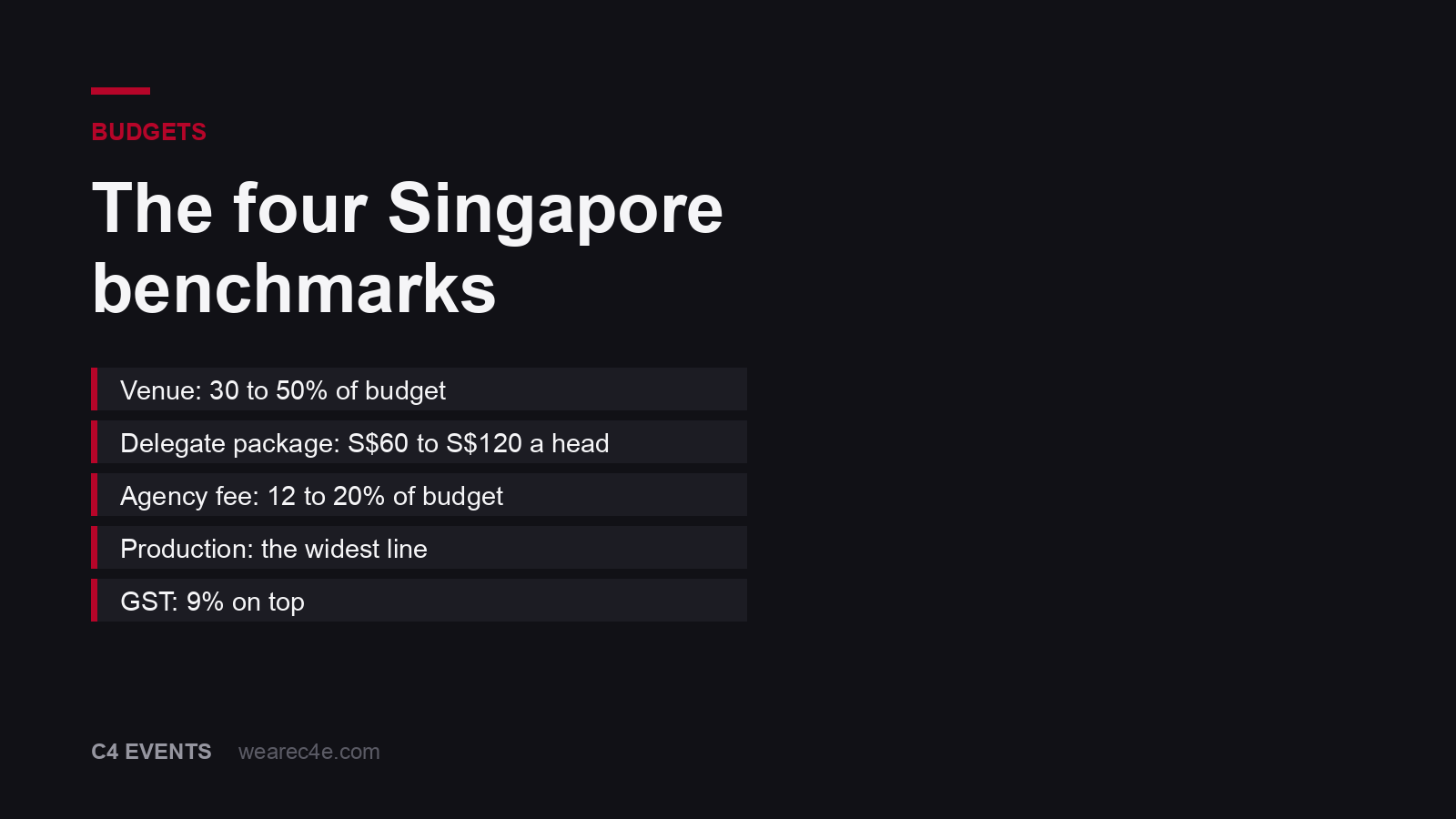
The four benchmarks
| Line | Benchmark | What moves it |
|---|---|---|
| Venue | 30 to 50 percent of total budget | District, hall type and the week you pick |
| Delegate package, full day | S$60 to S$120 per head | Hotel tier and what the package excludes |
| Event management fee | 12 to 20 percent of budget, in the proposals we see | Scope, and the fee model you agree |
| Production | The widest line in the budget | Room size, screen, camera count, rehearsal |
Take the delegate package first, because it is the number most often misread. A day delegate rate looks like a like-for-like comparison and it almost never is. One hotel’s S$78 includes room hire, two breaks, lunch, a screen and a lectern mic. Another hotel’s S$68 includes lunch and coffee and charges you for everything else.
Get both exclusion lists side by side before you compare the two numbers. That one habit is worth more on a Singapore budget than any negotiation you will run afterwards.
GST, and the five-figure misunderstanding
Singapore’s GST rate is 9 percent and it applies to standard-rated supplies, which covers almost everything in an event budget.
On a S$400,000 event that is S$36,000. It is not a rounding error and it is not a footnote. Two quotes that look 9 percent apart may be identical underneath, with one stated before tax and the other after. Ask, every time.
Where the money goes
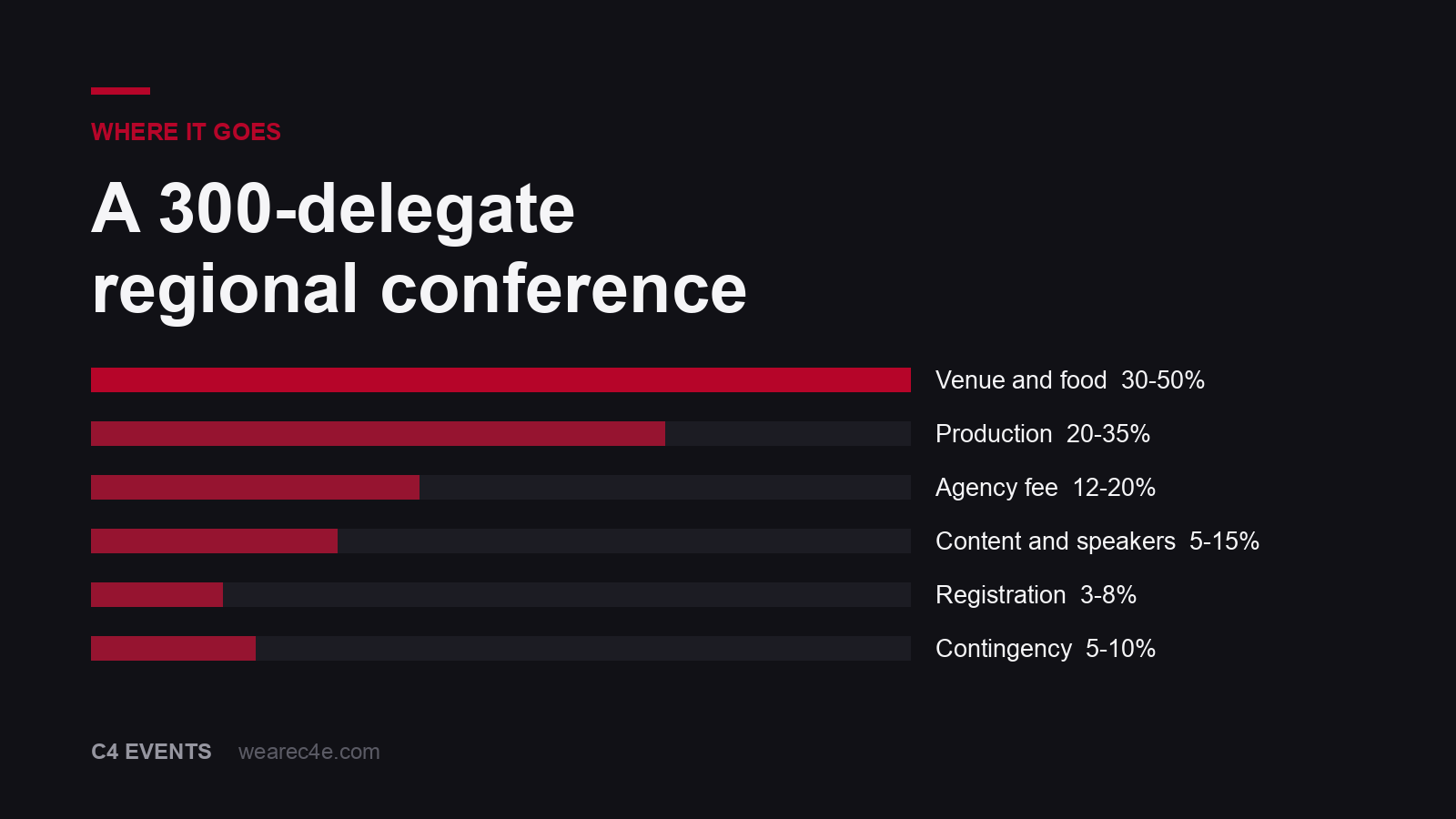
On a two-day regional conference for 300 delegates, with a plenary, breakouts, a gala dinner and a rehearsal day, the shape tends to land near this.
| Line | Share | Comment |
|---|---|---|
| Venue and food | 30 to 50 percent | Higher if the gala is in a landmark venue |
| Production | 20 to 35 percent | Screen, cameras, rehearsal, set, crew |
| Agency fee | 12 to 20 percent, in the proposals we see | Depends on who signs the contracts |
| Content and speakers | 5 to 15 percent | External talent, film, translation |
| Registration and delegate management | 3 to 8 percent | Rises fast above 500 delegates |
| Contingency | 5 to 10 percent | Keep it |
Rooms sit outside that table on most projects, in a travel budget somebody else owns. That split is fine for accounting and dangerous for planning, because on an event that flies people in, the room-night total is often the second largest number in the project. Put it on the same page as the event budget even if it is paid from a different code.
The line-by-line regional comparison is in what a corporate event costs in Asia, and the production stack that moves most is broken out in conference production costs.
What the premium buys
Singapore costs more than Bangkok, Bali, Ho Chi Minh City or Kuala Lumpur. The question is never whether it is expensive. The question is whether the thing it is expensive for is a thing your event needs.
1/ Attendance. Changi reaches the region and the world, and visa-free access covers most of the passports a corporate audience carries. On a ten-country delegate list that is worth more than any venue saving, because a cheaper city that costs you 15 percent of your attendance is not cheaper.
2/ Language. English is the working language, so no session needs simultaneous translation and no breakout needs a bilingual facilitator. That is a real line removed from the budget rather than a soft benefit.
3/ Institutional credibility. Regulators, investors, regional headquarters and boards meet here without anybody explaining why. For an event whose job is to look serious, the postcode does work that production cannot.
None of those three matter for an internal offsite or a reward trip. If that is the brief, the same money buys more nights and a better resort elsewhere, and the comparison sits in the best MICE destinations in Asia.
The weeks that move the number
Singapore has no cheap season, and it does have expensive weeks.
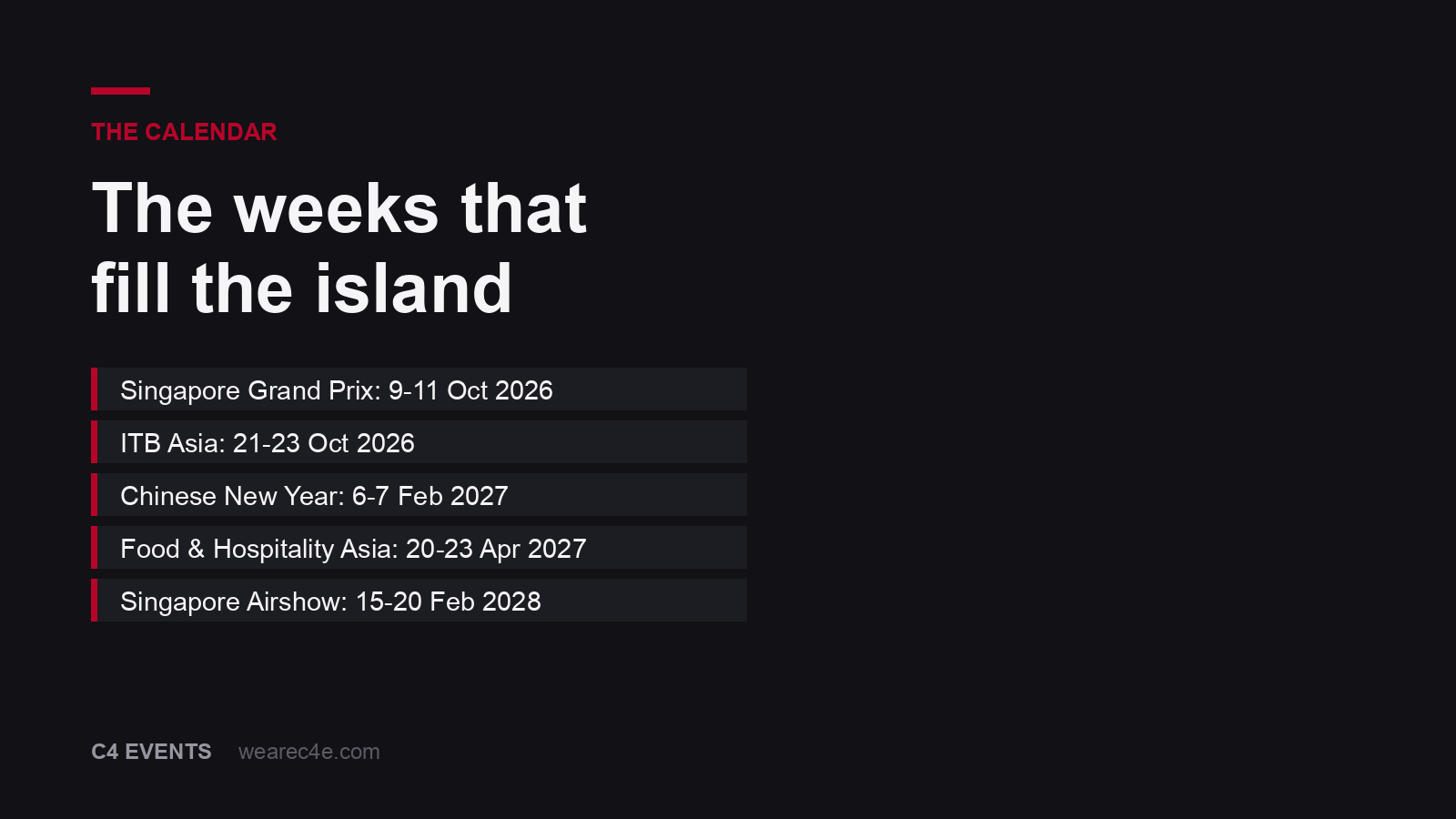
The Formula 1 weekend is the largest. The race takes hotel inventory across the island and pushes room rates up hard for everyone else in town, and the effect starts days before the cars run. The big recurring trade shows do the same on a smaller footprint, as do the major finance and technology weeks.
Moving your event by seven days is often worth a five-figure difference on rooms alone. The dates are in the Singapore event calendar.
The money the government will contribute
This is the part most Singapore budgets never consider, and it can be the largest single change to the number.
The Business Events in Singapore scheme supports qualifying third-party costs across professional services, content development, marketing and bidding, for events that bring foreign delegates. It has one rule that ends most applications before they start: the project must not have commenced, and signing a venue, calling a tender or paying a supplier all count as commenced.
Which means the grant question belongs before the venue question. If your event is more than six months out, read the guide to Singapore event grants before you shortlist a room.
The same page covers the Approved International Fair double tax deduction for exhibitors, and the SHINE hotel programme, whose extended-stay conference rates cover up to five days either side of a conference and can change what an international delegate’s trip costs them.
Sizing a Singapore event before you brief anybody
Three numbers get you inside the right order of magnitude.
Take your headcount and multiply by the delegate package for the tier you want. Add production, which for a conference with a screen, two cameras and a rehearsal day will be a similar size to the venue and food line. Then add the fee band on top of the total.
That gives you a number you can take to a finance team as a range rather than a guess. Refine it with the AV cost estimator for the production line and the room capacity calculator to check the room you are pricing can hold the layout you are imagining.
The lines people forget
Five costs turn up late on Singapore events more than any others, and none of them are in a venue proposal.
| Line | Why it arrives late |
|---|---|
| Room hire, when the minimum spend is missed | Waived above a threshold, charged below it |
| AV outside the package | The package covers a screen and a mic, not a show |
| Rehearsal day venue hire | Priced as a second day, and often forgotten |
| Delegate management platform | Scales with headcount and with data requirements |
| Freight and customs on anything shipped in | Nobody owns it until it is stuck |
The rehearsal day is the one worth defending hardest. It is the only day of the project where a problem is cheap to solve, and it is the first line a nervous finance team reaches for. The registration side is covered in delegate registration and badging.
Three ways Singapore budgets go wrong
1/ The delegate packages were compared on price rather than on exclusions, and the cheaper hotel invoiced the room hire, the screen and the second coffee break as extras.
2/ The grant was considered after the venue was signed, which ended it.
3/ The event was moved to a cheaper city to protect the budget, and lost a fifth of the delegate list to visas, connections and a working language nobody had checked. That is not a saving. That is a smaller event.
Two cities, one programme
A pattern that works, and that more companies should price: run the serious part in Singapore and the reward part somewhere else.
The conference, the investor day, the partner summit or the regulated content goes where attendance and credibility are highest. The offsite, the incentive trip or the team days go to Thailand, Bali or Vietnam, where the same money buys more nights and a better resort.
Split that way, each half gets the setting it deserves and the total lands below doing both in Singapore. What does not work is the reverse: moving the conference somewhere cheaper and hoping the delegate list follows. The destination comparison is in the best MICE destinations in Asia.
Where to start
Decide what the event is for. If the answer needs regional attendance, credibility or English, Singapore earns the premium and the budget should be built to take it. If the answer is a reward trip or an internal offsite, spend the money somewhere it buys more.
Then check the grant, check the calendar, compare the packages on their exclusions, and keep the contingency.
How we run events here is on the Singapore page, and if you want the number for your brief rather than the shape of it, send us the brief.
What did I miss?
Frequently asked questions
How much does a corporate event cost in Singapore?
The useful benchmarks are proportions rather than a single figure. Venue takes 30 to 50 percent of a Singapore corporate event budget. A full-day delegate package runs S$60 to S$120 per head depending on hotel tier and what the package excludes. In the proposals we see, event management fees run 12 to 20 percent of budget. Production is the widest line and the one that varies most.
How much is a full-day delegate package in Singapore?
S$60 to S$120 per head. The spread is hotel tier plus what sits inside the package. Read the exclusions before comparing two quotes, because the cheaper number often excludes the room hire, the AV or the afternoon break that the dearer one includes.
Is GST charged on events in Singapore?
Singapore’s GST rate is 9 percent, per IRAS. It applies to standard-rated supplies, which covers most of an event budget. Check whether a quote is stated before or after GST before you compare two of them.
Why is Singapore more expensive than Bangkok or Bali?
Because you are buying attendance rather than a room. Changi connectivity, visa-free access for most corporate passports, English as the working language and a regulatory reputation that lets regulated industries meet here are what the premium buys. For an internal offsite none of that is worth paying for. For a regional conference with delegates from ten countries it does.
Can the government help pay for a Singapore event?
Yes, through the Business Events in Singapore scheme, provided you apply before the project has commenced. Signing a venue, calling a tender or paying a supplier counts as commenced and ends the application. There is also a Double Tax Deduction for Approved International Fair for exhibiting at approved shows.
What is the most expensive week to hold an event in Singapore?
The Formula 1 weekend, and it is not close. The race takes hotel inventory across the island and pushes rates up hard for anyone else in town. The big recurring trade shows and the major finance and technology weeks do the same on a smaller scale.
How far ahead should we book a Singapore venue?
Nine to twelve months for the prime convention space and the landmark venues, six months for a hotel ballroom, and longer if your dates sit near the race weekend or a major show. Singapore has no cheap season, which means the calendar affects availability more than it affects price.
Should we split the event across two cities to save money?
Sometimes. A regional conference in Singapore paired with a reward trip in Thailand, Bali or Vietnam costs less than doing both in Singapore and gives each part the setting it deserves. What does not work is running the conference somewhere cheaper to save money and then losing 15 percent of attendance to visa friction.