The annual dinner and dance is the most Singaporean corporate format there is, and the one most often underplanned.
It gets treated as a party with a budget attached. Book a ballroom, order the set menu, hire a band, print some tickets. Then the evening runs long, the awards eat an hour, half the room leaves before the grand prize, and somebody in HR spends January hearing about it.
It is a real event with a real programme and it deserves the same planning discipline as a conference. Here is how we build one.
What the evening is for
Ask the question before the venue search, because the answer changes everything downstream.
1/ A thank you. The company had a year and this is the acknowledgment. The programme is short, the food is good, the dancing starts early, and nobody is asked to sit through a strategy update.
2/ A recognition event. Awards are the spine of the evening and the room needs sightlines, a stage that works, a photographer who knows what they are doing and a run of show that respects the winners.
3/ A culture moment. New offices, a merger, a rebrand, a difficult year survived. The evening carries a message and the message needs somebody who can deliver it in four minutes rather than fourteen.
Most dinner and dance briefs are two of those three, and the trouble starts when nobody has decided which two. An evening trying to be all three is the one that runs to five hours.
The budget, and the number people miss
Almost every dinner and dance budget starts with a banquet package and stops there.
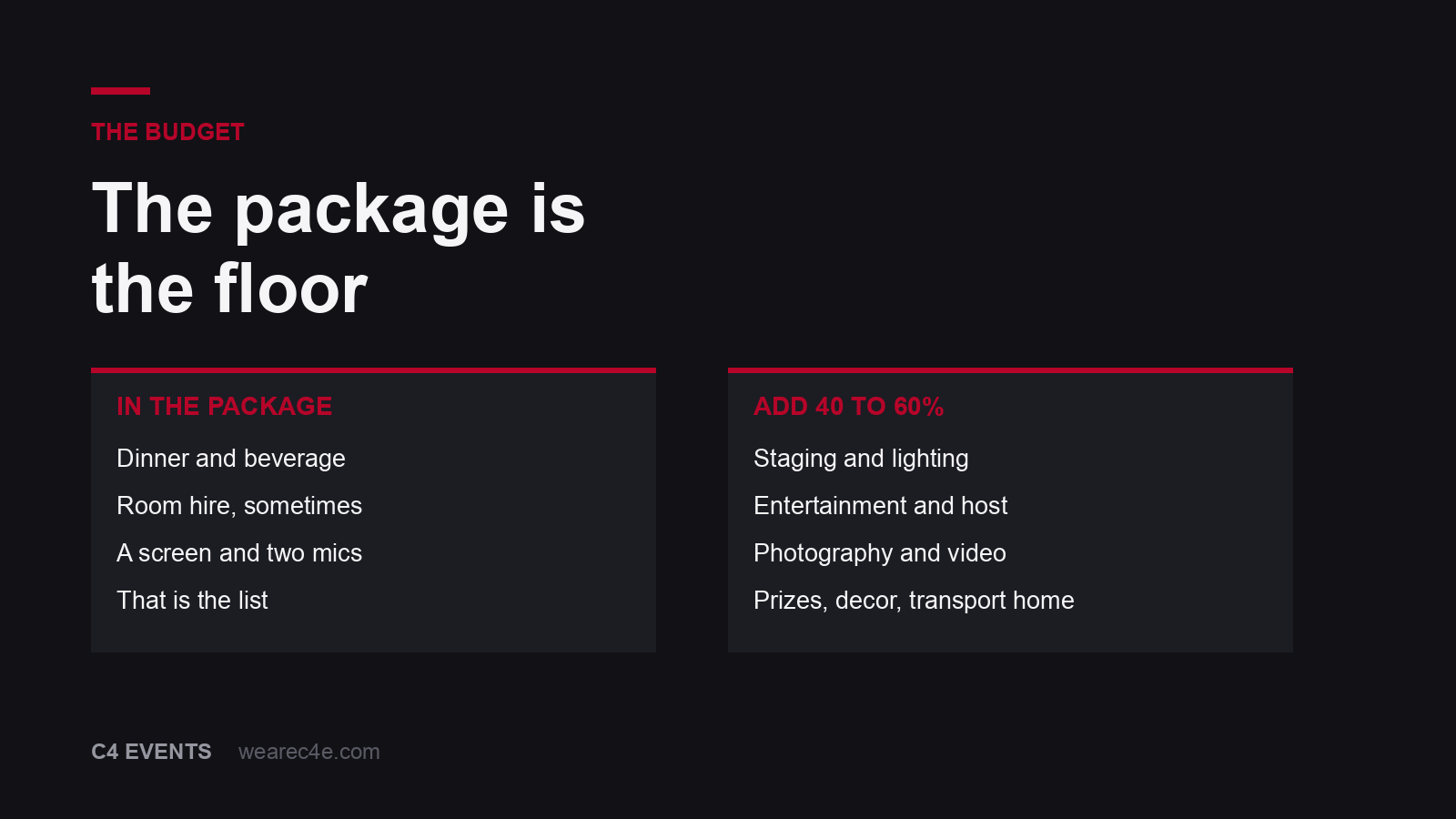
The package is the floor. Everything that makes the evening memorable sits outside it.
| Line | In the package? | Comment |
|---|---|---|
| Dinner and beverage | Yes | Check the beverage tier and the top-up rate |
| Room hire | Sometimes | Waived above a minimum spend, so ask |
| Basic AV | In part | A screen and two mics. Not a show |
| Staging and lighting | No | The single largest add |
| Entertainment | No | Band, DJ, or both across the night |
| Host | No | Worth paying for. See below |
| Photography and video | No | The asset the company uses all year |
| Prizes and their logistics | No | Buying, storing, moving, handing over |
| Theming and decor | No | Where budgets disappear without a brief |
| Staff transport home | No | Unglamorous, and it belongs on every honest budget |
A working method: price the package, then add 40 to 60 percent for the rest. If the total frightens somebody, cut the decor before you cut the host or the photographer, because one of those is scenery and the other two are the evening.
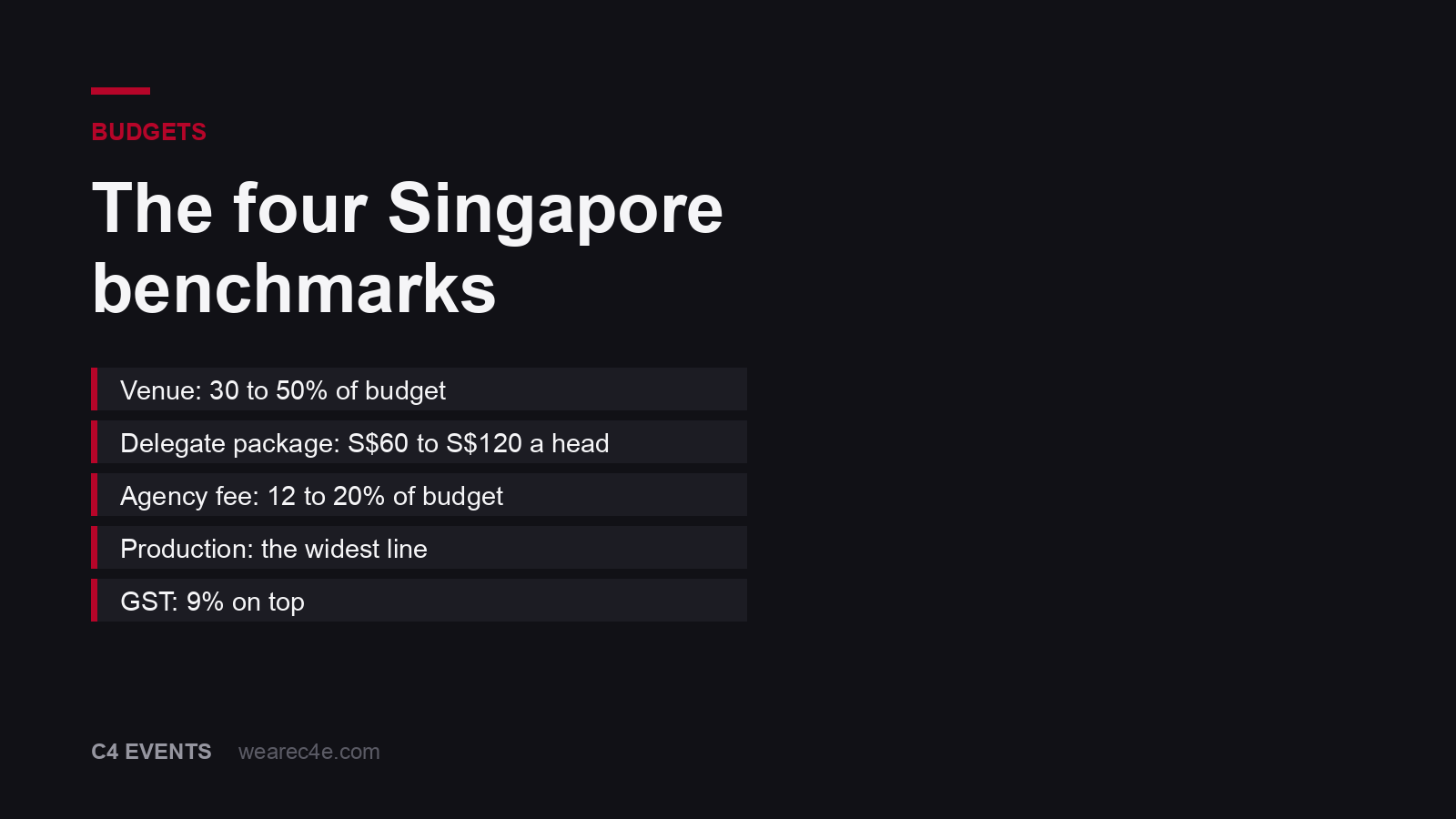
GST at 9 percent sits on top, and the wider budget context is in what a corporate event costs in Singapore.
The venue decision
Three categories, and the choice is about what the evening is for rather than about capacity.
| Hotel ballroom | Landmark or waterfront venue | Sentosa and resort venues | |
|---|---|---|---|
| Suits | Awards, formal recognition | Milestone years, statements | Relaxed, family-inclusive |
| Cost shape | One package, one contract | Venue plus everything brought in | Between the two |
| Getting home | Easy, central | Depends on the venue | Plan it, or people leave early |
| Risk | Low. It is a room that does this weekly | Higher. Build, power, weather | Transport, and the last train |
The bottom row of that table decides more evenings than the top one. A spectacular venue people cannot get home from empties at ten, and every hour you lose at the end is an hour of the budget you spent on the part nobody saw. Solve transport in the venue decision, not after it.
The general form of the venue argument is in ballroom, convention centre or unique venue, and the Singapore shortlist is in Singapore conference venues compared.
The licence question
A dinner and dance has live music, a DJ or both, which is where Singapore’s Public Entertainment rules become a question rather than a formality.
The published test turns on whether the entertainment is provided in a place to which the public, or any class of the public, has access, whether gratuitously or otherwise. A closed, invitation-only company event in a hotel ballroom sits in a different position from a ticketed public show. Established venues also hold their own establishment licences, which is why most hotel-based events carry no separate clock.
Two things to do rather than assume. Ask the venue whether their licence covers your programme and until what hour, because closing time is set by the licence type. And if the event is anywhere unusual, take the question to the Licensing Officer. The published fees, categories and exemptions are set out in the Singapore event licence guide.
The run of show
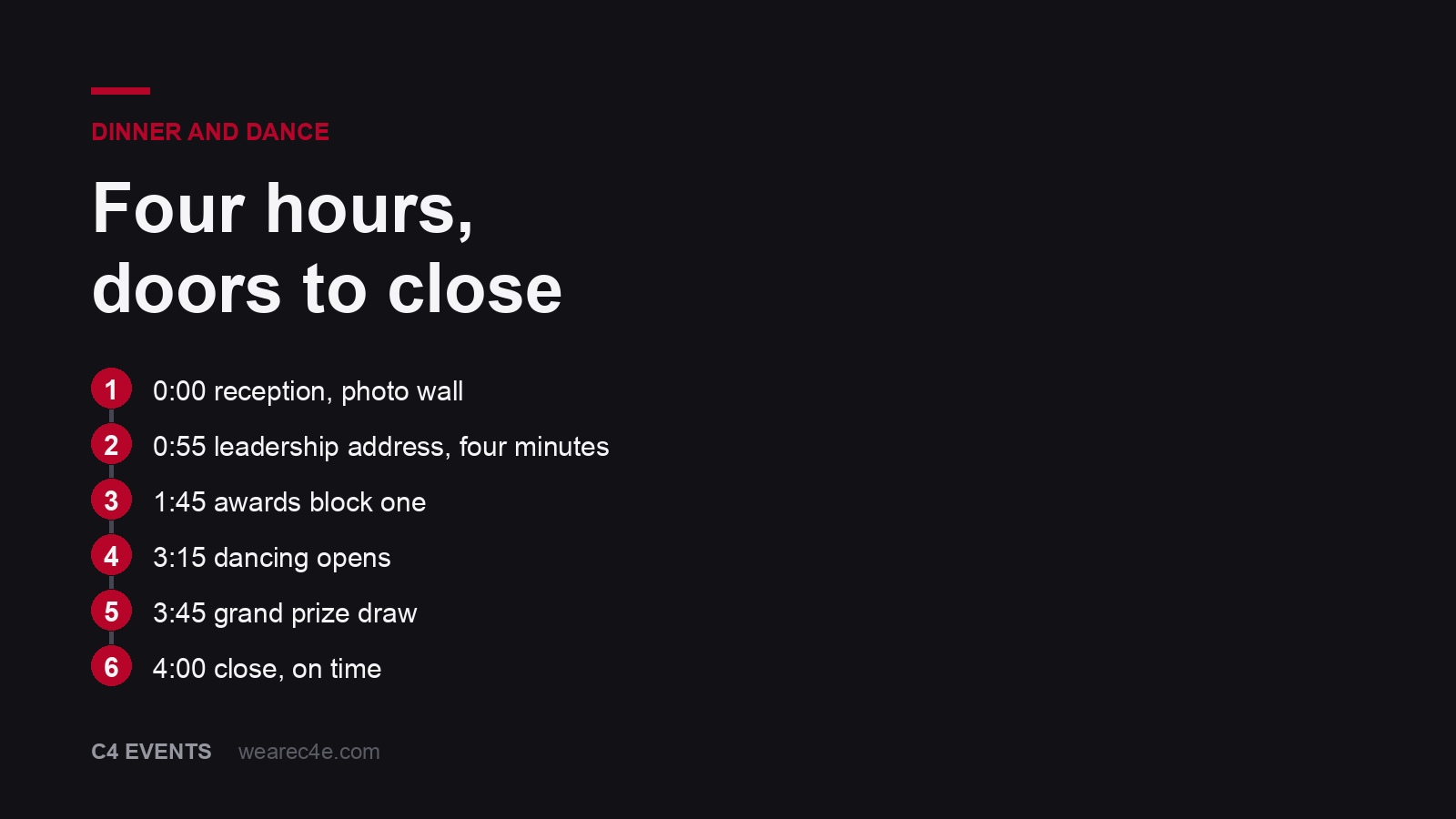
Four hours, doors to close. This shape works and we have run it many times.
| Time | What happens | Why |
|---|---|---|
| 0:00 to 0:45 | Reception, photo wall, drinks | Late arrivals absorbed without delaying dinner |
| 0:45 | Doors, seating, host opens | A host moves 400 people faster than a screen does |
| 0:55 | Leadership address, four minutes | Before food, while the room is listening |
| 1:05 | First course, first entertainment set | Something happening while people eat |
| 1:45 | Awards block one | Grouped, paced, photographed |
| 2:15 | Main course, second set | The room breathes |
| 2:45 | Awards block two, and the first draws | Prizes start, and people commit to staying |
| 3:15 | Dancing opens | The floor fills while the room is still full |
| 3:45 | Grand prize draw | Announced from the start as the last item |
| 4:00 | Close | End on time. Always |
Two rules inside that table are worth stating on their own.
Put the leadership address before dinner. A speech after the third course is competing with dessert, with conversation and with a room that has started drinking, and the speech loses. Four minutes at the top gets heard.
Hold the biggest prize to the last draw and tell everybody that is the plan, at the start and twice more during the evening. It is a crude mechanism and it works every time. The alternative is a grand prize announced to a half-empty room, which reads as an insult to whoever won it.
The awards problem
Somebody will send you a list of twenty awards. Every award is about three minutes once you count the walk-up, the handshake, the photograph and the applause. Twenty awards is an hour of the evening, and an hour of awards will kill it.
Group the long-service awards and present them as a cohort, on stage together, with names on the screen. Keep individual moments for the ones that carry real weight. Ten minutes of well-run recognition beats an hour of queueing.
And brief the photographer on the shot list before the night rather than during it. The awards photograph is the artefact the company uses for a year, and it is taken in about eight seconds. The wider format sits in gala dinner and awards night planning.
Hire a host
The most common false economy in this format is asking somebody from the marketing team to compere.
A professional host does three things an internal volunteer cannot. They move 400 seated people through a programme without it feeling like herding. They hold the room when something slips, and something always slips. And they make the awards feel like an occasion rather than a queue.
It is one of the smallest lines in the budget and one of the two or three that decides how the evening is remembered.
The date
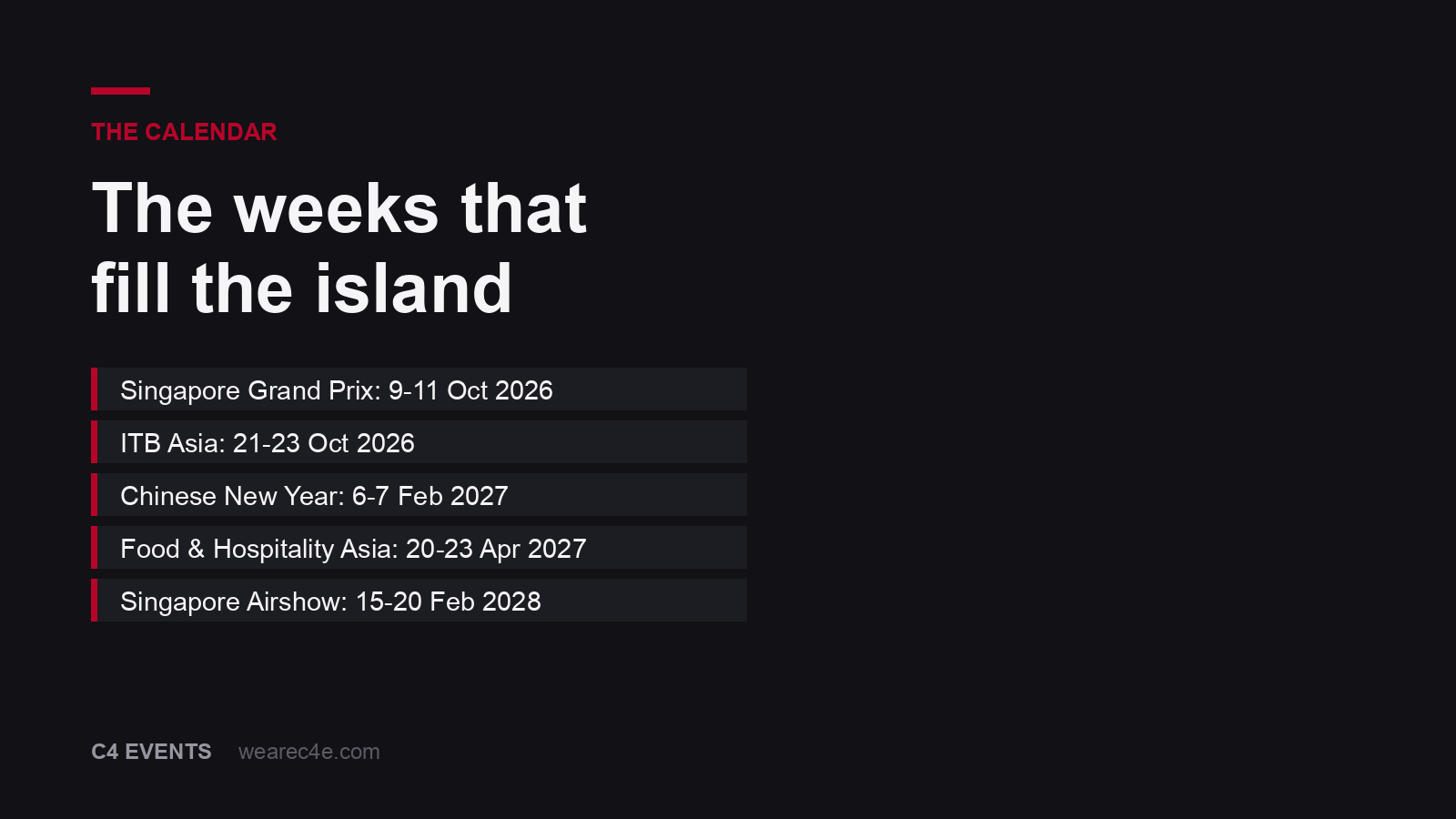
The traditional window sits between the financial year end and Chinese New Year, which is why November to January is crowded and why the constraint is availability rather than price. Singapore has no cheap season, so booking early protects your choice of room, not your rate.
Book nine to twelve months ahead for that window. Or hold the evening in a quieter month and get a better venue for the same money, which more companies should do and few do. The dates to check are in the Singapore event calendar.
The things worth spending on
If the budget has to come down, cut in this order and the evening survives.
Cut decor first. A themed ballroom photographs well for ten minutes and nobody remembers it in March.
Cut the beverage tier second, and top up at the bar rather than upgrading the whole package.
Do not cut the host, the photographer, the sound or the transport. Those four decide whether people could hear, whether the company has anything to show for the evening, whether the awards felt like an occasion, and whether the room was still full at the end.
The short version
Decide what the evening is for. Price the package and add 40 to 60 percent. Choose the venue for how people get home as much as for how it photographs. Ask the venue about the licence and the closing hour. Run four hours, put the speech before dinner, group the awards, and hold the grand prize to the end.
Do those and the evening works. Skip them and you will have spent a serious budget on a room that emptied at nine.
We run these in Singapore every year. If you want a run of show built for your headcount and your award list, tell us the date, or read how we work in the market on the Singapore page.
What did I miss?
Frequently asked questions
How much does a dinner and dance cost per person in Singapore?
Work from the venue’s package rather than a market average. A hotel banquet package sets the floor, and the additions that follow, entertainment, staging, photography, prizes and a host, carry the number upward from there. A useful planning method is to price the package, then add 40 to 60 percent for everything the package does not include.
Do we need a licence for a company dinner and dance in Singapore?
The published test is whether the entertainment is provided in a place to which the public, or any class of the public, has access. A closed, invitation-only company event in a hotel ballroom is a different situation from a public show. Established venues also hold their own entertainment licences. Ask the venue first, and take the Licensing Officer’s answer for your own facts.
When should we hold a dinner and dance in Singapore?
The traditional window is between the end of the financial year and Chinese New Year, which is why November to January is crowded and why venue availability rather than price is the binding constraint. Book nine to twelve months ahead for that window, or hold it in a quieter month and get a better room for the same money.
How long should a dinner and dance run?
Four hours from doors to close works. Reception 45 minutes, dinner and programme two hours, dancing and prizes the rest. Anything past four and a half hours and you are watching the room empty while the last prize is still unclaimed.
What makes people stay to the end?
Holding the biggest prize to the last draw, and telling everyone that is the plan. It is a crude mechanism and it works every time. The alternative is a room that is half empty by the time the grand prize is announced, which reads as an insult to the person who won it.
How many awards should we give out?
Fewer than the list you were sent. Every award is three minutes with a walk-up, a handshake and a photograph, so twenty awards is an hour of the evening. Group the long-service awards, present them together, and save the individual moments for the ones that carry weight.
Should the CEO speak at a dinner and dance?
Yes, and for four minutes, at the start, before dinner is served. A speech after the third course competes with dessert and loses. Put the serious content early and let the rest of the evening be the reward it was billed as.
What gets forgotten in a dinner and dance budget?
Photography and video, prize procurement and its logistics, a professional host, the AV that the venue package does not include, and staff transport home after the trains stop. The last one is not glamorous and it belongs on every honest budget.