A product launch event has one job that no other corporate format has: it has to make several hundred people feel something at a specific minute, and that minute is set by manufacturing, legal and a press embargo rather than by you.
Everything else follows from that constraint. Here is how to build around it.
Start from the availability date, not the event date
The single most common planning error in this format is counting backwards from the day you want to hold the event. The count should start from the date the product is confirmed available, because that is the date that can move and every other date depends on it.
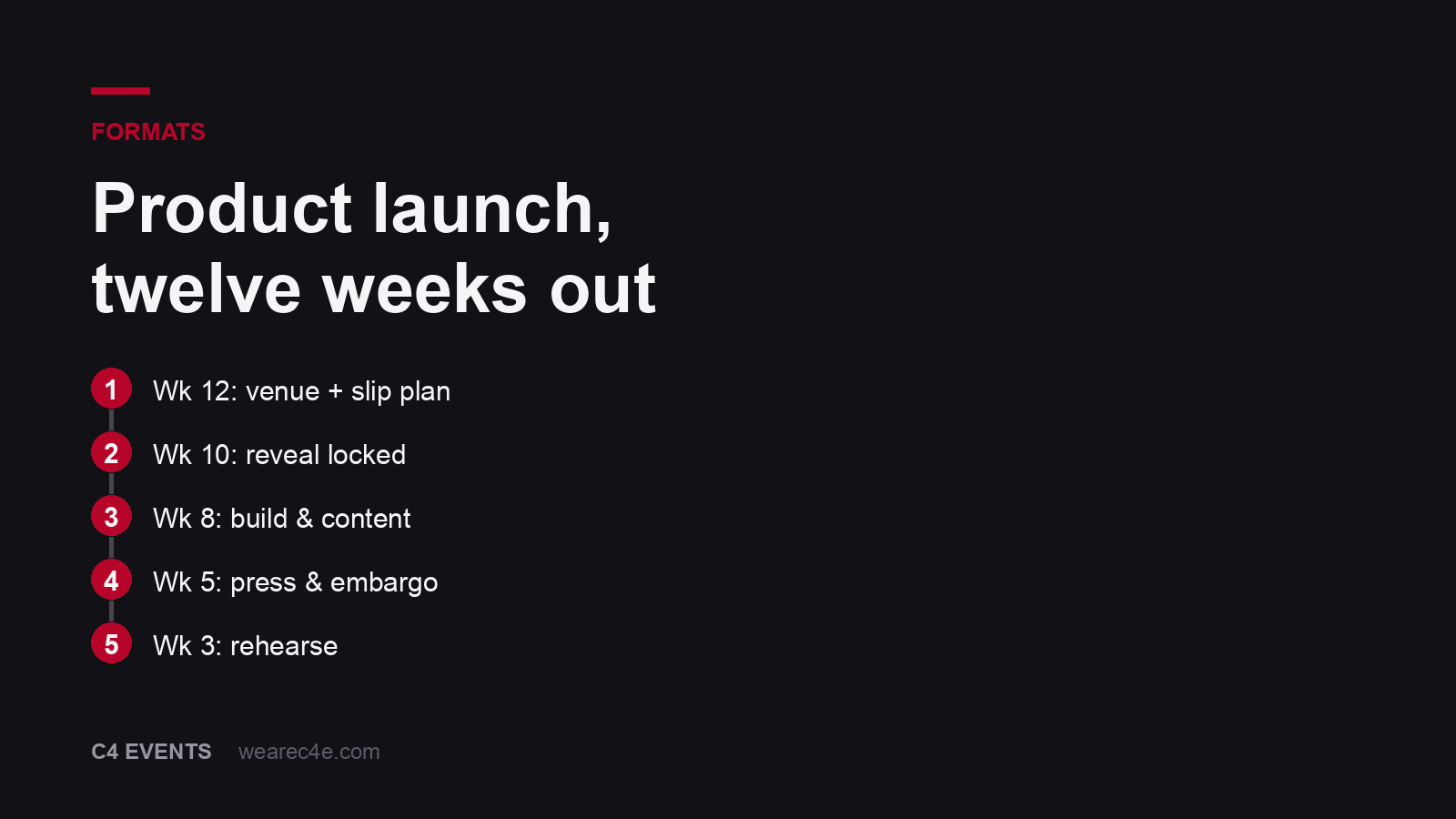
Twelve weeks is a workable minimum for a mid-size launch. Inside that:
- Weeks 12 to 10: venue, date, and the slip scenario. Which contracts allow a date move, and at what cost.
- Weeks 10 to 8: creative and the reveal mechanic. This has to be locked early because it drives the production build.
- Weeks 8 to 5: production build, content, film, demo environment. Permits for anything unusual.
- Weeks 5 to 3: press strategy, embargo terms, briefings, guest list, the run of show.
- Weeks 3 to 1: rehearsal, technical build, dry runs of the demo with things going wrong on purpose.
Build the slip scenario in week 12, not in week 4 when you need it. Ask each supplier what a two-week move costs. Get it in writing. A launch date that cannot move is a launch date that will hold a bad event rather than a good one.
The reveal
The reveal is why people came, and there are only a few ways to do it well.
Physical products reward physical reveals. A drape drop, a lift from below the stage, a turntable, a wall that opens, a vehicle driving on. Anything where the object arrives in the room and every person sees it at the same second. The mechanic costs money and it is the money best spent in the whole event.
Software rewards a live demo. Done by someone who knows the product well enough to recover when it breaks, because it will. A live demo that hits a bug and gets handled with composure is more convincing than a flawless recording, and the audience knows the difference.
The failure mode is the reveal that plays as a film. If the moment is a video on a screen, you did not need the room, the travel, the catering or the stage. You needed a YouTube upload and a press release. Anything you can send, send. What justifies the room is what cannot be sent.
One rule that has never failed: rehearse the reveal until it is boring. Then rehearse it once more with the lights, the music and the cue stack live. See why the rehearsal day is the highest-return line in the budget.
The room, and who is in it
Launch audiences are most often four groups with four different needs, and a single agenda that serves all four serves none.
Press need accuracy, access and time. Brief them before the public moment so their copy is right rather than fast. Give them a room, power, wifi that works under load, and someone senior for ten minutes each.
Partners and channel need commercial detail: pricing, margin, availability, support. This is a different session and it should be one.
Customers need to touch the thing. Build hands-on time into the agenda rather than hoping it happens at the drinks.
Internal teams need pride and clarity. They are also your best ambassadors in the room, so brief them on what they can and cannot say before they walk in.
Embargoes, and planning for the break
Set the embargo time. Put it in writing to every attending journalist. Time your own channels to the same minute, and have them staged and ready rather than being assembled while the news breaks.
Then assume it breaks a few minutes early somewhere. Someone tweets from the room. A regional outlet misreads the timezone. This happens often enough that the plan should not depend on it not happening. What protects you is having your owned channels ready to publish rather than reacting: your site, your release, your assets, your social, all queued.
If the product is under a hard regulatory or financial-disclosure constraint, that is a legal conversation and it outranks the event plan. Have it in week ten.
The stream
Hybrid events are growing at 11.72 percent a year across Asia Pacific, faster than the market around them. For a launch, the stream is often where most of the audience is.
Three things that make it work rather than exist.
1/ Its own host. Someone speaking to the remote audience, setting up what they are about to see, filling the gaps a room does not notice but a stream does.
2/ Its own mix. The broadcast audio mix is a different job from the room mix and needs different ears. Same for lighting, which has to read on camera rather than to the eye.
3/ A plan for the reveal on camera. The physical reveal that lands in the room can look flat through one lens. Shoot it with at least two cameras and cut it, or the moment you spent the most on is the moment the stream underdelivers.
When the product is not ready
This is the scenario every launch team hopes to avoid and about one in five will face.
Decide the trigger date in advance. The point after which you postpone rather than proceed. Write it down while everyone is calm, because in the week it matters the room will be full of people arguing for pushing on, and they will have reasons.
A launch event for a product that is not ready costs more than a delayed launch. Press write what they see. Partners quote what they were told. Customers try the thing. All three of those become durable if the product underdelivers in front of them.
The postponement is the harder call and the cheaper one.
The week after
Launch teams plan to the reveal and stop. The week after is where the value is captured or lost.
Assets out the same hour. Photography, video, the demo recording, the press kit, the product shots. If your channel partners have to wait three days for images, they post nothing and the moment passes.
Follow-up sequenced by audience. Press get the detail they asked for in the room. Partners get pricing and availability. Customers get a route to try it. Internal teams get the numbers and what to say. Four sequences, not one mailshot.
Capture what broke. While it is fresh, and in writing. Every launch teaches you something about your own product, your own demo environment and your own messaging, and none of that survives a fortnight unless somebody writes it down on the Friday.
One decision worth making early: who owns the product on the day. Not the launch, the product. A named person with the authority to pull a feature from the demo at 8am because it is not stable. Without that name, the argument happens at 8am anyway, and it happens between people who cannot decide.
Where we got this wrong
We produced a launch where the reveal mechanic was strong, the room worked, and the demo environment was on conference wifi because the venue assured us it would hold. It held during rehearsal with 20 people in the building. It did not hold with 400 people and 400 phones in the room.
The demo recovered, the presenter was good, and nobody wrote about it. We still spent the budget on a moment that had a single point of failure nobody had stress-tested at load. Every launch we build now carries a wired connection for anything live and a local fallback that runs with no network at all.
And keep one person off the show-day floor whose only job is the press room. Journalists have deadlines that do not care about your run of show, and an unattended press room is where a good launch turns into thin coverage.
And rehearse the questions as well as the script. The first hostile question from a journalist or a partner sets the tone of every write-up that follows, and the answer to it should not be improvised by whoever is nearest a microphone.
And decide who speaks to press if something goes wrong. One name, briefed, with the authority to say less than they know. That person should not be the same person presenting the product.
Three rules
1/ Count from availability, not from the event date. And build the slip scenario in week 12.
2/ If the reveal could be a video, it should be. The room has to earn itself with something that cannot be sent.
3/ Stress-test the live element at load. Wifi, demo, feed, everything. Rehearsal at 20 people proves nothing about 400.
See how we run launches and corporate events across Asia and the Gulf, or product launches in Dubai where a lot of regional reveals land.
Tell us what you are launching and when it is confirmed available. We will start from that date.
What did I miss? Lemme know what you think.
Frequently asked questions
How far in advance should a product launch event be planned?
Twelve weeks minimum for a mid-size launch, and the countdown runs from the product’s confirmed availability date, not from the event date. If the product can still slip, the event plan needs a slip scenario built in from week one, including which contracts have movable dates.
What makes a good product reveal?
One moment, seen by everyone, that could not be replicated in a video. Physical products reward physical reveals: a drape drop, a lift, a turntable, a wall that opens. Software rewards a live demo done by someone who can recover when it breaks. The failure mode is a reveal that plays as a film, because then you did not need the room.
How do you handle press embargoes at a launch event?
Set the embargo time, put it in writing to every attending journalist, and time your own channels to the same minute. Assume it will break by a few minutes somewhere and have your owned channels ready to publish rather than reacting. Give press a briefing before the public moment so their copy is accurate rather than fast.
What happens if the product is not ready?
Decide the trigger date in advance: the point after which you postpone rather than proceed. Then check which of your contracts allow a date move without penalty, and negotiate that flexibility at signature rather than in the week you need it. A launch event for a product that is not ready damages more than a delayed launch does.
Should a product launch be in-person, hybrid or streamed?
In-person for the room that matters, streamed for everyone else. Hybrid events are growing at 11.72 percent a year across Asia Pacific, faster than the market around them. The mistake is treating the stream as a camera pointed at a stage. It needs its own host, its own mix and someone owning the remote audience.