Singapore has a reputation for paperwork that its event licensing does not deserve.
The Public Entertainment licence is cheap, the process is published, the fees are on a four-page document anybody can download, and a large share of corporate events never need one. What people get wrong is not the difficulty. It is the test.
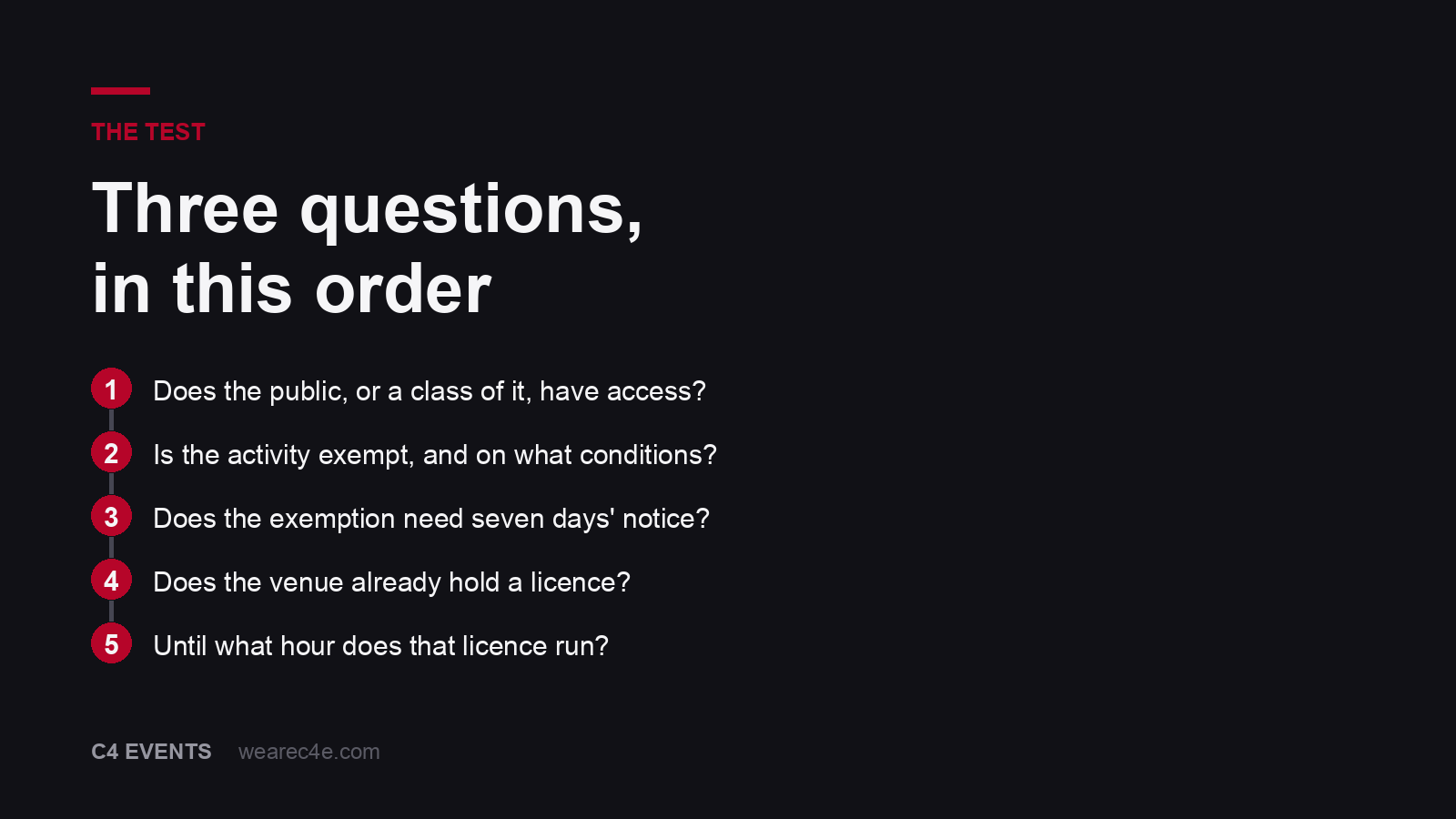
This page sets out what the Singapore Police Force publishes, what the exemptions order says, and the three questions to ask in order. It reports the documents. For your own event, the Licensing Officer is the answer, not a blog.
The test is access, not size
The Act reaches public entertainment provided in a place to which the public, or any class of the public, has access, whether gratuitously or otherwise.
Read that phrase twice, because it is doing all the work. It is not about how many people are coming. It is not about whether tickets are sold. Free entry is covered by the words whether gratuitously or otherwise. What matters is whether the public, or a class of it, can get in.
That distinction is why a ticketed concert in a hall and a closed company dinner in the same hall can land in different places. It is also why nobody sensible tells a client their event is exempt from a distance. Two events that look identical on a floor plan can differ on access, and access is the thing the Licensing Officer looks at.
The published fees
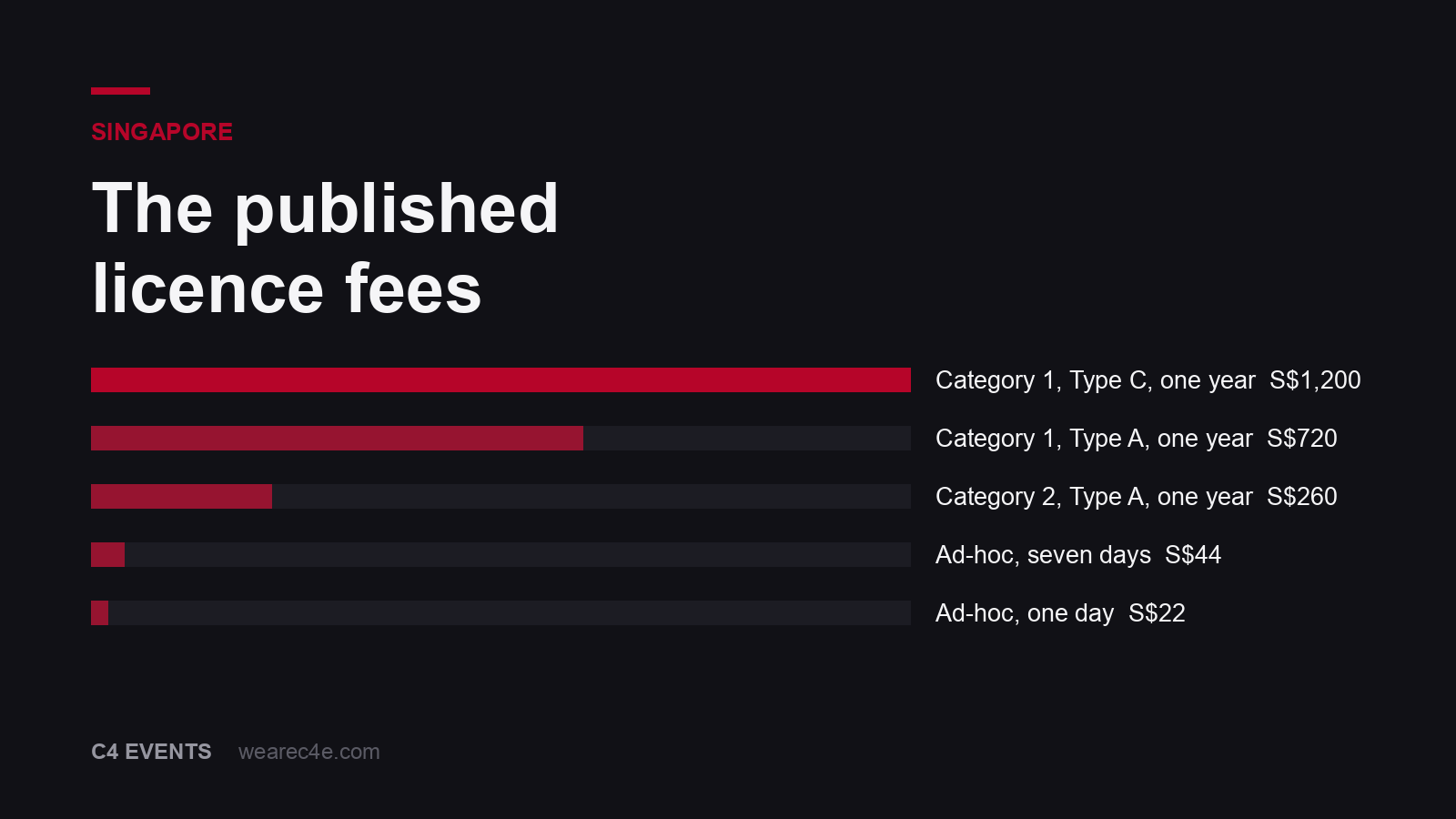
The Police publish a fee table by category. Two numbers on it are worth committing to memory.
| Category | What it covers | Ad-hoc, 1 day | Ad-hoc, 7 days |
|---|---|---|---|
| 1 | Recorded music, or a variety act, music, singing, dancing, gymnastics or acrobatics, including where customer dancing is permitted | S$22 | S$44 |
| 2 | Recorded music where customer dancing is not allowed | S$22 | S$44 |
| 3 | Amusement centre, billiard saloon or computer games centre | S$22 | S$44 |
| 5 | Boxing or wrestling contest | S$22 | S$44 |
| 6 | Variety act, music, singing, dancing, gymnastics, acrobatics, demonstration or parade | S$22 | S$44 |
| 7 | Circus or exhibition of animals | S$22 | S$44 |
| 8 | Any other entertainment other than arts entertainment | S$22 | S$44 |
S$22 for a day. S$44 for a week. Across every category.
Whatever your Singapore event risk register says, the entertainment licence fee is not on it. The cost of a Singapore event lives somewhere else, and that somewhere else is set out in what a corporate event costs in Singapore.
Establishment licences, for venues rather than events
The annual licences are the venue’s problem rather than yours, and knowing they exist explains why so many corporate events need nothing.
| Category | Type A | Type B | Type C |
|---|---|---|---|
| 1 | S$720 | S$960 | S$1,200 |
| 2 | S$260 | S$350 | S$440 |
| 3 | S$360 | S$480 | S$600 |
Type A permits operation up to 1am Monday to Saturday and 2am on Sunday and public holidays. Type B extends that to 3am and 4am. The type is about closing time, not about size.
An established hotel, club or venue holds one of these. Your event runs inside it. Which is why the single most useful question on a Singapore site visit is whether the venue’s own licence covers what you are planning, and until what hour.
The exemptions, and the seven-day notification
The Public Entertainments and Meetings (Exemptions) Order sets out activities that do not need a licence provided the organiser sticks to the conditions attached. The order splits them three ways.
1/ Activities exempt with conditions, where the organiser has to notify the police at least seven days before the event. The published example that matters most to corporate work is certain events in the plaza, concourse, atrium or lobby of a hotel or shopping centre. The conditions include no more than two loudspeakers, loudspeakers angled down and facing the audience, no vulgar or obscene gesture, remark or song, performers decently attired, and the organiser or an authorised agent present throughout.
2/ Activities exempt with conditions but with no notification needed. Busking at a National Arts Council designated site, bowling in a bowling centre, the Seventh Month Festival, and a list of specified demonstrations that runs from calligraphy to top-spinning.
3/ Classes exempted from the Act outright. The one every event planner should know: the transmission of recorded music in the premises of hotels, shopping centres, offices, clinics and shops, excluding transmission by a disc jockey or by the operation of a jukebox. Recorded music in restaurants is exempt too, except during any time the premises are operating as a bar, pub or nightclub.
That third group is the reason background music at a corporate reception in a hotel is not the problem people expect. It is also the reason a DJ is a different conversation, because the exemption names the disc jockey as an exclusion.
Before you apply, planning permission
The Police are clear on sequence. You are required to obtain planning permission from URA, SLA or HDB on the land use of the premises before applying for the entertainment licence.
For a hotel ballroom or a licensed venue this is already settled, which is another reason established venues carry no clock. For a warehouse, a car park, an open field, a shophouse or anywhere the intended use differs from the approved use, it is a real step with a real duration in front of the three weeks.
Two further published warnings are worth quoting in a project plan. Processing fees charged by URA and HDB do not guarantee approval of the entertainment licence. And the existence of other entertainment outlets near your proposed location does not mean yours will be approved, because law and order considerations for the area are assessed too.
The sunk-investment rule
This is the sentence to put in front of any client who wants to start building before approvals land.
The Police state that sunk investments, such as renovation, purchase of equipment and rental of premises, are not grounds for a licence to be granted, and that you should obtain the licence or approval before starting renovation works or using the premises.
In other words, spending money creates no entitlement. Anybody who has run events for long enough has watched somebody try the opposite argument. It does not work here.
Arts entertainment sits with a different regulator
Arts entertainment covers plays, opera, music, dancing and exhibitions, and the Infocomm Media Development Authority regulates it rather than the police.
For a corporate event the line matters when the programme has a performance in it. A live band at a dinner, a dance troupe at a launch, a theatrical opening to a conference. Ask which regime applies before you contract the act, because finding out afterwards means renegotiating with a performer who is already booked.
How this fits a project plan
| Question | Ask it | If the answer is no |
|---|---|---|
| Does the venue hold its own licence? | Site visit | You have a three-week clock |
| Until what hour does it run? | Site visit | Your afterparty ends earlier than planned |
| Is the land use already approved? | Before you sign | Add URA, SLA or HDB in front of the three weeks |
| Is there a DJ or a live act? | At programme sign-off | Check which regime, police or IMDA |
| Is any part open to the public? | At concept | Assume you are inside the Act and check |
Five questions. Most Singapore corporate events clear all five inside a single site visit, and the ones that do not have found their real risk early, which is the point of asking.
Two situations that catch corporate planners
The first is the offsite venue. A team wants something other than a ballroom, so the shortlist fills with warehouses, art spaces, rooftops and shophouses. Each of those may be a delightful room and none of them can be assumed to carry an entertainment licence or an approved land use for what you have in mind. Ask both questions on the first call rather than after the deposit.
The second is the closing hour. A venue’s licence type sets when it has to stop, and Type A stops earlier than Type B. An awards night that overruns by forty minutes is an inconvenience. An awards night that overruns past the licence is the venue’s problem, which means it becomes yours, at speed, in front of your guests.
Both are answered in one email to the venue. Neither is answered by assuming that a room used for events every week must be fine for yours.
What this means in practice
Singapore’s licensing is not a barrier to running an event here. It is one of the reasons the city works: the rules are published, the fees are trivial, and the process is the same for everybody.
The mistake is treating it as an afterthought and then discovering that your venue’s licence stops at 1am, or that your chosen warehouse has never been approved for the use you have in mind, or that the DJ you booked sits outside the exemption you assumed.
Ask the five questions. Then get on with the event. The wider regional picture on permits sits in event permits in Asia and the Gulf, the money in Singapore event grants, and the way we run events in the market on the Singapore page.
If you want the answer for your venue and your programme rather than the published general case, tell us what you are planning.
What did I miss?
Frequently asked questions
Do I need a Public Entertainment licence for a company dinner in Singapore?
The published test turns on access. The Public Entertainments Act reaches entertainment provided in a place to which the public, or any class of the public, has access, whether gratuitously or otherwise. A closed company dinner in a hotel ballroom, invitation only, is a different situation from a ticketed public show. Settle it with the venue and the Licensing Officer for your own facts rather than assuming either way.
How much is a Public Entertainment licence in Singapore?
The Singapore Police Force publishes the fees. An ad-hoc licence is S$22 for one day or S$44 for seven days, across every category. An establishment licence for a year runs S$720, S$960 or S$1,200 for category 1 depending on the closing hours it permits, and S$260, S$350 or S$440 for category 2. The licence is not the expensive part of a Singapore event.
How long does a Public Entertainment licence take?
About three weeks from receipt of the application and the supporting documents, per the GoBusiness listing. Planning permission from URA, SLA or HDB on the land use of the premises has to be in hand before you apply, so the real clock starts earlier than the three weeks suggests.
Which events are exempt from a licence in Singapore?
The Public Entertainments and Meetings (Exemptions) Order lists them, and the exemptions come with conditions attached. Some require the organiser to notify the police at least seven days before the event. Among the classes exempted outright is the transmission of recorded music in the premises of hotels, shopping centres, offices, clinics and shops, excluding music played by a disc jockey or a jukebox.
Does a DJ change the answer?
It can. The published exemption for recorded music in hotels, shopping centres, offices, clinics and shops excludes transmission by a disc jockey or by a jukebox. There is a separate conditional exemption covering a disc jockey at certain events in the plaza, concourse, atrium or lobby of a hotel or shopping centre, and that one carries conditions including no more than two loudspeakers and a seven-day notification to the police.
Who applies for the licence, us or the venue?
Often the venue, because an established venue holds its own establishment licence and your event sits inside it. That is the first question to ask on the site visit, because it decides whether you have a three-week clock in your project plan or none at all.
What is Arts Entertainment and who regulates it?
Arts entertainment covers plays, opera, music, dancing and exhibitions. The Infocomm Media Development Authority regulates it, not the police. If your event has a performance element rather than background music, check which of the two regimes you are in before you book the act.
Can we start building before the licence is granted?
The police are blunt about this. Sunk investments such as renovation, purchase of equipment and rental of premises are not grounds for a licence to be granted. Commit money before the approval and you have created an argument you will lose.