Three companies pitch for the same event. One calls itself a DMC, one an event agency, one a PCO. All three send a deck with the same photographs of a stage.
They are not doing the same job, they do not carry the same risk, and two of them are wrong for your event.
The short version
| DMC | Event agency | PCO | |
|---|---|---|---|
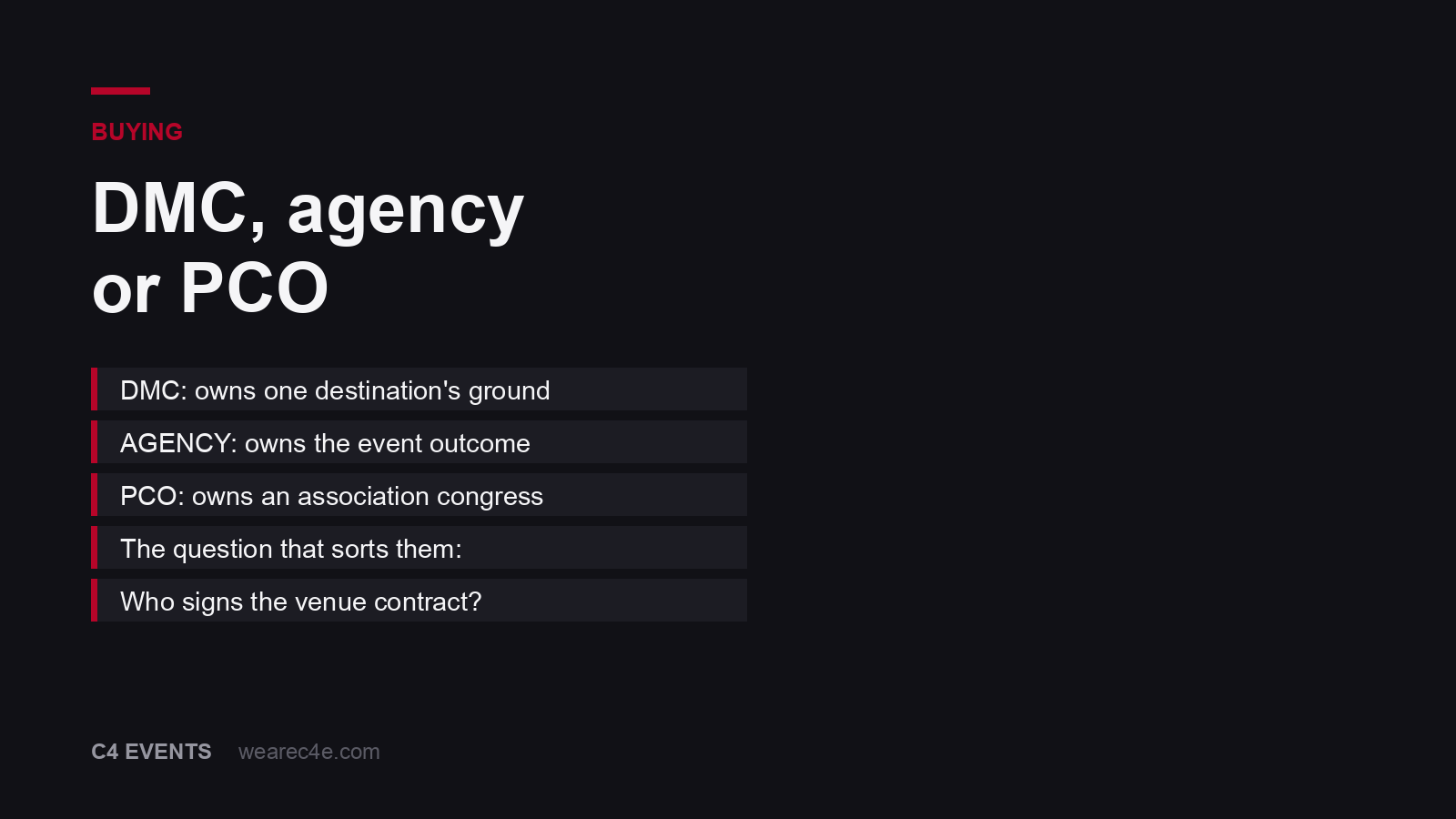
| Owns | One destination | The event outcome | The congress, end to end |
| Buys | Venues, transport, vendors, permits | Everything, in any market | Venue, registration, sponsorship, exhibition |
| Content | No | Yes | The scientific programme, with a committee |
| Typical client | An agency, or a corporate buying ground | A corporate | An association or a society |
| Charges | Margin on ground services, or a fee | Management fee, or pass-through plus fee | Fee, plus registration and sponsorship share |
| Carries risk | Ground execution | The whole event, if they sign | Often the congress budget itself |
| Hire when | You have a lead and need the city | You need one throat to choke | You are running an association congress |
The DMC
A destination management company is the ground. Vendors, venues, transport, permits, staff and the relationships that decide whether the last LED wall in the city comes to you or to somebody else in a peak week.
What they give you is local knowledge that cannot be bought any other way. Which hotel’s banqueting team is good and which is under-staffed this season. Which road closes. Which permit officer wants the application in a particular format. Which vendor’s quote is low because they are hungry and which is low because they are about to fail.
What they do not give you is the event. A DMC does not write your content, does not own your message, and in most cases does not want to be accountable for whether the audience left convinced. Our guide to choosing a destination partner has the eight questions we ask.
Hire a DMC on its own when you have an in-house team who can lead the event and you need a city you do not know. Hire one underneath an agency when the event crosses a border. Do not hire one and then expect it to behave like an agency, because you will have bought ground services and be holding the outcome yourself.
The event agency
An event agency owns the outcome. Brief to debrief, content to crew, in whichever market the event lands in.
That is the difference worth paying for. When the venue moves the load-in window by four hours and the LED vendor wants a second advance and the client adds 200 people to the gala dinner, one company is accountable for all three, and it is not you.
Agencies work in one of two ways abroad. Some have their own teams in each market. Some appoint a DMC and manage them. Both work. The one that does not work is an agency that says it has a partner and turns out to mean an email address. Ask who files the permit, in whose name, and who is at the loading dock at 6am. Our in-house against agency guide covers the prior question of whether to hire out at all.
The cost is a layer. You pay the agency fee on top of ground services, and in exchange you stop carrying coordination risk. For a single event in a city your team knows, that layer may not earn its keep. For an event across a border with a live production, it earns it in the first week that goes wrong.
The PCO
A professional congress organiser is a different animal, and the confusion costs corporate buyers real money.
IAPCO, the accreditation body, defines a PCO as “a Professional Congress Organiser or Meeting Planner who administers and brings to fruition the organisation of a congress, meeting, event or convention in a professional manner”. The words that matter are congress and administers.
A PCO handles the machinery an association congress needs and a corporate event does not. Abstract submission and review. A scientific programme built with a committee. Registration at a scale where the registration system is a product decision. Sponsorship and exhibition sales as a revenue line. Delegate finances, sometimes including carrying the congress budget.
IAPCO accreditation asks for proof of at least 10 international meetings at set attendance levels, plus a detailed site inspection of a live congress by a committee member. That is a real filter, and it is a filter for the association job rather than the corporate one.
So if you are running a medical society’s annual congress, hire a PCO and check the accreditation. If you are running a partner summit, a PCO will do it and you will be paying for machinery you do not need.
The question that sorts all three
Who signs the venue contract?
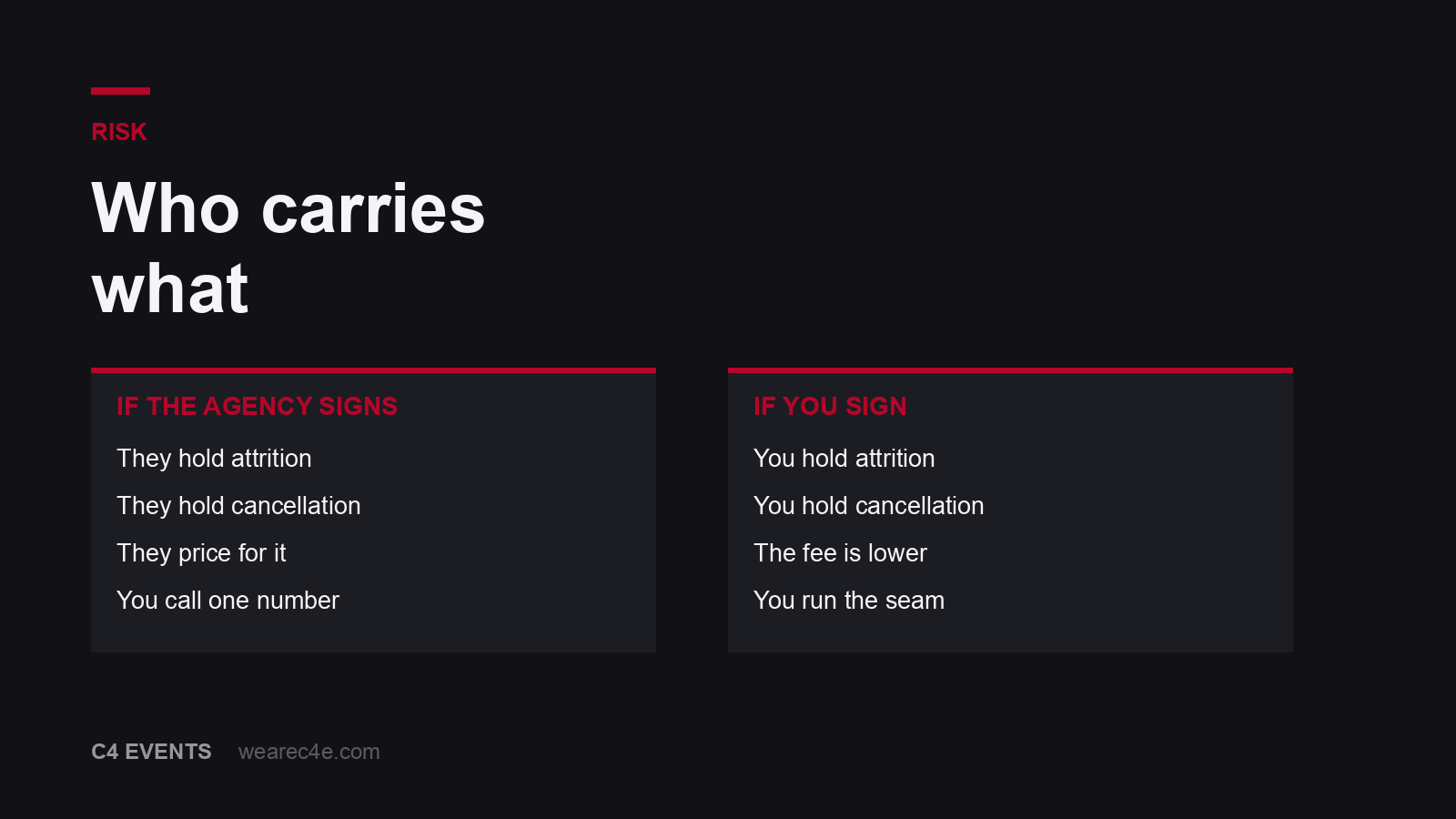
That single question tells you where the risk sits, and the risk is what you are buying. If the agency signs, they carry the attrition, the cancellation scale and the force majeure position, and their fee reflects it. If you sign, you carry all three and your fee is lower.
Both are defensible. What is not defensible is signing without knowing which one you chose, which is how a company ends up billed for 60 empty rooms it thought somebody else was holding. Our guide to the three clauses covers what you are taking on.
The same question applies down the chain. If your agency appoints a DMC, ask whether the DMC contracts with you or with the agency. That answer decides who you call when the DMC fails, and whether you have a contract with them at all.
What each one costs
A DMC charges margin on ground services, a management fee, or both. Ask which, and ask for the ground services quoted at cost with the fee stated as a number. A DMC that will not separate the two is telling you something.
An event agency charges a management fee on budget, at 10 to 20 percent in the proposals we see across the markets we work in, or pass-through plus a stated fee. Procurement teams prefer the second because they can audit it. Our comparison of the fee models works through what each one does to your incentives and theirs.
A PCO charges a fee, and often takes a share of registration and sponsorship revenue. On a congress that is the point, because their work generates that revenue. On a corporate event it makes no sense, because there is none.
What we would hire
1/ Corporate event in your home market, in-house team, 200 people: nobody, or a production partner for the room. 2/ Corporate event across a border: one agency who owns the outcome, with a DMC underneath them that you have met. 3/ Association congress with abstracts and sponsors: a PCO, accredited, with references from a society your size. 4/ Series of events across five markets: one agency for the content and the standard, five DMCs underneath, one contract that names them all.
The pattern in all four is the same. One company owns the outcome. Everyone else is under them, and the contract says so.
The failure mode
Two suppliers, both senior, neither one in charge. It happens when a corporate hires a DMC straight to save the agency layer and then hires a production company for the room, with no one holding the seam between them.
The seam is where events break. The stage arrives before the venue releases the room. The registration desk is built where the catering flows. Nobody is wrong, and nobody is accountable, and the person who ends up standing in the middle solving it at 7am is you.
If you are going to run the seam yourself, decide that on purpose, name the person on your team who owns it, and give them the authority to overrule both suppliers on the day. That works. What does not work is discovering on load-in morning that the role was never assigned.
The word that hides the difference
All three call themselves partners. The word that tells you what you are buying is not partner, it is accountable.
Ask each bidder to finish this sentence in writing: if the event fails, we are accountable for the following. A DMC’s honest answer covers the ground. A production house’s covers the room. An agency’s covers the outcome, and an agency that will not write that down is selling you a coordination service at outcome prices.
In the end
The label on the website is the least useful thing about any of these three. The useful things are who has a team in the market, who signs the venue contract, and who is accountable when the audience leaves unconvinced.
Ask those three in the first meeting. The answers sort the shortlist faster than any deck, and they sort it on the two things that decide a show day: who is in the market, and who is on the hook.
What did I miss? If you have hired all three and the distinction reads another way from where you sit, tell us.
Frequently asked questions
What is the difference between a DMC and an event agency?
A DMC is local and owns the ground: vendors, venues, permits and transport in one destination. An event agency owns the event end to end and can work across destinations, often hiring a DMC underneath it. The DMC knows the city. The agency owns the outcome.
What does a PCO do that an agency does not?
A PCO runs congresses, and carries abstract handling, scientific programme management, delegate registration at scale, sponsorship and exhibition sales, and the association’s finances. IAPCO defines a PCO as someone who administers and brings to fruition the organisation of a congress, meeting, event or convention in a professional manner. Corporate agencies seldom do the association parts.
Do I need all three?
Almost never. A corporate event abroad needs one lead who owns the outcome, with a DMC underneath them for the ground. Adding a third party adds a handover, and handovers are where events fail.
Which one is cheapest?
A DMC hired straight, because you are buying ground services without a layer above them. You then carry the coordination yourself, which is a real cost paid in your team’s time and in the risk you are now holding.
How do I know if a DMC is any good?
Ask who is on site at 6am on load-in day, by name, and what else that person has on that week. Then ask for a reference from an event that went wrong. The second question tells you more than the first.
Is IAPCO membership worth checking?
It is a real filter for a congress. IAPCO requires proof of at least 10 international meetings at set attendance levels, plus a site inspection of a live congress before accreditation. For a corporate event it tells you little, because the accreditation is aimed at a different job.
Can one company be all three?
Some are, in a specific market. The test is not the label on the website. It is whether they have their own team in the destination or a partner they email, and whose name goes on the permit.
Who should sign the venue contract?
Whoever you want carrying the attrition risk. If the agency signs, they carry it and price for it. If you sign, you carry it and pay less for the agency. Both are defensible. Signing without deciding which one you chose is not.