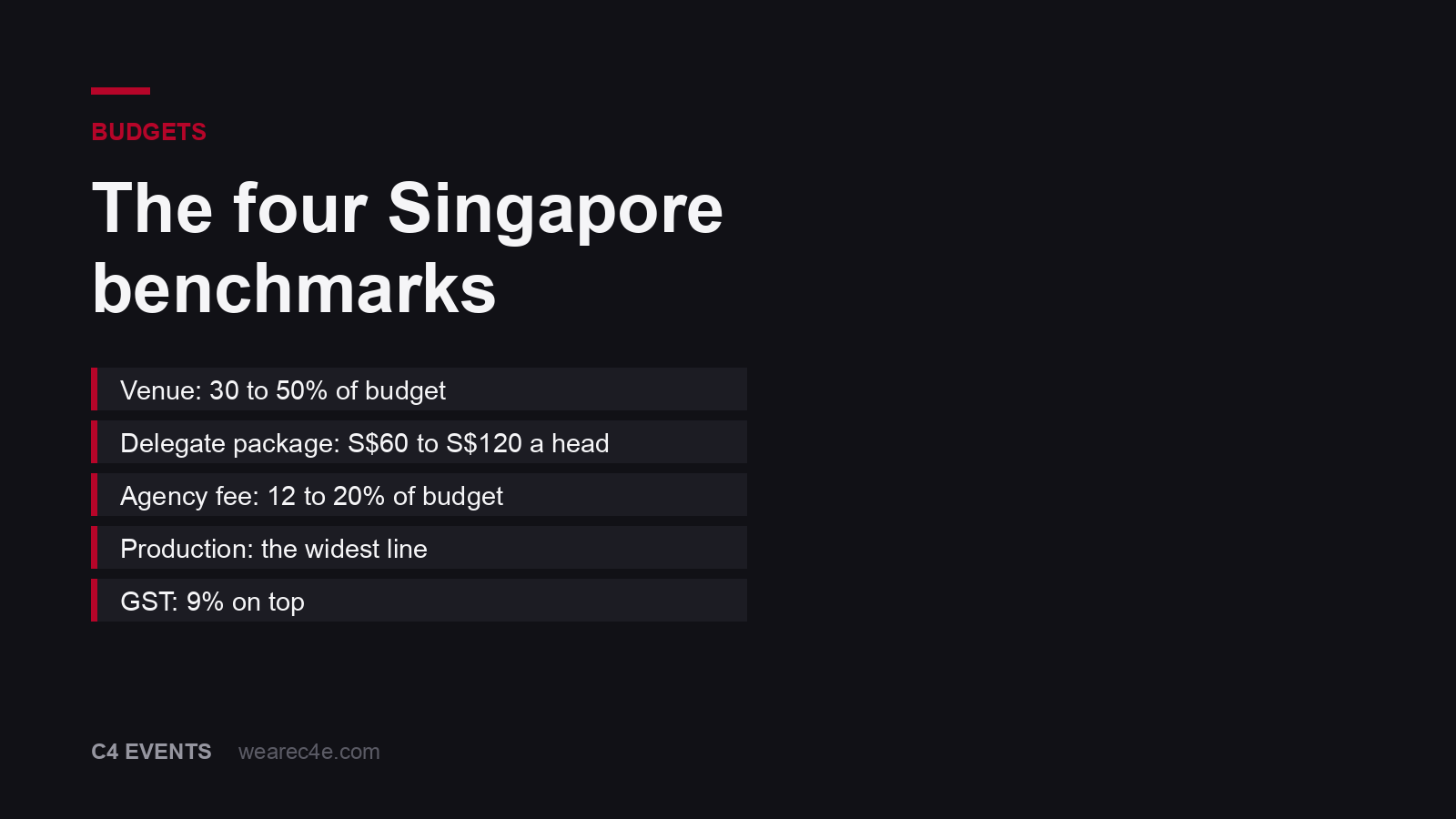
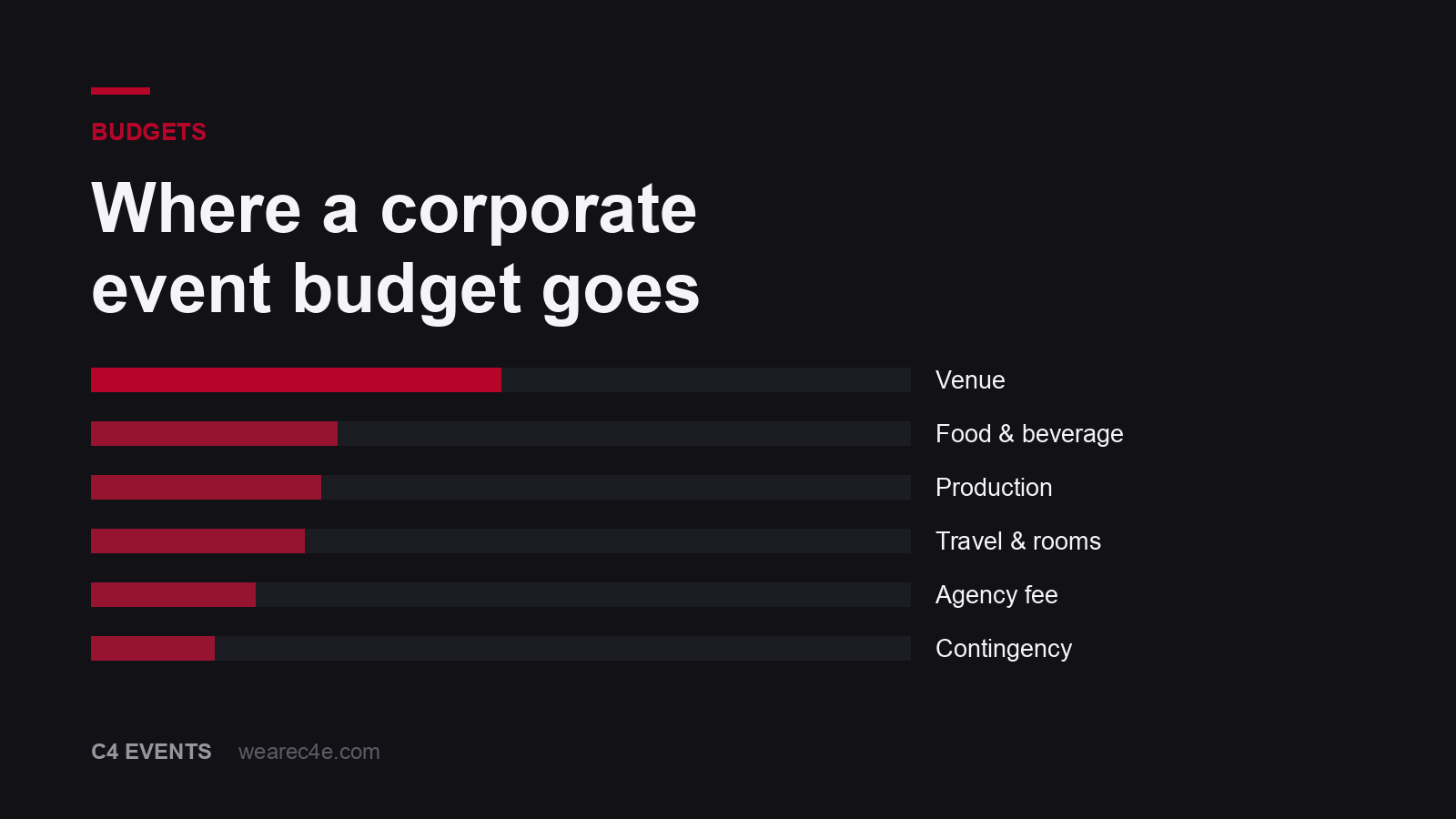
Venue eats 30 to 50 percent of a corporate event budget in Singapore. Hold that number for a second, because it explains most of the arguments I have watched between a buyer and a planner. It also explains how two agencies can read the same brief and come back 40 percent apart on price.
Event budgets are not hard. They are unfamiliar. Most people who sign one off do it two or three times a year, against suppliers who do it two or three times a week. That gap is where the money goes.
So here is the budget, line by line, the way we build it at C4 Events. The numbers come from live markets in Asia and the Gulf. Where I have a verified benchmark I give it. Where I do not, I say so.
Start with the three layers, not the line items
Every event budget splits three ways. Get this right and the rest is arithmetic.
1/ Fixed costs. These do not move when headcount moves. Venue hire, staging, sound, lighting, LED, the creative, the film, the crew, the rehearsal day. A 200-person conference and a 400-person conference in the same ballroom can carry an identical production bill.
2/ Per-head costs. These scale with every name on the list. Food and beverage, rooms, transfers, gifting, badges, insurance. In Singapore a full-day delegate package runs S$60 to S$120 per person. That one line decides whether your event is a hall with sandwiches or a room people talk about afterwards.
3/ Contingency. 10 to 15 percent. Not padding. The line that absorbs a currency move, a venue swap, or a sponsor who adds a slot on Tuesday for a Friday show.
When a buyer tells me the budget doubled, the cause is almost never a fixed cost. It is a per-head cost multiplied by a headcount nobody re-forecast. Two hundred became two hundred and sixty, and every per-head line moved with it while the spreadsheet still said two hundred.
The venue line, and why it decides everything after it
Venue is the first commitment and the least reversible. It sets your production cost, because a ballroom with a 4.2-metre ceiling caps your screen height. It sets your food cost, because most hotels enforce a minimum spend. It sets your logistics cost, because a venue 40 minutes from the airport means coaches, and coaches mean coordinators.
Four questions before you sign anything.
- What is the minimum spend, and what counts toward it? Some hotels count room nights. Some count food and beverage alone. On a 300-person programme the difference is six figures.
- What is the in-house AV exclusivity? If the venue owns the audio-visual contract, your production budget stops being a market price and becomes a rate card.
- What is the load-in window? A build that has to happen between midnight and 6am costs more than the same build across a free afternoon. Overtime is a real line.
- Is anything being renovated? A venue with construction next door is your problem on the day, not theirs, unless the contract says otherwise.
The six places budgets leak
These are the lines missing from most first drafts. I have watched each one blow a number.
Rehearsal. A rehearsal day is a full production day. Crew, venue, catering, power. Budget it, or cut it on purpose, but do not discover it in week three. More on this in what conference production costs.
Crew costs. Your technical team eats, sleeps and travels. On a 40-person crew across a three-day build, that is a line worth a mid-size sponsorship.
Freight and customs. Shipping a stand or a product into Dubai, Bangkok or Bali means duties, clearing agents and a broker who wants paperwork you have not prepared. See event permits and licences across Asia and the Gulf for what each market demands.
Translation and interpretation. Simultaneous interpretation needs booths, receivers, and two interpreters per language per day. Not one. Two. They rotate every 30 minutes because the work is that hard.
Overtime and turnaround. A gala that finishes at midnight in the room you need set for a 9am plenary is an overnight reset at premium rates.
Currency. If you budget in euros and pay in baht, you are running an unhedged position across the months between signature and delivery. Fix the rate in the contract or accept the swing and hold it in contingency.
What the agency fee should look like
In the proposals we see, event organisers charge 12 to 20 percent of total budget as a management fee. A flat project fee is also fine, and on a repeat programme it is often better, because a percentage fee rewards a bigger budget and that incentive points the wrong way.
What you should refuse is the invisible fee. If an agency will not show you what the venue quoted them and what they added, you cannot tell whether you are paying for their skill or their markup. Ask for the supplier quotes. A good partner hands them over. We do, on every programme, and it has never cost us a piece of work.
I will be honest about our own record here. Our first budget in a new market has been wrong before, and it is wrong in one direction: we under-price the ground. Local transport, permit facilitation and the second interpreter are the three lines that catch us. We now build them in at brief stage rather than finding them in week four. That change came from getting it wrong, not from a better spreadsheet.
Payment terms are part of the price
Buyers negotiate the number and sign the schedule without reading it. The schedule is where a good price turns into a cash-flow problem.
Three things to fix in writing. 1/ What triggers each payment stage: a date, a milestone, or a deliverable. 2/ Whether the final payment sits before or after the event, because an agency holding no balance at load-in has no incentive left. 3/ Who carries the float on supplier deposits, since venues in most Asian markets want 30 to 50 percent up front and somebody’s balance sheet is funding that.
Tax matters too. Service tax, VAT and withholding vary across Singapore, Thailand, Indonesia, India and the UAE. Ask whether the quoted number includes them. A 5 to 18 percent surprise at invoice stage is a bad conversation to have in month five.
A worked example: 250 people, three days, Bangkok
Rough shape, not a quote. Every one of these moves with season, venue and brief.
- Venue and meeting space: the anchor, and in Bangkok often bundled against room nights
- Rooms: 250 people across three nights is 750 room nights before you count crew and early arrivals
- Food and beverage: delegate packages plus two evening events, the second of which always costs more than the first
- Production: stage, screen, audio, lighting, content playback, plus a rehearsal day
- Content and creative: the deck nobody budgets and everybody needs
- Ground transport: airport transfers on arrival and departure waves, plus the offsite dinner
- Staffing: registration desk, floor managers, a producer, a stage manager
- Contingency: 10 to 15 percent on the total
Bangkok holds 11th place in the ICCA global city rankings with 118 international association meetings in 2025, one place behind Tokyo. It has the supply. What it does not have is a single price, because a five-star riverside property and a four-star Sukhumvit conference hotel are different businesses wearing the same category label.
Build the budget into the brief, not after it
The strongest thing a buyer can do costs nothing: put the budget range in the brief. Not the exact figure. The range.
Agencies who hear no number quote what they think you can afford. Agencies who hear a range design to it. You lose nothing by naming one, because the market already knows what 250 people in Bangkok for three days costs. Withholding it does not create bargaining room. It creates three proposals you cannot compare.
Then ask every bidder for the same three things: a costed line-item budget, the supplier quotes behind it, and the assumptions. The twelve RFP questions that decide your budget covers the full list.
When the budget gets cut
It will. Here is the order I would cut in, and it is close to the reverse of what most teams do.
1/ Gifting first. A branded bag is in a cupboard within a week. Nobody has ever described an event by its tote.
2/ A night, not a notch. Two nights done well beats three nights done thin. Dropping a star rating makes everyone feel downgraded. Dropping a night makes the programme tighter.
3/ Set dressing before audio. An audience forgives a plain stage. It never forgives not hearing the speaker.
What I would protect: the rehearsal, the recognition moment if there is one, and the one evening the room will remember. Fund those in full and let the rest flex.
Three rules for a first-time buyer
1/ Price the brief and the brief’s shadow. Rehearsal, crew, freight, overtime, interpretation. The shadow is 10 to 20 percent of the visible event.
2/ Fix headcount before you fix the venue. Every per-head line moves with it, and the venue locks your minimum spend against it.
3/ Spend the contingency on purpose. A contingency that survives untouched every time was never contingency. It was margin someone else was holding.
And that, ladies and gents, is the budget. Not glamorous. It is the document that decides whether the room works.
Planning something in Asia or the Gulf and want a costed line-item budget rather than a headline number? Tell us the brief and we will build one.
What did I miss? Lemme know what you think.
PS: the venue share, delegate package and agency fee benchmarks here are Singapore market figures. Bangkok, Bali and Dubai each carry their own shape, and we publish those on their own pages.
Read next
- What a corporate event costs in Dubai, in dirhams
- What a corporate event costs in Singapore, in Singapore dollars
Frequently asked questions
What percentage of an event budget goes to the venue?
In Singapore, venue runs 30 to 50 percent of a corporate event budget. Across Bangkok, Bali and Dubai the share sits lower, because room rates and food and beverage cost less, so production and travel take a bigger slice. If a quote puts venue below a quarter of the total, ask what has been cut.
How much do event management companies charge?
In the proposals we see, event organisers charge 12 to 20 percent of total event budget as a management fee. Some work on a flat project fee instead. Both are defensible. What is not defensible is a fee hidden inside supplier margins, because you can no longer tell what the vendor costs and what the agency costs.
What is a reasonable contingency for a corporate event?
10 to 15 percent. Contingency covers what you cannot quote at brief stage: a currency move, a venue change, a headcount jump, an extra truck. If you have never spent your contingency, the padding is sitting somewhere else in the budget.
How far ahead should I budget a corporate event in Asia?
For a city event of 100 to 200 people, 45 to 60 days works. For a destination programme of 300 or more, plan 90 days minimum, and longer in peak season. October to April in Dubai and April to October in Bali both compress availability and push rates up.
Why do two agencies quote different numbers for the same brief?
Three reasons. 1/ One has priced the brief and the other has priced what the brief implies, including rehearsal days, crew meals and buffer trucks. 2/ One has put their fee inside the line items and the other has shown it on its own line. 3/ One has assumed your headcount holds and the other has assumed it moves.