
Three proposals land on your desk. One is 40 percent cheaper than the other two. You have no idea why, and the agency that wrote it is not going to volunteer the reason.
That is an RFP problem, not a pricing problem. When bidders are given room to make their own assumptions, they will, and every one of them will assume in their own favour. The fix sits upstream: a brief that removes the room.
Here are the twelve questions that make bids comparable. Most of them are about you, not about the agency.
The six you answer
1/ What is this event for? Not the format. The outcome. “Align 300 channel partners on next year’s targets and launch two SKUs” is a brief. “A two-day dealer meet” is a booking. The first produces a designed event. The second produces a quote.
2/ Who is in the room, and how do they get there? Headcount as a range, not a point. Origins, because travel is the line that moves most. Seniority, because it sets the standard. And whether partners bring spouses, because that changes every per-head number in the document.
3/ What is the budget range? Say it. A range, an all-in currency, and whether it includes travel. This one change improves bid quality more than anything else on the list, and buyers resist it hardest.
4/ What are the dates, and how flexible are they? Shoulder season at the same property saves more than dropping a category. If your dates can move by a week, say so and let bidders find the saving for you.
5/ What do you want the agency to own? Venue only, or venue plus production plus travel plus delegate management. Name the boundary. Half the price gaps between proposals are scope gaps wearing a disguise.
6/ Who decides, and by when? Name the decision-maker and the date. Agencies triage on this. A brief with no decision date goes to the bottom of a pile behind briefs that have one.
The six you ask
7/ Show the line-item budget, not the total. Venue, rooms, food and beverage, production, content, transport, staffing, fee, contingency. A single number is not a proposal. See what a corporate event budget looks like line by line for the shape to ask for.
8/ Show the supplier quotes behind it. A partner who will not show you what the venue quoted them cannot be audited. You will never know whether you are buying their skill or their markup. We hand these over on every programme.
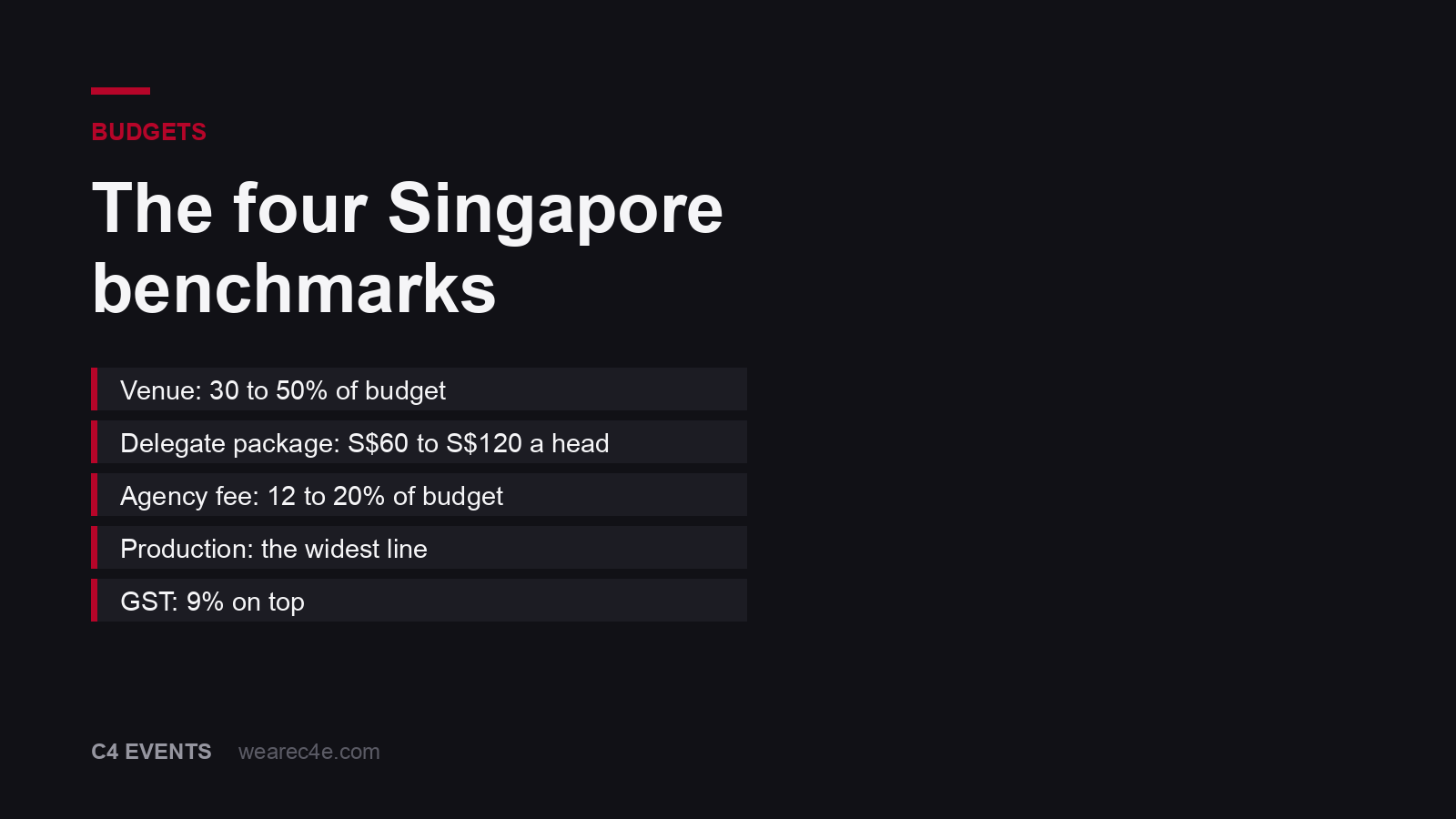
9/ Where does your fee sit, and what is it? In the proposals we see, management fees run 12 to 20 percent of total budget in this market. A flat project fee is also fine. A fee buried inside supplier line items is not.
10/ What are the assumptions? Headcount, exchange rate, rehearsal days, crew size, load-in window, and whether the venue holds AV exclusivity. Ask for the assumptions in writing and the 40-percent-cheaper proposal explains itself in about a minute.
11/ Who is on the ground, and are they employees? There is a difference between an agency with a team in Bangkok and an agency with a contact in Bangkok. Ask which. Ask who will be in the room on show day, and whether you meet them before you sign. Our guide to choosing a destination event management company goes deeper on this.
12/ What happens if it moves or stops? Cancellation, postponement, attrition, force majeure. See what those clauses mean in practice. Flag them in the RFP so bidders price them, rather than negotiating them after you have already chosen.
The terms to flag before anyone quotes
An RFP should name the contract terms that will affect the final number. Bidders can then price the risk instead of discovering it later. Flag these:
- Cancellation and the sliding scale by date
- Attrition and the room-block review dates
- Force majeure, including whether pandemics and travel bans are named
- Payment schedule and what triggers each stage
- Vendor exclusivity, above all in-house AV
- Taxes and service fees, and whether quoted numbers include them
- Price-change language, so a quote is not re-priced in month four
- Construction disclosure, because a venue renovating next door becomes your problem on the day
How to run the process
Three bidders. Not two, which gives you no comparison. Not five, which burns a week of four teams’ work and returns five thin responses. Tell each of them how many are competing, because it changes how much effort they will put in, and you want that effort.
Two weeks to respond. Three if the brief needs in-market sourcing in a destination they do not hold live inventory for. A 72-hour turnaround produces a rate card.
Give everyone the same brief, in writing, at the same time. Take questions in writing and share every answer with every bidder. This feels like extra admin. It is the only way the bids stay comparable, and it is how you find out which agency asks the sharpest questions. That question quality is the best signal in the whole process. Better than the deck.
Score it before you read it
Write the scoring matrix before the proposals arrive, and give it weights. Otherwise you will score whichever proposal you read first as the baseline and mark the others against it.
A weighting that has held up for the buyers I have watched:
| Criterion | Weight | What it is testing |
|---|---|---|
| Operations and ground team | 30 | Whether the people who deliver are employees, and whether you meet them before you sign |
| Budget transparency | 25 | Line items and the supplier quotes behind them, not a total |
| Creative and content | 20 | The part that is easiest to buy and easiest to change after signature |
| Commercial terms | 15 | Cancellation, attrition, force majeure, and what triggers each payment |
| References | 10 | The event that went wrong, not the one that went well |
Notice creative is fourth. That is deliberate. Creative is the easiest part to buy, the easiest to change after signature, and the part that flatters a pitch meeting most.
Two more process rules. Do a site visit with the shortlisted agency rather than alone, because you will learn more from what they ask the venue than from what the venue tells you. And speak to a reference whose event went wrong, not one whose event went well. Every agency has both. Only one of those calls tells you anything.
The mistake I see most
Buyers score proposals on creative and choose on price. Then they run the event with the operations team, who were not in the room for either conversation.
Operations is what you are purchasing: the person who knows that the load-in dock at that venue takes one truck at a time, that the permit office closes for a fortnight in that season, and that the ballroom’s rigging points cap your set height. None of that is in a deck.
Score the operations answer. Ask question 11 twice.
And here is our own gap. We have lost work to proposals that looked better than ours and cost less, and on two of those the client came back mid-project. That is not a boast. It means our proposal failed to make the operational difference visible enough to be worth the delta at decision time. We changed how we write proposals because of it. The assumptions and the ground team now sit on page two, not in an annexe nobody opens.
What a good response looks like when it arrives
You will know within two pages. Three markers separate a proposal from a brochure.
It disagrees with you somewhere. A bidder who accepts every element of the brief without challenge has either not read it or has decided not to risk the pitch. The best responses we have seen and written say: your dates sit in peak season, move them by ten days and the same budget buys a better property. That is the partner you want.
It names what it excluded. A proposal listing what is out of scope is worth more than one listing only what is in. Exclusions are where the second invoice comes from.
It answers the question you did not ask. Permits, freight lead times, a public holiday inside your build window, a competing event holding the city’s crew that week. Whoever surfaces that in the response has run events in that market. Whoever does not, has not.
Three things to do this week
1/ Put a budget range in the brief. Costs nothing. Improves every bid.
2/ Ask for assumptions in writing. This is the question that makes the cheap proposal explain itself.
3/ Name the show-day team. Not the pitch team. The show-day team. Then ask to speak to the producer who will run your floor, before you sign rather than after.
And one thing not to do. Do not run an RFP you have already decided. If an incumbent is going to win, tell the other two before they spend a week on it. The events industry in Asia and the Gulf is small enough that word travels, and the agency you burn this year is the one holding the crew you need next year. Buyers who run clean processes get better bids, because the good agencies keep answering.
Writing an RFP for an event in Asia or the Gulf? Send it to us. We will answer all twelve, and we will tell you what the brief is missing before we quote it.
What would you add to the list? Do you agree?
Frequently asked questions
What should an event RFP include?
Objective, audience, headcount with a range, dates with flexibility stated, destination or destination criteria, budget range, the scope you want the agency to own, the decision timeline, and the contract terms you will require. An RFP that omits the budget range produces bids you cannot compare.
Should I put my budget in the RFP?
Yes, as a range. Agencies who hear no number quote what they think you can afford. Agencies who hear a range design to it. The market already knows what your brief costs, so withholding the number does not create bargaining room. It creates three proposals built on three different sets of assumptions.
How many agencies should I invite to an event RFP?
Three. Two gives you no comparison and five wastes everyone’s time, including yours, because a serious response takes a week of work. Invite five and you will get five thin responses. Tell every bidder how many are competing.
What contract terms should an RFP flag upfront?
Cancellation, attrition, force majeure, payment schedule, vendor exclusivity, taxes and service fees, damage clauses, and price-change language. Flag them in the RFP so bidders price them, rather than discovering them in the contract after you have already chosen.
How long should agencies get to respond to an event RFP?
Two weeks for a standard programme. Three if the brief requires site visits or in-market venue sourcing in a destination the agency does not hold live inventory for. A 72-hour turnaround produces a rate card, not a proposal.