Ninety minutes. That is how long a room will stay with an awards ceremony before attention breaks, and almost every corporate awards night is built to run longer.
What follows from that one constraint decides the whole evening: how many categories you can have, how long each citation runs, when dinner is served, and whether the winner announced at 10.40pm gets the reception they earned or the reception of a room that wants to go to the bar.
Here is how to build a gala that works, and the run of show that protects it.
The timing that holds
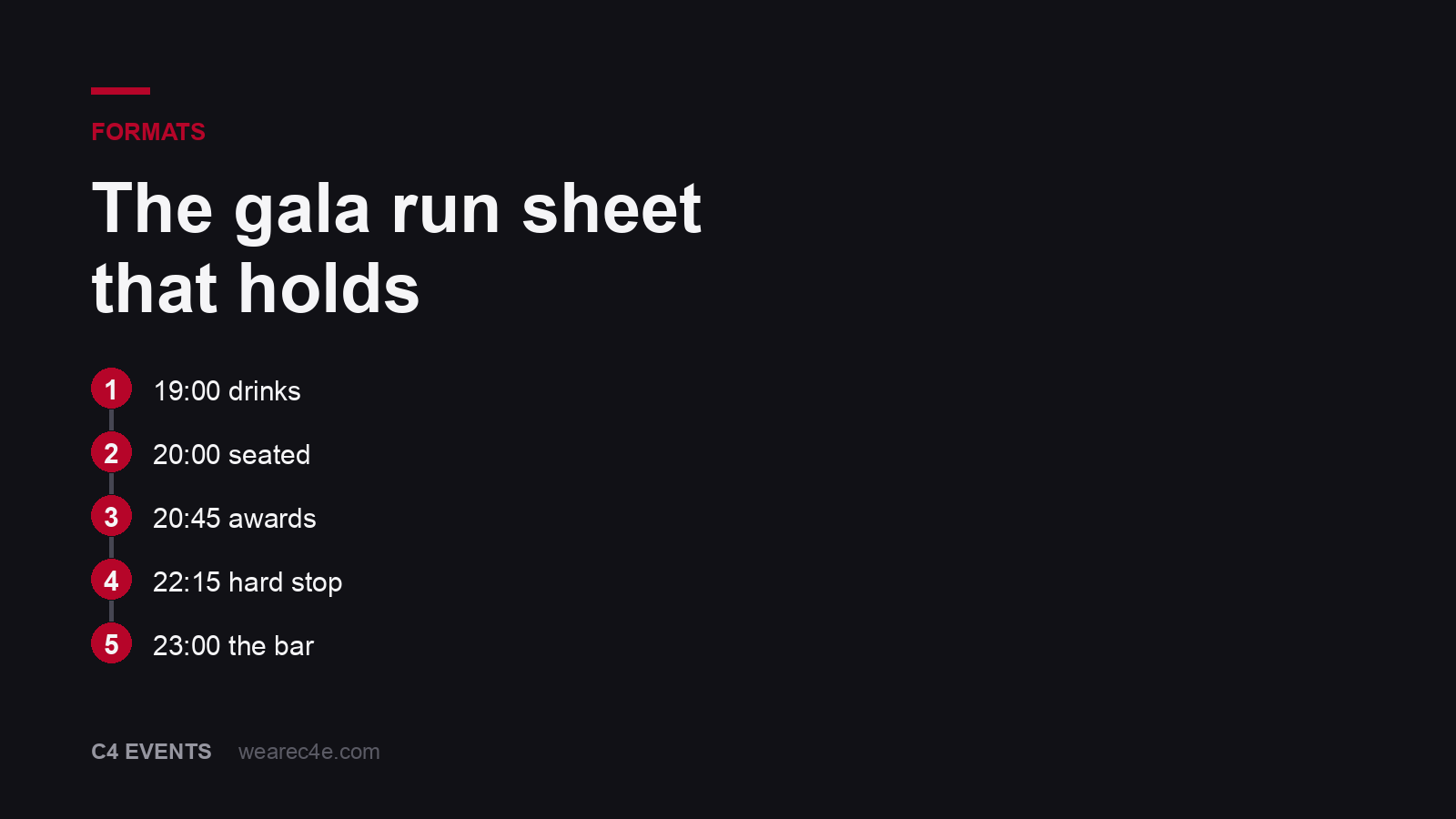
A shape that survives contact with a real room:
- 19:00 drinks reception. Long enough to matter, short enough that nobody arrives at the table already tired.
- 20:00 seated. Call it twice, with intent, and start moving people at 19:50.
- 20:10 first course served.
- 20:45 awards begin. The room is fed, seated, warm, and has not been drinking for three hours.
- 22:15 awards end. Ninety minutes, hard stop.
- 22:20 main course, or dessert if the main ran earlier.
- 23:00 music, bar, the part where people talk.
The two decisions that matter here are starting the awards after the first course and ending them at 90 minutes whatever remains. Both get argued against, and both are right.
Fewer categories than you want
Between 8 and 15 awards for most corporate and channel nights. Past that each one is worth less, and past about 20 the ceremony becomes a list.
The pressure to add categories comes from a good instinct: more people go home with something. What it produces is the opposite. A night where a third of the room wins is a night where winning means nothing, and the people who took a genuine top award feel it.
Three ways to hold the line. 1/ Recognise more people inside fewer categories, with runners-up named from the stage but not called up. 2/ Move minor recognition to the dealer meet or kickoff earlier in the day, where it can breathe. 3/ Give one big award real time, three minutes with a film, rather than fifteen awards 40 seconds each.
The citation is the product
The trophy costs a few thousand rupees. The citation is what the winner remembers and repeats.
A citation that works is 25 to 40 seconds, names one specific thing the person did, and includes a number or a moment rather than a description of character. “Grew the western region 34 percent and opened eleven new dealers in a year everyone else called flat” beats “consistent performance and dedication” by a distance the whole room can hear.
Write them in advance. Have the winner’s name checked for pronunciation by someone who knows. Get the photograph right, because the photograph goes on a wall in an office for years and a bad one wastes the whole exercise.
Seating, and the top-table mistake
Assign tables, not seats, for groups under 300. It gives people agency without letting the room self-segregate into the teams they already sit with every day.
Mix on purpose. Regions, functions, seniority. The value of a gala is the conversation between people who do not otherwise meet, and a seating plan that lets Mumbai sit with Mumbai has thrown that away before the first course.
Then the one most companies get wrong: do not build a top table. Putting the leadership team together at one raised table removes them from the room they came to be in, and it tells everyone else where the real event is. Spread the senior people across tables. One leader per table changes the night for the eight people sitting with them.
The speeches problem
Every gala has one speech that was not on the run sheet. Someone is moved, takes the microphone, and speaks for eleven minutes.
You cannot ban this. You can design around it. Brief every scheduled speaker on their time in writing and in person, and give the MC explicit authority to move things along. We have written about briefing speakers on timing and what to do when one runs over, and a gala is where those two documents earn their keep.
Build 10 minutes of slack into the 90. It will get used. If it does not, you finish early, and no room has ever complained about that.
Service, and the thing nobody plans
Food service and the programme have to be planned together, in one document, with the banqueting manager in the conversation. This is the single most-skipped step in gala planning.
What happens when they are planned apart: a course lands in the middle of a citation, and 200 waiters walk between the stage and the room during the moment you spent the most money on. The winner is on stage. Half the room is watching a trolley.
Three rules. 1/ No service during awards, full stop. Clear before, serve after. 2/ Agree the clearing signal with the banqueting manager and put it in the run sheet. 3/ Brief the venue that the run sheet is the authority, because the default hotel rhythm will otherwise serve on its own schedule.
Production for a room with round tables
A gala room is harder to produce than a conference room and gets less production budget.
Round tables mean half your audience has their back to the stage. That makes screens on both sides of the room a requirement rather than an upgrade, and it makes audio coverage harder because the room is wider than it is deep. Ceiling height in a banqueting room is often lower, which caps your screen size.
What to protect: audio, screens on both sides, a lighting state that can lift for the awards and drop for dinner, and a stage manager who runs the winners on and off. What you can cut: set dressing, because the tables and the room already carry the look. More on the trade-offs in what conference production costs.
Where we lost one
We produced an awards night with 22 categories because the client had 22 and cutting them was a political problem nobody wanted. We built the run sheet to fit, at 45 seconds a citation, and it ran on time.
It was still a failure. By award 16 the applause had gone flat, and the three biggest awards of the night, held to the end for build, landed in a room that had stopped paying attention an hour earlier. The winners deserved better and we gave them a queue.
We now push hard on category count at the design stage and offer the alternative: recognise the same number of people, in fewer categories, with runners-up named from the stage. It is a harder conversation in month two and it saves the night.
The MC decides the night
An MC is the cheapest line in a gala budget and has more effect on the evening than the band.
What a good one does: holds the pace, covers a gap when a winner is in the bathroom, reads a name right the first time, and moves a long speech along without embarrassing anyone. What a poor one does is fill. Filling is what kills a 90-minute ceremony, because every 30-second improvisation between awards adds seven minutes across the night.
Three rules for the MC. 1/ Brief them on every winner and every pronunciation, in writing, the day before. 2/ Give them a visible clock and the authority to use it. 3/ Rehearse the awards sequence with them on the actual stage, so they know where winners enter and exit.
An internal executive as MC is a false economy in most rooms. They know the business and they do not know how to hold a room to time, and asking a colleague to police a senior person’s overrun puts them in a position they cannot win.
The photograph
Every winner gets one. It goes on a wall, into a LinkedIn post, into a newsletter, and it lasts longer than anything else you produce that night.
Get it right with three decisions. A dedicated photographer on the stage side, not the roving one. A clean backdrop rather than the live screen, which will be showing the next name. And a marked position for the handshake so nobody has their back to the lens. Then send the photographs within 48 hours while the night is still current, named by winner so they can find their own.
The morning after
Two things to do while the night is still current, and both get skipped.
Send the winners their photograph and their citation text within 48 hours. They will post it, their team will see it, and the recognition you paid for gets a second life outside the room. A citation emailed as written, so they can quote it, is worth more than a generic congratulations.
And write down what ran long, in the room, that night, before anyone flies home. Every gala teaches you something about your own category count and your own speakers, and none of it survives the week unless somebody records it while it stings.
Three rules
1/ Ninety minutes, and cut categories to fit. Not citations. Categories.
2/ Awards after the first course. Fed, seated, and not three hours into the bar.
3/ Plan the service with the programme. One document, banqueting manager in the room.
Gala dinners and awards nights sit inside most of the programmes we run, from dealer meets to conferences and incentive trips.
Tell us the format and the category list and we will tell you what will fit in the time.
And that, ladies and gents, is the evening. Lemme know what you think.
Read next
Frequently asked questions
How long should an awards ceremony be?
Ninety minutes from first award to last, and no longer. Past that the room stops listening and the winners announced late get a thinner reception than the ones announced early. If you have more categories than 90 minutes allows, cut categories rather than shortening each moment.
How many awards should a corporate awards night have?
Fewer than you think. Between 8 and 15 for most corporate and channel events. Every extra category dilutes the value of all of them, and a night where a third of the room wins something has stopped being recognition and become participation.
What time should a gala dinner start?
Drinks from 7, seated by 8, awards starting no later than 8.45 after the first course. Running the awards before any food leaves a room that is hungry and restless. Running them after the main course leaves a room that has been drinking for two hours. First course is the window.
How do you handle seating at a corporate gala?
Assign tables, not seats, for groups under 300. Mix teams and regions on purpose rather than letting people cluster with the colleagues they see daily. Put senior leadership across different tables rather than at one top table, because a top table removes the leaders from the room they came to be in.
What ruins a gala dinner?
Three things, in order. 1/ Awards that run long, because everything after them suffers. 2/ Speeches that were not briefed, above all the unscheduled thank-you that becomes eleven minutes. 3/ Service timed against the programme rather than with it, so a course lands mid-citation and 200 waiters walk through the moment.