
Planning an event in a country where you have no office is a trust problem wearing a logistics costume.
You cannot inspect the venue. You cannot check whether the supplier is real. You cannot tell whether the permit takes two weeks or two months, and the person telling you has an interest in the answer. Everything you would verify by walking down a corridor, you now verify by email, across a time zone, in a second language.
So the choice of partner is the whole decision. Here is how to make it.
First, know which thing you are buying
Two different businesses answer to the same enquiry.
A destination management company sells local knowledge and ground handling in one market. They know the venues, the transport firms, the permit office and which caterer can do 600 covers without collapsing. They are strong at logistics and hospitality. Hand them a production brief with a live reveal and a broadcast feed, and they will subcontract it.
An event agency owns the programme: strategy, content, production, delivery. Some work across many markets with their own teams. Some work through local partners and manage them for you.
Neither is better. They answer different briefs. What causes trouble is buying one and expecting the other. Ask which you are talking to in the first call, and ask what they subcontract.
The ground-team test
This is the question that separates operators from brokers, and it takes one minute.
Ask: who will be in the room on show day, are they your employees, and can I speak to one of them before I sign?
An agency with a real presence puts you on a call that week. An agency with a contact in that city will offer a case study instead, or introduce you to a director who will “oversee” delivery from another country.
Three follow-ups worth asking in the same conversation:
- How long have you worked in this market? Not how many events. How many years. Permit officials, venue managers and crew chiefs are relationships, and relationships take time.
- What did you run there in the last twelve months? Recent, local, verifiable.
- Who is your production supplier there, and do you contract them or do we? The answer tells you where the risk sits.
The reference call worth making
Every agency will hand you references. All of those events went well. That is what a reference list is.
Ask instead for a client whose event went wrong. Every agency has one. If they say they do not, they are either new or lying, and both are disqualifying.
What you are testing on that call is not whether something broke. Something always breaks. You are testing three things: how fast the client found out, who told them, and what it cost to fix. An agency that reports its own failure at 6am on show day is an agency you can work with. An agency the client discovered was in trouble by walking into the room is not.
Eight questions that reveal an operator
1/ What is the load-in window at this venue, and is the venue trading before it? An operator knows without checking.
2/ What permits does this event need, and how long do they take in season? Alcohol, public gathering, drone, pyrotechnics, imported product, foreign performer. Read what each market requires and see whether their answer matches.
3/ Does the venue hold AV exclusivity? If they have not checked before quoting, the quote is a guess.
4/ What is on in the city that week? A competing convention takes the crew, the trucks and the hotel inventory. The good operators track this.
5/ What is the public holiday risk in the build window? In Thailand, Indonesia and the Gulf this closes offices, ports and permit desks.
6/ Who pays the suppliers, and when? If the agency pays late, your event is exposed to their cash flow, not their skill.
7/ What insurance is in place, and what does it exclude? Public liability, employer liability, and cancellation cover. Ask for the certificate.
8/ What would you change about our brief? The best answer to this question is the best signal in the whole process. A partner who will challenge the brief before signature will challenge a bad idea in month four.
Watch how they price, not what they price
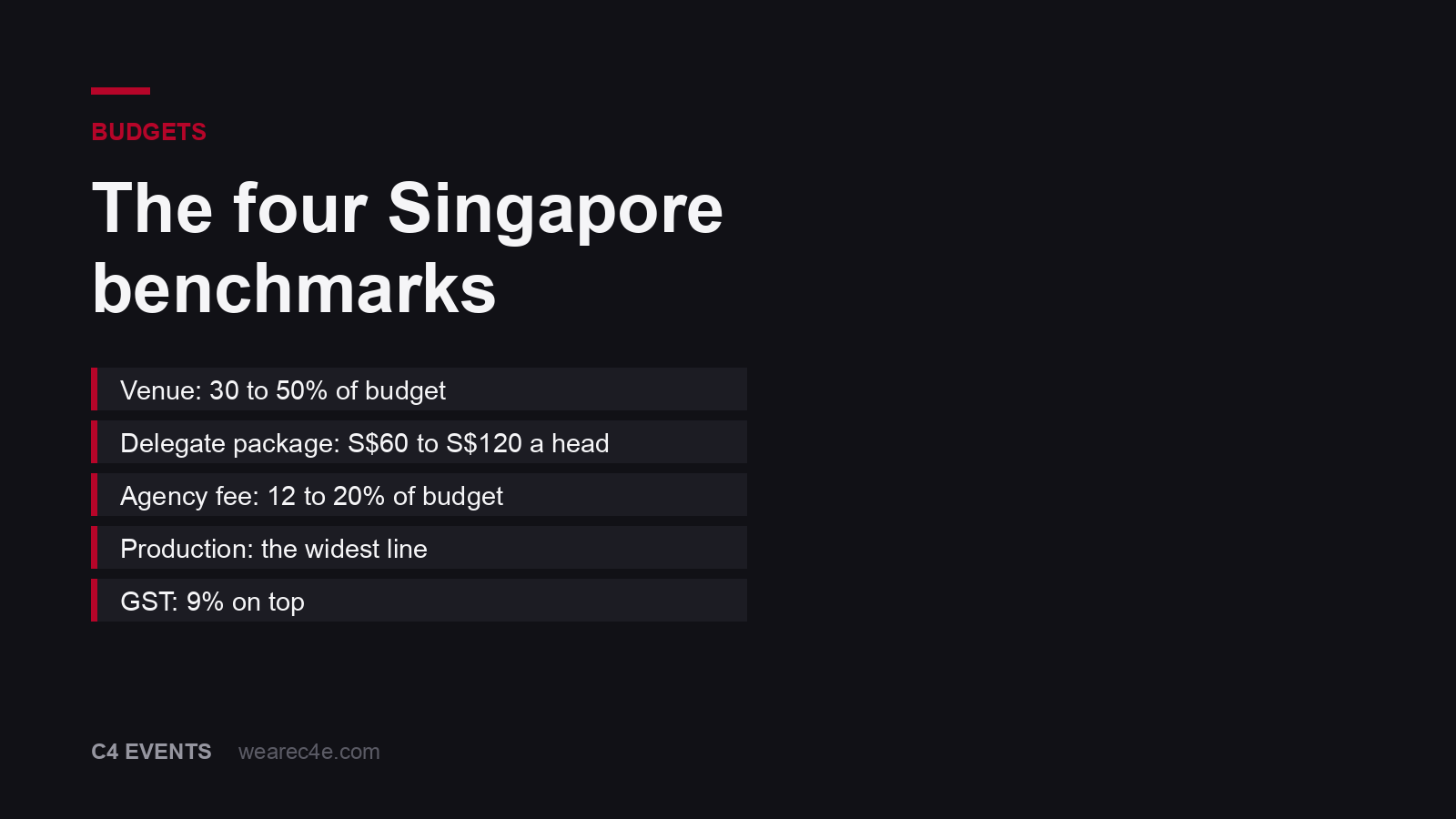
In the proposals we see, management fees run 12 to 20 percent of total budget in this market, or a flat project fee. Both are defensible.
What matters more than the percentage is whether you can see it. Ask for supplier quotes alongside the budget. A partner who hands them over has nothing to hide and knows their value sits in judgement rather than in margin. A partner who refuses is asking you to trust a number you cannot audit.
The second pricing signal: does the proposal name its assumptions? Headcount, exchange rate, rehearsal days, crew size. The RFP questions covers how to force this out. A proposal without assumptions is a proposal that will be re-priced later.
Where this goes wrong
The pattern I see most: a buyer picks on creative and price, then discovers in month three that the ground team is a subcontractor nobody introduced them to, working to a scope nobody wrote down.
The creative was the easiest part to buy and will change anyway. The ground team is the actual product.
Our own version of this. We have taken on programmes in markets where we were newer than the client assumed, and we said so at pitch stage, and we still under-estimated the permit lead time in one of them. It did not cost the client the event. It cost us margin and it cost our team a fortnight of stress that better questions at the start would have removed. We now run a market checklist before we quote a country we have not worked in for two years, and if the checklist comes back thin, we say so rather than absorbing the risk and hoping.
What a good partner does in month three
The pitch tells you little. Month three tells you most of it. Here is what a partner worth keeping does when nobody is watching.
They send bad news first. The venue lost your preferred date. The permit is slower than quoted. A supplier went under. You hear it from them, early, with two options attached. The alternative partner sits on it for a fortnight hoping it resolves, and it never does.
They keep one document current. One budget, one run of show, one contact sheet, versioned, shared, and true. Programmes fall apart when four people are working from three versions of the plan and nobody knows which is live.
They tell you when you are the problem. Late approvals, a moving headcount, a CEO who has changed the agenda twice. A partner who absorbs all of that without saying anything is storing up a conversation for the week before the event, which is the worst possible time to have it.
They do the boring reconciliation. Final invoices matched to quotes, variances explained, supplier disputes closed. This lands six weeks after the event when everyone has moved on, and it is where a lot of agencies stop trying and hope you will not notice.
Ask the reference about month three. Not about the show day. Show days are exciting and everybody rises. Month three is the job.
One test that cuts through all of it: ask what they would do if your event lost its venue eight weeks out. A partner who has lived through that answers with a sequence. A partner who has not answers with reassurance. The sequence is the thing you are buying.
A last word on chemistry, since everyone thinks it and nobody writes it down. You will be on calls with these people at odd hours for months and standing next to them at 2am when a truck has not arrived. Competence comes first. After competence, pick the team you would want in the room on a bad night, because there will be one.
The contract with your partner
Two clauses in your agency agreement are worth more attention than the fee.
Who owns the supplier relationships. If the agency contracts every vendor in their own name, you cannot move the programme without starting over. Ask for the right to novate key contracts to you if the relationship ends. Most partners agree. The ones who refuse are telling you something.
What happens to the deposits. Money you pay the agency that has not yet reached a venue should be identifiable and recoverable. Ask how client funds are held. This is an unglamorous question and it is the one that matters if a supplier fails.
Three rules for the decision
1/ Buy the ground team, not the deck. Meet them. Before signature.
2/ Call the reference whose event went wrong. That call tells you more than the other five combined.
3/ Take the partner who challenges the brief. Agreement is cheap. A partner who tells you your dates sit in peak season and your budget will buy more ten days later is worth the fee on that sentence alone.
We are the team on the ground across Asia, the Gulf and beyond, and we will answer all eight questions in writing before you ask twice.
Tell us what you are planning. What did I miss? Lemme know what you think.
Frequently asked questions
What is a destination event management company?
A specialist who plans and runs your event in a market where you have no team. They source venues, contract suppliers, handle permits, manage logistics and deliver the event on site, while you direct from wherever you are. The alternative is flying your own team into a city they do not know.
What is the difference between a DMC and an event agency?
A destination management company sells local knowledge and ground handling in one market. An event agency owns the whole programme, including strategy, content and production, and may work across many markets. Some firms do both. Ask which one you are buying, because a DMC handed a production brief will subcontract it.
How do I check whether an agency has a team in a market?
Ask for the names and roles of the people who will be on site, whether they are employees or freelancers, and how long the firm has had a presence there. Then ask to speak to one of them before you sign. An agency with a genuine ground team will put you on a call. An agency with a contact will find reasons not to.
What should I ask an agency’s references?
Ask for a reference whose event went wrong, not one whose event went well. Every agency has both. What you want to know is what broke, how fast they told the client, and what it cost. A reference who has only ever had a smooth event tells you nothing about the day something fails.
How much do destination event management companies charge?
In the proposals we see, management fees run 12 to 20 percent of total event budget in Asia and the Gulf, or a flat project fee. Both are fine. What is not fine is a fee hidden inside supplier margins, because it removes your ability to tell what the event costs and what the agency costs.