The average sales kickoff spends 70 percent of its agenda on presentation and then asks why nothing changed in February.
That is the whole problem. A kickoff is not an information transfer. Everything presented could have been an email, and the team knows it. What a kickoff can do, and what nothing else in the year does as well, is put every seller in a room with each other, with the product, with the leadership and with the number, for long enough that the year starts on a different footing.
Here is how to build one that earns the two days.
The split that works
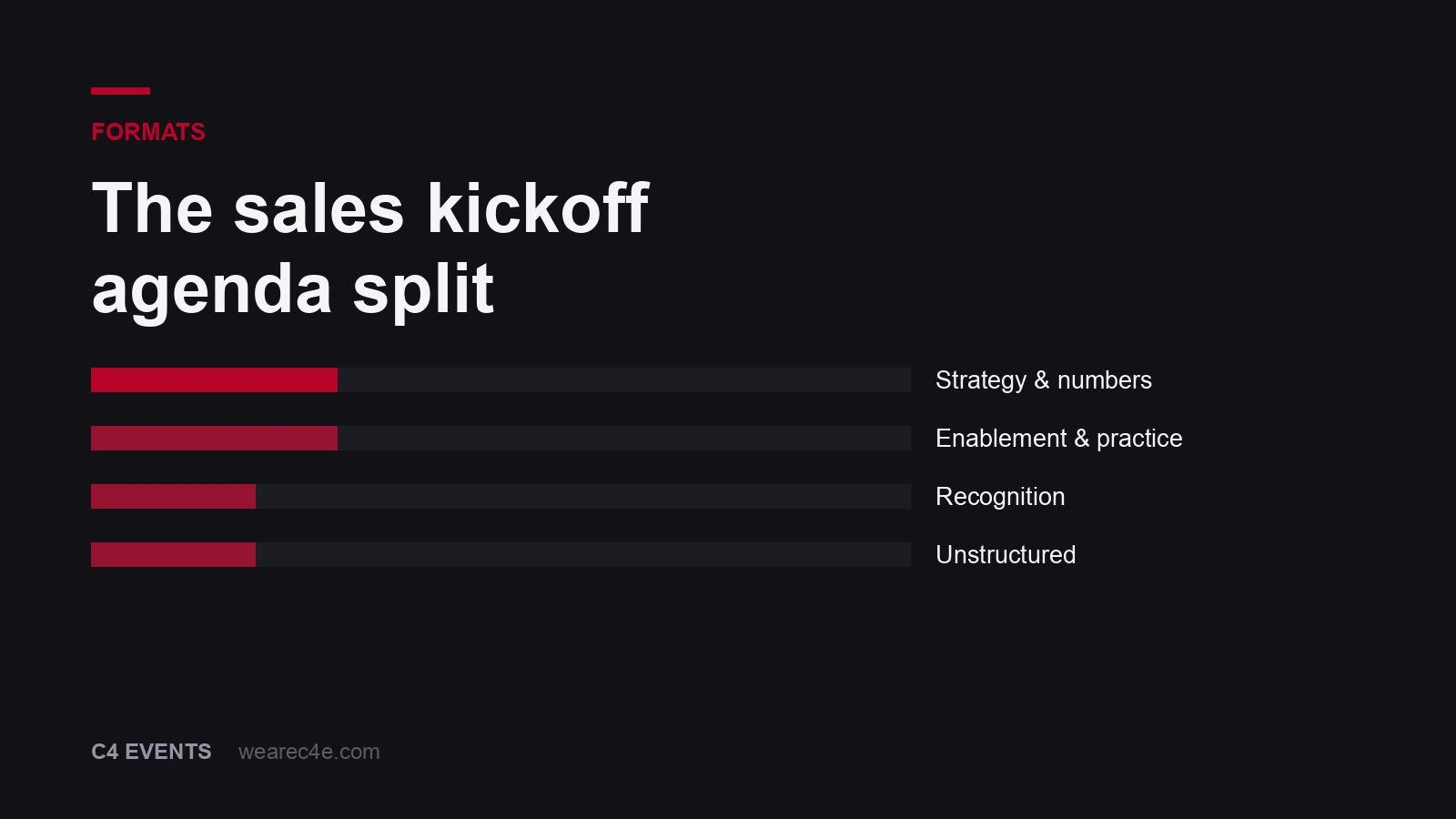
Four blocks, about even, and the second half is where the value is.
30 percent strategy and numbers. Where the business is going, what the target is, what changed in the product and the market. This is the part everyone plans and it is the part that needs the least time.
30 percent enablement and practice. Not a deck about the new messaging. Reps saying the new messaging out loud, to each other, badly at first, with someone correcting them. Role play, objection handling, live demo practice. This is the block that gets cut when the agenda tightens and it is the block that changes behaviour.
20 percent recognition. Top performers named on stage, in front of peers, with specifics about what they did. Ring-fence it. The moment it becomes the thing that gets shortened because a session overran, you have told the room what you value.
20 percent unstructured. Long meals, a real break, an evening with no programme. Reps talk to reps. The rep in Jakarta finds out how the rep in Manila handles the objection that has been killing her deals. You cannot design that conversation. You can only leave room for it.
Most kickoffs run 70/20/5/5 and wonder why the effect wore off by week three.
The numbers session, and how to not lose the room
There is a moment in every kickoff where leadership puts the target on a screen and the room does the mental arithmetic. What happens in the next ten minutes decides whether the rest of the event lands.
Three things that help.
1/ Show the maths, not the number. A target with no visible route is a demand. A target broken into segments, territories and the specific product mix that gets you there is a plan. Reps do not object to hard numbers. They object to numbers that look invented.
2/ Name what is changing to support it. More headcount, better leads, a pricing change, a product release. If nothing is changing and the target is up 30 percent, say that too, and say why. The room can handle honesty. It cannot handle a gap it is expected not to notice.
3/ Take questions live and unfiltered. Roving mics, no pre-submission. The questions the leadership team least wants are the ones circulating in the corridor anyway. Answering them in the room is the difference between a kickoff and a broadcast.
Timing: two windows, one of them wrong
Hold the kickoff in the first three weeks of the fiscal year. Later than that and the team has already set its habits for the year, and you are asking them to change something that has started to settle.
Never hold it in the last week of a quarter. You will have a room full of people working their phones under the table, and the ones closing deals are right to be doing so. That is a self-inflicted wound.
Two days for most teams. Three if people are flying long-haul, because a two-day event that costs a day of travel each way is a poor trade. One day is a town hall wearing a kickoff badge.
What to cut
Every kickoff agenda is over-full by the second draft. Here is the order I would cut in.
- Function updates that are not sales-facing. If it does not change what a rep says or does, it is an email.
- The second and third executive keynote. One senior voice, early, is powerful. Four is a queue.
- Partner and vendor slots that were sold rather than earned. The room can tell.
- The long product roadmap. Reps need what they can sell this quarter. The rest is a webinar.
What I would not cut: practice, recognition, unstructured time, and the Q&A. Those four are the event.
The production side
A kickoff needs less production than a customer conference and more than people expect. What matters:
Audio that works in a room configured for interaction. Roving mics for the Q&A, and someone whose job is getting one into the right hand fast. A question that takes 40 seconds to reach a microphone dies before it is asked.
A room you can reconfigure. Theatre for the keynote, rounds for practice, standing for the evening. If the venue cannot turn the room over inside a break, your agenda is fighting the building. Budget the turnarounds. See what production costs and where turnaround money goes.
Timing discipline. A kickoff that runs 40 minutes late by lunch eats the practice block, because practice is always after lunch and always the first thing sacrificed. This is why we wrote about briefing speakers on timing and what to do when one runs over. On a kickoff those two documents protect the part of the agenda that matters most.
The pre-work
The kickoffs that change behaviour do work before anyone travels, and it takes three things.
Send the numbers early. Territory assignments, quotas and comp plans should land a week before, not on a slide. Reps who see their number for the first time in the room spend the rest of the day processing it instead of listening.
Ask what is in the way. A short survey to every rep: what stopped you closing last year, what do you need, what will you not do again. Read the answers, then build sessions that address the top three. A kickoff agenda built from that survey lands where one built in a leadership offsite does not.
Give the practice block a script. Reps arrive knowing which scenario they will role-play and against which objection. Practice with no preparation becomes a discussion, and a discussion becomes a coffee break.
How to measure it
Most kickoffs are measured by a survey handed out while people wait for transfers. That measures the food.
Instead: pick three behaviours before the event, define how each shows up in the CRM, and read them at 30, 60 and 90 days. Pipeline created by attendees. Adoption of whatever you launched. Use of the new messaging in call notes and emails.
If those three do not move, the kickoff was a party with slides, and next year’s budget conversation will be harder for it. The wider method is in how to measure event ROI.
One more thing on the room itself. Seat the kickoff in rounds rather than theatre wherever the content allows. Theatre seating tells a sales team they are an audience. Rounds tell them they are a group, and the conversation between sessions starts on its own instead of needing a facilitator.
Where these go wrong
The failure I see most is a kickoff designed by the people presenting rather than for the people attending. Every function wants a slot. The agenda fills from the inside out. By the time anyone asks what a rep should be able to do on Monday that they could not do on Friday, there are 20 minutes left and they get filled with a video.
The fix is a single line written before the agenda: on the Monday after this, every rep should be able to do X. Then build backwards, and refuse anything that does not serve it.
Our own honest note. We have built kickoffs where the production was strong, the room looked right, and the practice block got compressed to 25 minutes because the morning ran over. The client got a good-looking event and less behaviour change than they paid for. We now protect the practice and recognition blocks in the run of show the same way we protect a live broadcast window, which means something else gives instead.
And read the numbers against a control group where you can. Attendee performance compared to the reps who could not travel tells you more than attendee performance compared to last year, because last year had a different market in it.
And put the leadership team on the floor for the practice block rather than in a side room. A VP who watches reps struggle with the new messaging learns more about whether it works than any dashboard will tell them.
Three rules
1/ Write the Monday sentence first. What every rep can do on Monday that they could not do on Friday. Build backwards from it.
2/ Protect practice and recognition. Everything else can flex.
3/ Measure behaviour at 30, 60, 90. Not satisfaction on the day.
See how we run corporate events across Asia and the Gulf, or offsites and retreats if the format is smaller and more senior.
Tell us the team size and the Monday sentence and we will build the agenda around it.
And that, ladies and gents, is the kickoff. Do you agree?
Frequently asked questions
How long should a sales kickoff be?
Two full days for most teams, three if the group is flying long-haul. One day is a town hall with a different name. Four is a conference the sales team resents, because every day they are in a room is a day they are not selling and they will do that arithmetic out loud.
What should a sales kickoff agenda include?
A rough split that works: 30 percent strategy and numbers, 30 percent enablement and skills practice, 20 percent recognition, 20 percent unstructured time. Most kickoffs run 70 percent presentation and wonder why nothing changed. The practice and the unstructured time are what move behaviour.
When should a sales kickoff be held?
Within the first three weeks of the fiscal year, and never in the last week of a quarter. Hold it too late and the team has already set its own habits for the year. Hold it during a close and you will have a room full of people on their phones, which is worse than not holding it.
How do you measure whether a sales kickoff worked?
Pick three behaviours you want changed, define how each is visible in the CRM, and read them at 30, 60 and 90 days. Pipeline created, adoption of whatever you launched, and use of the new messaging in call notes. A satisfaction survey collected in the room measures the catering.
Should a sales kickoff be in-person or virtual?
In-person, if you are going to run one at all. The value of a kickoff sits in the corridor conversations, the peer pressure of a leaderboard read aloud, and reps meeting the product and marketing people they email. None of that survives a video call. If the budget only allows virtual, run a shorter, sharper enablement series instead and save the money.