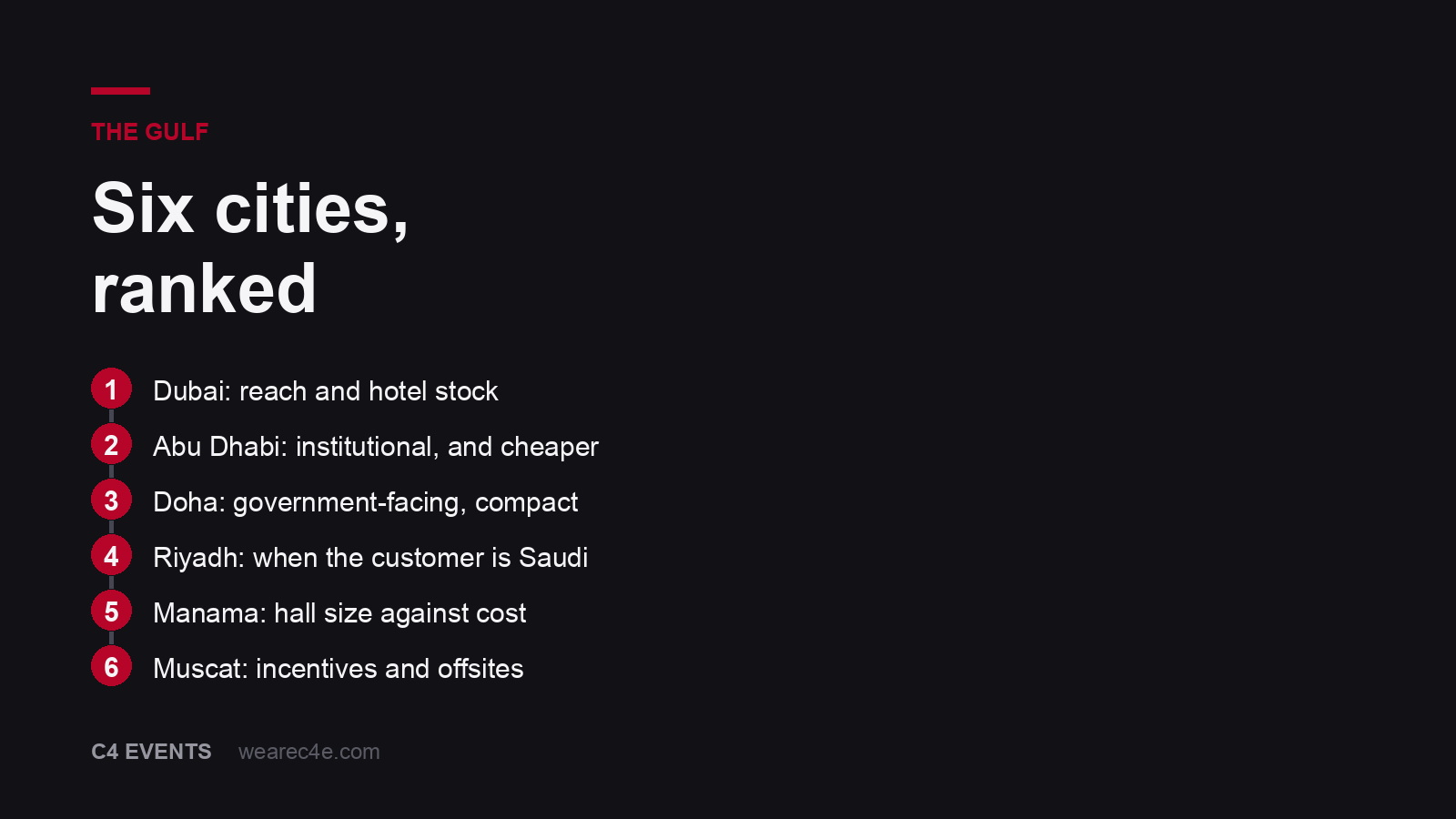
Six cities, one region, and a decision most teams make on a logo rather than on a delegate list. Here is the ranked version, with the numbers each city publishes about itself.
The ranking is for a corporate event: a conference, a partner summit, a dealer meet or a launch, somewhere between 200 and 2,000 people. It is not a ranking of cities, and it is not a ranking for exhibitions, where hall size leads and the order changes.
The ranking
| # | City | Take it for | Anchor venue |
|---|---|---|---|
| 1 | Dubai | Reach, hotel stock, vendor depth, launches | DWTC, 145,000 sqm |
| 2 | Abu Dhabi | Institutional, energy, culture, lower cost | ADNEC, 153,678 sqm |
| 3 | Doha | Government-facing, sport, tight logistics | DECC, 29,035 covered sqm |
| 4 | Riyadh | Saudi market entry, regulated sectors | Building fast |
| 5 | Manama | Regional meetings, hall size against cost | Exhibition World Bahrain, 95,000 sqm |
| 6 | Muscat | Incentives, offsites, a calmer room | Oman Convention Centre |
1. Dubai
Dubai wins the general case and it is not close. The reach is the reason: an airport inside eight hours of Europe, Africa, South Asia and Southeast Asia, and a corporate audience that will fly in for a single day and out again.
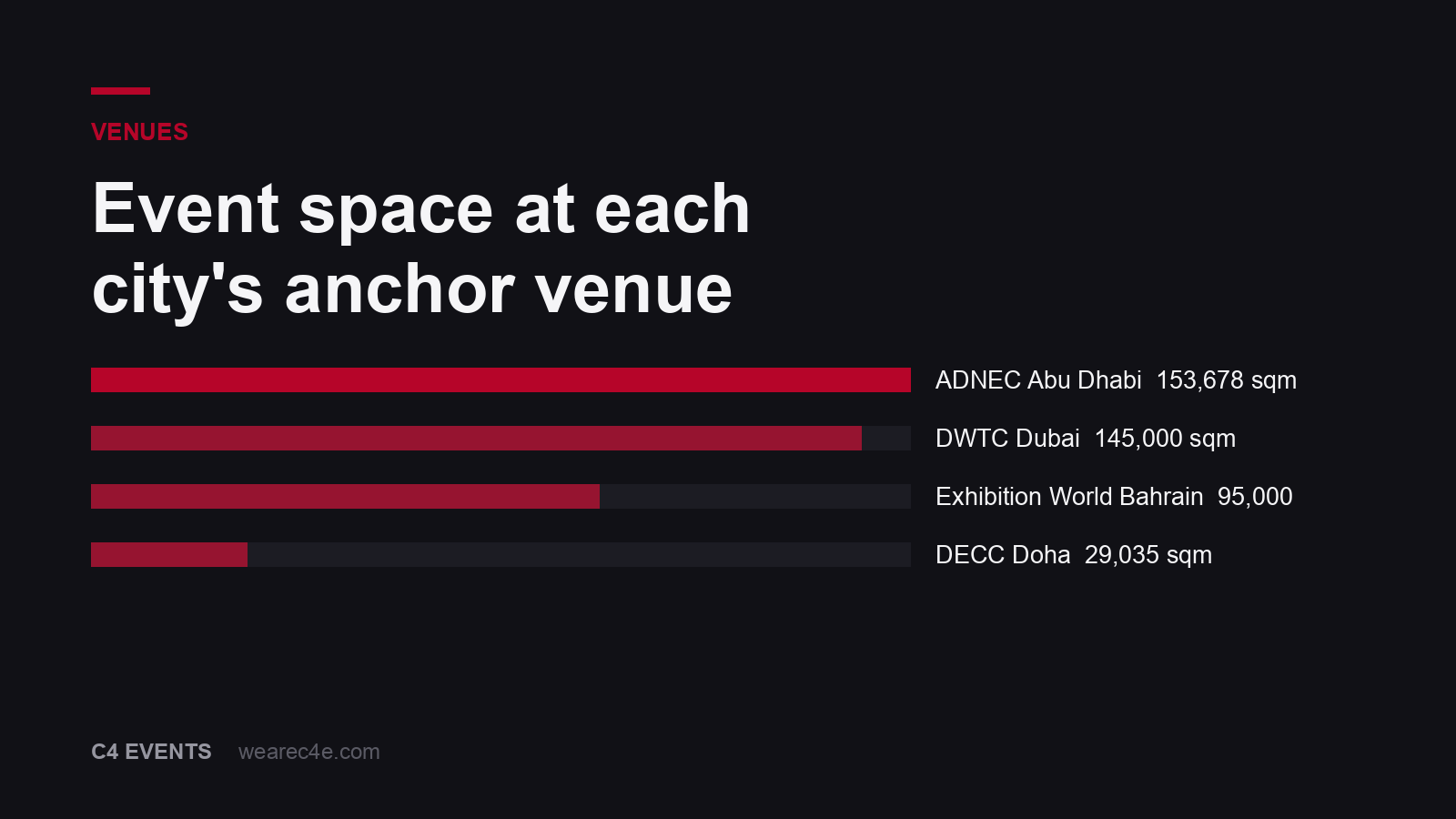
Dubai World Trade Centre carries 145,000 square metres of event space, with the Za’abeel Halls adding 15,500 more, and it ran 71 events in the first half of 2026. Around it sits the deepest five-star ballroom stock in the region, plus desert camps and rooftops for the gala night.
The calendar matters more than the headcount: October to March is peak and works outdoors, and May to September is indoor only at the lowest rates of the year. Our Dubai events guide and the Dubai cost breakdown have the detail.
Where it breaks. Crew supply in February. Every good showcaller, LED vendor and stream producer in the city is booked, and the ones still free are free for a reason.
2. Abu Dhabi
Abu Dhabi is the institutional answer, and on stated figures it has the largest venue in the region. ADNEC Centre Abu Dhabi carries 153,678 square metres of event space across 12 interconnected column-free halls, with ICC Abu Dhabi seating up to 6,000 delegates, four conference halls, 21 meeting rooms, a 10,000 square metre Marina Hall and around 1,800 hotel rooms in the surrounding Capital Centre.
That last number is the one to notice. Delegates who sleep, meet and eat inside one campus lose no time to transfers, and a two-day agenda gets an hour back each morning.
The city suits energy, defence, government-facing and cultural programmes, and it costs less than Dubai across most categories. Our Abu Dhabi against Dubai comparison takes that decision apart.
Where it breaks. Delegate draw. Fewer people will fly in for one day, and an evening in Abu Dhabi is a quieter proposition than an evening in Dubai. For a reward-shaped event, that cuts both ways.
3. Doha
Doha does tight, well-run, government-adjacent events better than its size suggests. The Doha Exhibition and Convention Centre states 29,035 covered square metres and four meeting suites holding 18 rooms, and the city’s hotel stock was built for a World Cup it no longer has to fill.
Take Doha when the business reason is Qatari, when the guest list is institutional, or when a compact city with short transfers is worth more than choice. Sport, energy and public-sector programmes land well here.
Where it breaks. The vendor bench is shallower than Dubai’s, and inbound flight options for a wide regional audience are thinner. Price the freight and the crew flights with care.
4. Riyadh
Riyadh belongs on this list for one reason: the business case. Companies with a Saudi market to serve are running events there because that is where the customer is, and the market rewards showing up with intent rather than showing up for convenience.
Venue and hotel stock is being added at pace. We are not quoting figures for the Riyadh convention centre here, because we could not fetch them from the venue itself, and a number from a directory is not a number.
Where it breaks. Approvals, alcohol-free programme design, and a supplier market where the good operators are booked. Plan the social half of the agenda around what the city offers rather than porting a Dubai run sheet.
5. Manama
Bahrain is the value play, and it has more hall than most people expect. Exhibition World Bahrain states 95,000 square metres across 10 halls, with a Grand Hall taking up to 4,000 guests and 19 meeting rooms from 10 to 182 people.
Manama takes the regional meeting that wants Gulf presence without Dubai pricing, and it is a 45-minute drive from Saudi Arabia’s Eastern Province, which matters for a Saudi-facing audience.
Where it breaks. Delegate draw again, and a smaller local crew pool. Most production of any scale flies in, so build that into both the budget and the schedule.
6. Muscat
Muscat is the incentive and offsite answer rather than the conference answer. Mountains, coast, a slower city and a room that feels unlike the rest of the region. For a leadership offsite or a reward trip that has to be somewhere new, it earns its place.
For a 1,200-person partner summit, it does not. The venue and hotel inventory is real and finite, and the shortlist gets short fast.
Where it breaks. Scale and flight access. Check both against the delegate list before falling for the photographs.
What it costs across the region
The spread inside a single headcount is wide enough that a per-head rule of thumb will mislead you.
The three drivers are venue tier, production ambition and whether anything happens outdoors. The fourth, which nobody prices at the start, is crew flights. In Doha, Manama, Muscat and Riyadh a chunk of the senior production crew flies in, and their flights, rooms and per diems belong in the budget from version one rather than as a variation in month four. Our corporate event budget guide has the full split.
What the ranking does not tell you
Hall inventory decides an exhibition. It decides almost nothing about a conference for 400 people, because every city on this list has more ballrooms in that band than you will shortlist.
What decides a conference is: can the audience get there, will they come, is there a crew who has done this before, and what happens on the day something breaks. Three of those four favour Dubai. The fourth favours whichever city your partner has a real team in.
1/ Sort the delegate list by nationality and check the slowest visa in each city. 2/ Put the dates against Ramadan and against the summer window. 3/ Ask whether the format needs outdoors. 4/ Then look at venues.
The pairing that works
Dubai with Abu Dhabi is 90 minutes by road, and running one event across both is the only multi-city Gulf format we would recommend without an argument.
It works when the two halves have different jobs: the conference and the exhibition in Dubai where the delegates already are, the institutional dinner or the site visit in Abu Dhabi where the counterpart sits. It fails when it is done for variety, because a coach transfer costs two hours of agenda and buys a change of carpet.
Treat it as one event with two venues rather than as two events. One run sheet, one production partner, one crew that moves with you, and a transfer written into the schedule with a buffer that survives traffic on Sheikh Zayed Road.
Season, everywhere
The whole region shares one calendar. October to March is peak and works outdoors. May to September is indoor only, and the rates in that window are the lowest of the year across every city here. April and, in some markets, late September are the shoulder weeks where the value sits.
Ramadan moves about eleven days earlier each Gregorian year and changes what is appropriate, what is open and who attends. Check it before holding a venue rather than after.
In the end
Dubai is the right answer often enough that the useful question is not which Gulf city, but whether your event has a reason to be somewhere else. Abu Dhabi has that reason when the guest list is institutional. Riyadh has it when the customer is Saudi. Muscat has it when the point is that nobody has been.
Pick on the delegate list and the calendar, then let the venue tour confirm what you already decided.
What did I miss? If you run events across the Gulf and this order looks wrong from where you sit, tell us why.
Sources and disclaimers
Venue figures are quoted from each venue’s own site as published in August 2026: DWTC, ADNEC Centre Abu Dhabi, Doha Exhibition and Convention Centre via Qatar Tourism, and Exhibition World Bahrain. Riyadh and Muscat carry no figures here because their venue sites could not be reached. Cost bands reflect observed market ranges rather than price lists, and move with headcount, season and production scale.
Frequently asked questions
Which Gulf city is best for a corporate event?
Dubai, for most briefs, on delegate reach, hotel stock and vendor depth. Abu Dhabi takes the institutional and energy-sector brief and costs less. Doha, Riyadh, Manama and Muscat each win specific events rather than the general case.
Is Abu Dhabi cheaper than Dubai?
In most categories, yes, and the gap is smaller than it was. What Abu Dhabi gives up is the delegate draw and the number of daily flights. What it gives back is a calmer city, cultural venues and a government that engages with the institutional event.
What is the biggest venue in the Gulf?
On stated figures, ADNEC Centre Abu Dhabi at 153,678 square metres of event space across 12 column-free halls, ahead of Dubai World Trade Centre at 145,000. Exhibition World Bahrain states 95,000 square metres across 10 halls.
When should I avoid the Gulf?
May to September for anything outdoors, everywhere in the region. Indoor conferences run all summer at the lowest rates of the year. Check Ramadan against your dates too, because it moves about eleven days earlier each Gregorian year.
Which city is easiest for visas?
The answer depends on your delegate list, not on the city. Sort the list by nationality and check the slowest passport against each city before you shortlist venues. This decides more Gulf events than budget does.
Is Riyadh worth considering yet?
Yes, if the business reason for being in Saudi Arabia is real. Venue and hotel stock is being built at pace, and the market rewards events with a purpose there. It is not the city to pick for convenience.
How far ahead should I book a Gulf venue?
Nine to twelve months for the October to March window in Dubai and Abu Dhabi. Six to nine for the summer window, and for the smaller markets. Crew books out before venues do in show season.
Can I run one event across two Gulf cities?
Yes, and Dubai with Abu Dhabi is the pairing that works, at 90 minutes by road. Treat it as one event with two venues rather than two events, and put the coach transfer in the run sheet with a real buffer.