Singapore is the most expensive place in Southeast Asia to run a corporate event, and it is also the only one where the government will help you pay for it.
Almost nobody outside the local industry knows this. In ten years of pitching against agencies for Singapore work, the number of client briefs that arrive mentioning the grant is close to none. It is published, it is administered by a named bureau, and it sits behind a page most planners never open.
What follows is what the Singapore Tourism Board publishes, scheme by scheme, and the one rule that disqualifies more applicants than every eligibility criterion put together.
Who runs it
The Singapore Exhibition & Convention Bureau is the lead government agency for business events here, and it sits inside the Singapore Tourism Board. Every scheme on this page runs through it, and one email address, secb@stb.gov.sg, is the door to all of them.
That matters because it means you are not shopping across agencies. One conversation covers the grant, the hotel programme and the operations programme, and the officer you speak to can tell you which of the three your event has a case for.
The rule to read first
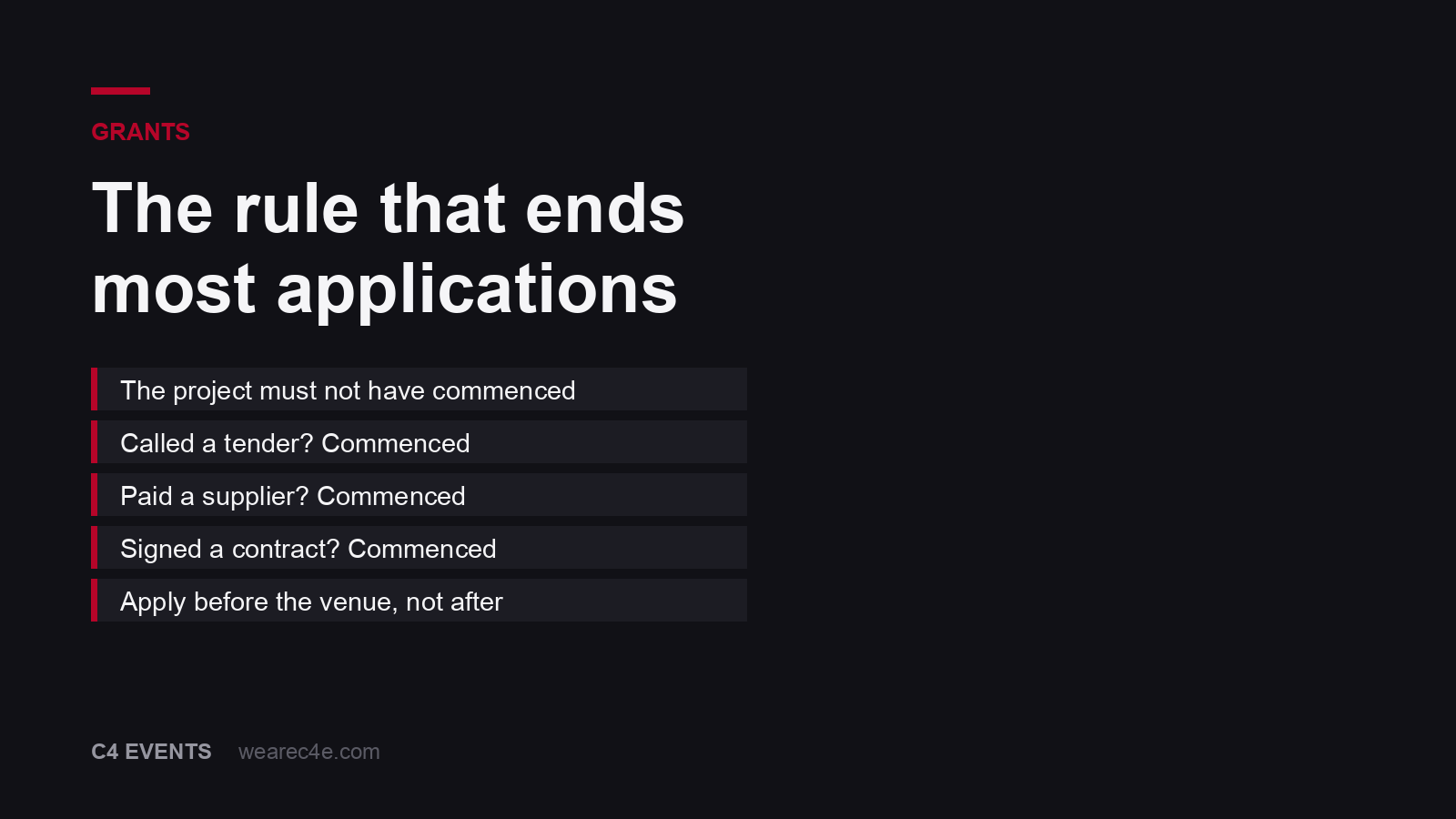
Before eligibility, before criteria, before anything: your project must not have commenced at the point of application.
STB defines commenced, and the definition is wide. A project has commenced if the applicant has started work, and calling a tender counts as started work. It has commenced if the applicant has made any payment to a supplier, vendor or third party. It has commenced if the applicant has signed a contractual agreement with a supplier, vendor or third party.
Read that against how a normal event gets planned. You hold a date. You sign a venue. You pay a deposit. Then somebody suggests looking at grants.
By then it is finished. Not because the event is unworthy, but because the sequence was wrong. The grant conversation belongs before the venue conversation, and that single fact is worth more than the rest of this page.
BEiS, the main scheme
Business Events in Singapore aims to attract and grow high-quality events in Singapore over the long term and to catalyse new content. It also supports activities that build the foundation for quality business events.
Who it is open to: the MICE industry only, including businesses and associations.
What projects qualify, in STB’s own list:
| Category | Examples STB names |
|---|---|
| Hosting a business event in Singapore | Association conventions, corporate activities, exhibitions, incentive travel, meetings, trade conferences |
| Pre-event activities | Business and capability development, market feasibility studies, bidding activities |
Note the second row. Bidding is fundable. If you are an association or a company trying to win a rotating conference for Singapore, the work of building that bid can be inside the scheme rather than a cost you carry alone.
How a project gets assessed
STB assesses the project scope against five published criteria.
1/ Event programme. 2/ Event content. 3/ Event size. 4/ Attendees’ profiles, and the criterion names foreign visitorship. 5/ Sustainability initiatives for the event.
Three of those five are about who comes and what they experience rather than how much you spend. The fourth is the one to build your case around: Singapore is buying foreign visitors, and an event that brings delegates into the country is arguing for itself. The fifth is now standard and worth a real answer rather than a paragraph about recycled lanyards.
What money is covered
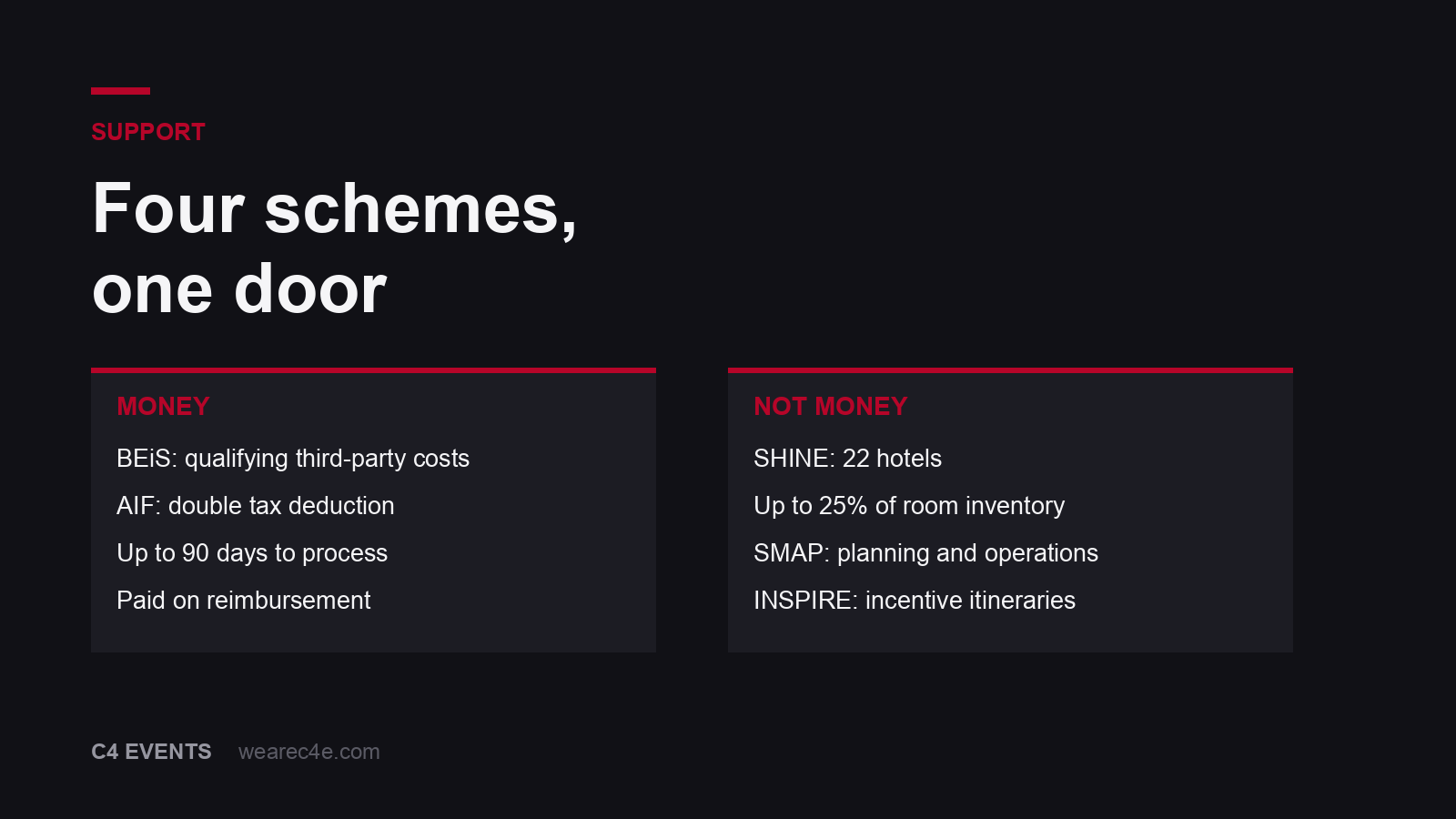
Funding support covers qualifying third-party project-related costs in four areas: professional services, content development, marketing and bidding activities.
The word doing the work is third-party. This is not a subsidy on your own staff time. It is support for what you buy from outside.
Qualifying costs have to be incurred, meaning goods and services received, invoiced to the grantee, and paid for by the grantee, all within the qualifying period. Miss any of the three and the cost falls out of the claim.
The application, and the clock
| Step | What happens |
|---|---|
| 1 | Check eligibility. STB provides a chatbot to identify the right fund |
| 2 | Prepare an executive summary: objectives, description, schedule and costing. STB publishes a template |
| 3 | A Singapore Exhibition & Convention Bureau officer gets in touch to advise on eligibility |
| 4 | Formal application, then up to 90 days for processing |
Ninety days is the published figure, from receipt of the completed and signed form and supporting documents, and STB notes timelines vary with complexity. Executive summaries go to the bureau at secb@stb.gov.sg.
Put the ninety days on your Gantt chart in front of the venue search rather than beside it, because of the commencement rule. An event twelve months out has room for this. An event four months out does not.
How it gets paid
On reimbursement, and with an audit attached.
Grants are disbursed subject to verification of qualifying costs and achievement of agreed deliverables and milestones. The grantee has to submit an Agreed-Upon Procedures report by a practitioner covering the qualifying costs, plus supporting documents proving the deliverables happened.
Two consequences for a budget. First, this is cash flow you fund and recover, not cash flow you receive. Second, the record-keeping is a real task with a real cost, and it belongs in the project plan as somebody’s job rather than as an afterthought in month nine.
The tax deduction nobody mentions
Separate from BEiS, Singapore offers a Double Tax Deduction for Approved International Fair. To qualify, the event has to be AIF-approved, and STB publishes the approved list.
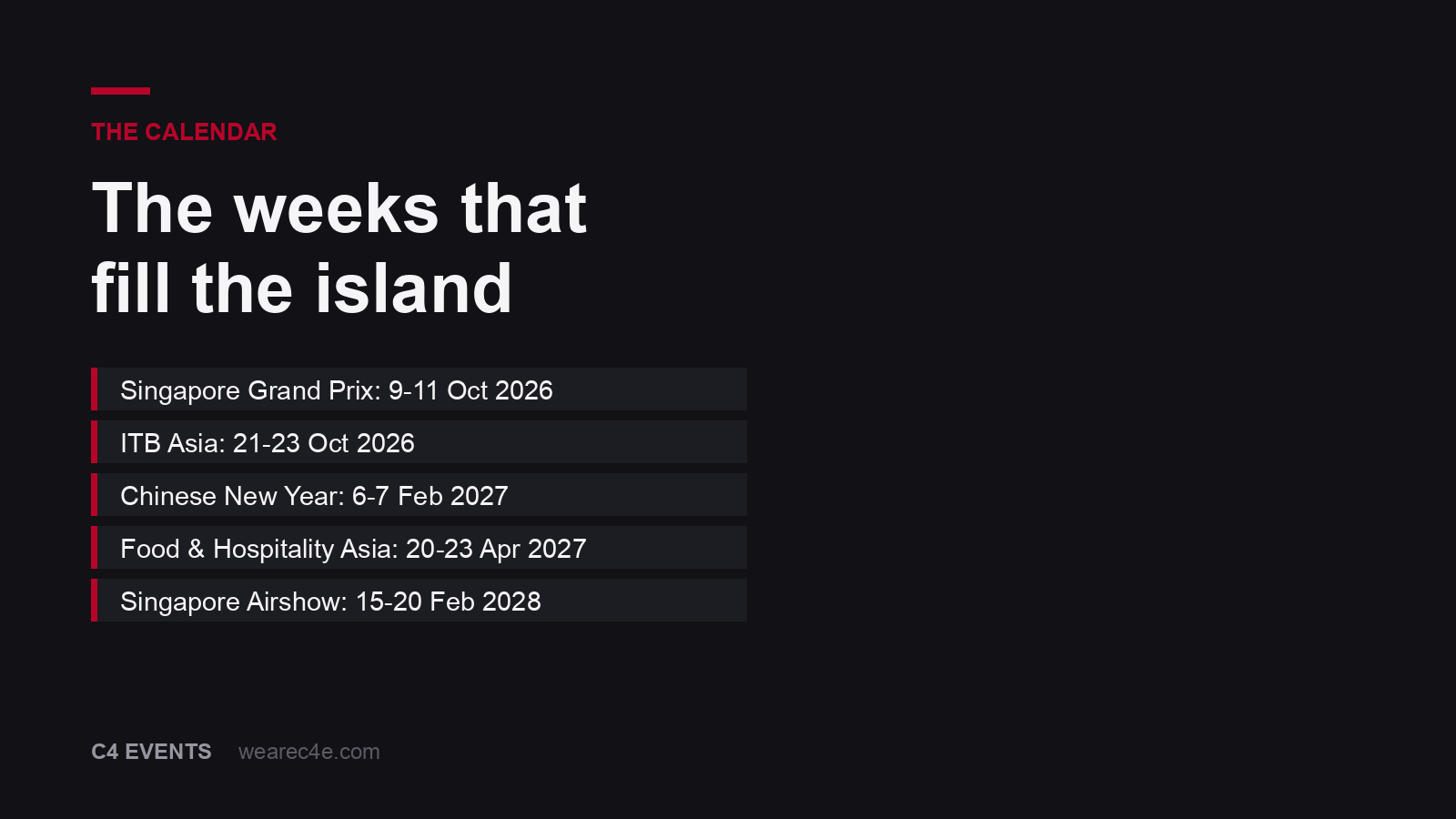
The named shows across the coming years include ITB Asia, Tech Week Singapore, Food & Hospitality Asia, Medical Fair Asia, IDEM Singapore, Singapore Airshow, Asia Pacific Maritime, Sea Asia, IMDEX Asia, GovWare, MRO Asia Pacific, Seafood Expo Asia and Singapore International Water Week. STB notes the list is not exhaustive.
If your Singapore activity is exhibiting rather than hosting, this is the scheme that applies to you, and the question to ask your finance team is whether the show you are booking carries AIF approval for the year you are attending. Our page on exhibition stand management in Asia covers the rest of that spend.
The three programmes that are not grants
Alongside the money sit three schemes that reduce cost or effort without writing a cheque.
SHINE, the Singapore Hotel Incentives for Business Events, is a hotel partnership programme. The bureau has partnered 22 business-events-focused hotels representing up to 25 percent of Singapore’s hotel room inventory, spanning global and local brands across price points. It carries negotiated room rates and benefits, complimentary experiences for delegates, conference room rates for extended stays of up to five days before and after a conference, and discounts on dining and spa.
That extended-stay rate is the sleeper. If your delegates are flying from Europe or North America and you want them to arrive a day early and stay a day late, the rate on those shoulder nights is the thing that decides whether they do.
SMAP, the Singapore MICE Advantage Programme, streamlines planning and operations across tourism partners and gives delegates benefits at supported events. STB positions it as a complement to BEiS.
INSPIRE, In Singapore Incentives & Rewards, is a rewards programme of curated itineraries built around dining, entertainment and attractions, developed for incentive travellers from specific markets. STB is explicit that these packages are not available for commercial sale, which means they arrive through the bureau rather than through a supplier. If you are running an incentive programme, that is a reason to talk to the bureau early. The format itself is covered in incentive trip or corporate offsite.
Who this is worth the effort for
Not every Singapore event has a case, and pretending otherwise wastes the bureau’s time and yours.
| Event | Worth applying? | Why |
|---|---|---|
| Regional conference, foreign delegates, 12 months out | Yes | Foreign visitorship is an assessment criterion |
| Association congress bid | Yes | Bidding activity is named as fundable |
| Incentive programme bringing delegates in | Yes | Incentive travel is on the eligible list |
| Internal town hall for the Singapore office | No | No foreign visitorship to argue |
| Any event where the venue is signed | No | The project has commenced |
Read the last row again, because it is the one that catches people who did everything else right.
What to do with all this
If your Singapore event is more than six months out and brings delegates from outside Singapore, the order of operations is this.
Talk to the bureau before you talk to a venue. Get the eligibility read before anything is signed, tendered or paid. Build the executive summary while the concept is still moving, because that is when it is cheapest to shape the event around the assessment criteria rather than against them.
Then, and only then, start the venue search. The cost the grant is offsetting is set out in what a corporate event costs in Singapore, the licensing question in the Singapore event licence guide, and the dates to plan around in the Singapore event calendar.
We run events in Singapore and we have built these applications. If you want a read on whether your event has a case before you sign anything, send us the brief, or start with how we work in Singapore.
What did I miss?
Frequently asked questions
What is the BEiS grant?
Business Events in Singapore is the Singapore Tourism Board scheme that supports the hosting of quality business events in Singapore and the activities that build the foundation for them. It is open to the MICE industry, including businesses and associations, and is administered by the Singapore Exhibition & Convention Bureau.
Who is eligible for BEiS?
The scheme is open only to the MICE industry, including businesses and associations. Eligible projects cover hosting business events in Singapore, which STB lists as association conventions, corporate activities, exhibitions, incentive travel, meetings and trade conferences, plus pre-event activities such as business and capability development, market feasibility studies and bidding.
What disqualifies a BEiS application?
Starting. STB states that projects must not have commenced at the point of grant application, and that a project is considered to have commenced if the applicant has started work such as calling a tender, has made any payment to a supplier, vendor or third party, or has signed a contractual agreement with one. Sign the venue and the application is over.
What costs does BEiS support?
Qualifying third-party project-related costs across professional services, content development, marketing and bidding activities. STB requires those costs to be incurred, invoiced to and paid for by the grantee within the qualifying period to qualify for disbursement.
How long does a BEiS application take?
Up to 90 days from receipt of the completed and signed application form and supporting documents, per STB, with timelines varying by the complexity of the project. Add that to your planning calendar in front of everything else, because you cannot contract anything while it runs.
How is the BEiS grant paid?
On a reimbursement basis, subject to verification of qualifying costs and achievement of the agreed deliverables and milestones. The grantee has to submit an Agreed-Upon Procedures report by a practitioner on the qualifying costs, along with supporting documents proving the deliverables were achieved.
What is the Approved International Fair tax deduction?
Singapore offers a Double Tax Deduction for Approved International Fair. To qualify, an event has to be AIF-approved, and STB publishes the approved list by year. It covers shows including ITB Asia, Tech Week Singapore, Food & Hospitality Asia, Singapore Airshow, Asia Pacific Maritime and MRO Asia Pacific across the coming years.
What are SHINE, SMAP and INSPIRE?
Three MICE support programmes run through the Singapore Exhibition & Convention Bureau. SHINE is a hotel partnership covering 22 business-events hotels representing up to 25 percent of Singapore’s room inventory, with negotiated rates and conference room rates for stays up to five days either side of a conference. SMAP streamlines planning and operations with partner benefits for delegates. INSPIRE is an incentive rewards programme of curated itineraries whose packages are not available for commercial sale.