Convention and exhibition centres hold 44.85 percent of venue share across the Asia Pacific MICE market. Exhibitions are where a large part of the region’s business events money goes, and they are also where the most budget gets wasted, because the stand is treated as a build rather than as a sales operation with a build attached.
Here is the practical version: what to ship, what to build, what it costs on top of the fabricator’s quote, and how to tell whether it worked.
Build in-market, ship the brand
The default answer for anything larger than flight cases is to build in-market to your drawings.
Shipping a stand into Bangkok, Dubai, Singapore or Ho Chi Minh City means freight, duties, a clearing agent, a customs broker, and a documentation trail that has to be right before the container leaves. Then it has to clear in time for a build window measured in hours. On a mid-size stand, that cost lands close to or above what a good local fabricator charges to build the whole thing.
What is worth shipping: the elements where brand precision matters and local reproduction is a risk. Printed graphics on a specific stock, a product display case, a bespoke fitting, anything with your exact colour. Those travel in cases and clear as samples or exhibition material.
What to build in-market: structure, walls, flooring, counters, storage, lighting rig. A fabricator in Bangkok or Dubai working from your CAD will deliver these to specification and be on site to fix them.
| Element | Ship it or build it | Why |
|---|---|---|
| Structure, walls, flooring | Build in-market | A fabricator working from your CAD delivers to specification and is on site to fix it |
| Counters, storage, lighting rig | Build in-market | Same reason, and none of it carries brand risk |
| Printed graphics on a specific stock | Ship | Local reproduction is the risk, and they travel in cases |
| Product display case | Ship | Brand precision, and it clears as exhibition material |
| Bespoke fittings and anything in your exact colour | Ship | The one place local reproduction seldom matches |
| A full stand into Bangkok, Dubai, Singapore or Ho Chi Minh City | Build in-market | Freight, duties, a clearing agent and a broker land close to or above what a good local fabricator charges for the whole build |
Read what each market requires for imported material before you commit either way, because the answer differs by country and by what you are carrying.
The costs that are not the build
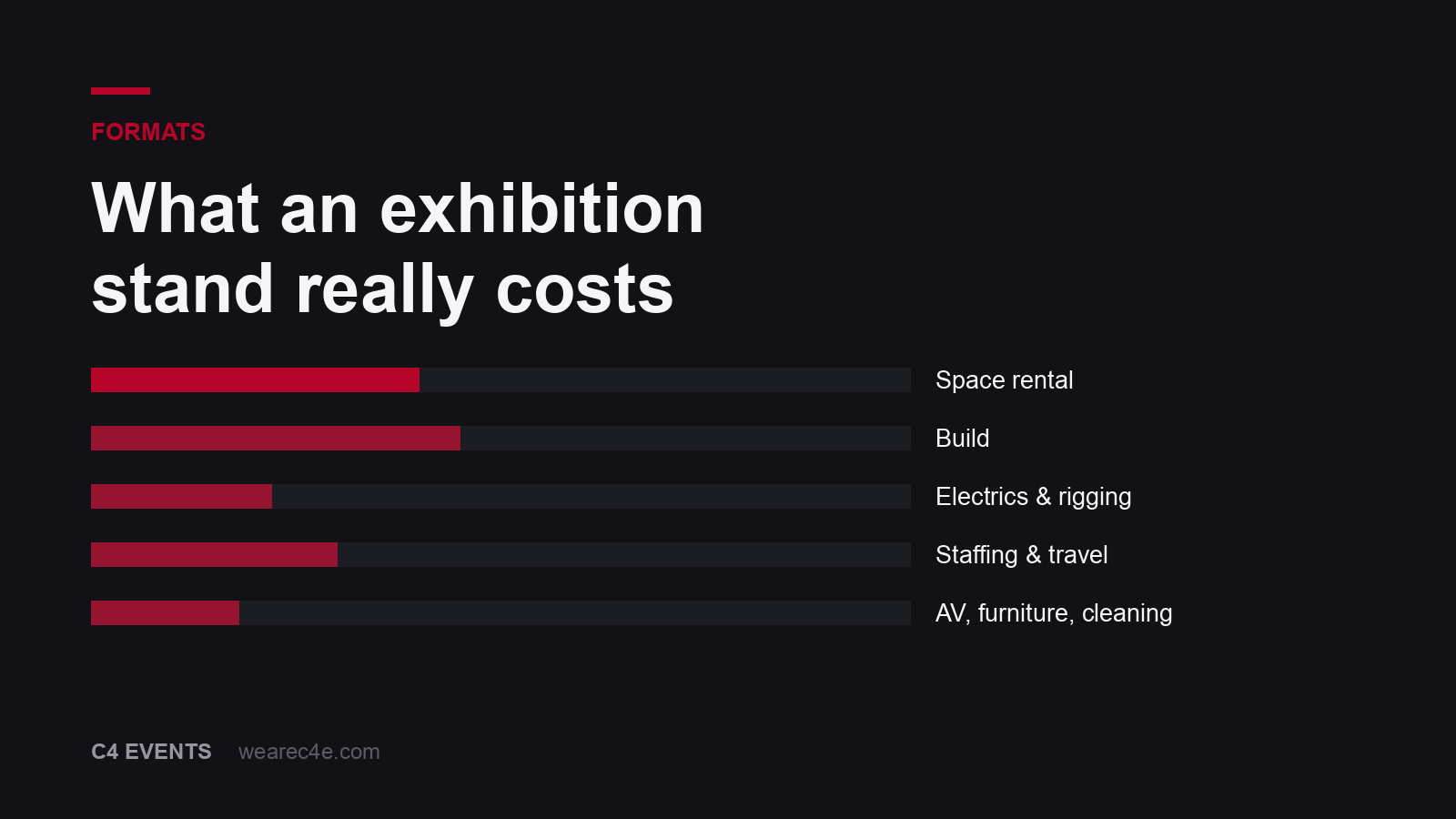
The fabricator’s quote is often under half your total. The rest sits in the organiser’s exhibitor manual, and most first-time exhibitors do not read it until week ten.
- Space rental, priced per square metre, and cheaper as an island than as a corner in most shows
- Electrics, charged by the organiser at rates that have nothing to do with the market
- Rigging, if anything hangs, and often a single approved supplier
- Furniture hire, which costs more than buying it and is still the right call
- AV, screens, players and the person who resets them each morning
- Storage for cases and stock during show days, because the aisles are not storage
- Stand cleaning, every night, which is a line and is not optional
- Staffing, including hosts, interpreters and the crew’s travel and rooms
- Catering on stand, if you are hosting meetings there
Two dates in the exhibitor manual are worth money. The early-order deadline, which discounts electrics and furniture, and the late-order surcharge date, which penalises everything ordered after it. Both are set by the organiser and neither cares about your internal approval cycle. Diarise them in week one.
Design the stand around the conversation
Most stands are designed to look good in a render and to work badly on a floor.
Three design decisions that change performance.
1/ Open the front. A counter across the entrance is a barrier. Visitors will not cross it. Pull the counter to the side and leave the floor open, and footfall onto the stand goes up without anything else changing.
2/ Give people somewhere to sit. The conversations that turn into pipeline are the ones that last more than four minutes, and nobody has a four-minute conversation standing in an aisle. Two seated positions beat a bigger graphic.
3/ One message, readable from ten metres. Visitors are walking past at speed, scanning. A stand that explains three propositions in nine lines communicates none of them. Say what you do in six words and let the conversation do the rest.
Staffing, and the shift rule
One person per 8 to 10 square metres on the floor at any time. Shifts of no more than four hours.
The shift rule is the one that gets ignored and it costs the most. A team standing for nine hours on a hard floor under exhibition lighting stops qualifying visitors by the afternoon of day two. They start sitting down, checking phones and talking to each other, which is the universal signal to walk past a stand.
Brief the team on two things before the doors open: the qualifying question that tells them in 30 seconds whether this conversation matters, and the single next step they are driving toward. A stand where each person is improvising both will produce inconsistent notes and a lead list nobody can use.
Book more staff than the rota needs. Somebody will be ill, and a stand is a place where being one person short is visible from the aisle.
What to measure
Badge scans measure footfall past a machine. They are the metric organisers provide and the metric that flatters everybody, which is why they persist.
Count qualified conversations instead. Agree what qualified means before the show, in one sentence, and have every person on the stand log against it. Then track those to pipeline at 30, 60 and 90 days. The method is in how to measure event ROI.
Two other numbers worth capturing: meetings booked in advance versus meetings made on the floor, which tells you whether your pre-show outreach is working, and cost per qualified conversation, which tells you whether to come back next year.
Where the region stands
Ho Chi Minh City’s Saigon Exhibition and Convention Centre carries 40,000 square metres, and Vietnam’s MICE market is heading from USD 7.71 billion in 2026 toward USD 10.31 billion by 2031. Bangkok, Singapore and Dubai all carry mature exhibition infrastructure with fabricators and freight handlers who have done this at volume.
Where you need to ask harder questions is in the newer venues and secondary cities, where the venue is excellent and the supplier bench around it is thinner. The ground-team test applies here with force, because an exhibition build has no recovery time. If the stand is not up when the doors open, the show has started without you.
What we learned the hard way
We shipped a stand into a regional show because the client wanted exact brand reproduction and had the budget for it. The documentation was right, the freight left in time, and the container cleared 26 hours later than planned because of an inspection nobody could have predicted.
The build happened. It happened overnight, at overtime rates, with a crew who had been awake since the previous morning, and the finish showed it in two places the client noticed.
Now we build in-market and ship only what has to travel, and where a full ship is unavoidable we plan the container to land two days early and pay for the storage. The storage costs less than the overtime and much less than the risk.
Before the show opens
Most exhibition value is decided before the doors open, and most exhibitors do the work after.
Book meetings in advance. The highest-return activity in the whole exercise. Reach out to the attendee list, the sessions you know your buyers attend, and your existing pipeline in that region, and fill the diary before you travel. A stand with twelve booked meetings across three days beats a bigger stand with none.
Tell people you will be there. Email, LinkedIn, and a note to every open opportunity in that market. Half of exhibition value is meeting people you already know, in a place where they have time.
Walk the hall before the doors open. Where you are on the floor, what is around you, where the catering sits, how the traffic flows. Stands near food and near main entrances carry footfall that a better stand in a dead aisle will never see, and you learn this by walking rather than by reading a floor plan.
The follow-up window
Leads decay fast. A conversation on Tuesday that gets an email the following Monday has lost most of its value, because the person has had four more days of a show and a flight home.
Send the follow-up within 48 hours, referencing something specific from the conversation rather than a template. That means the notes have to be good enough to reference, which is why the qualifying brief matters and why a scan with no note attached is close to worthless.
Split the follow-up by who you met. Existing pipeline goes to the account owner the same day. New qualified contacts go to a named person with a sequence. Everyone else goes on a nurture list and gets told, once, what you do.
Three rules
1/ Build in-market, ship the brand-critical parts. Freight plus duty seldom wins.
2/ Read the exhibitor manual in week one. The organiser’s deadlines are the real deadlines.
3/ Count qualified conversations, not scans. Then track them to 90 days.
See how we run MICE programmes and exhibitions across Asia, or exhibitions and trade-show stands in Dubai.
Send us the show and the space and we will come back with a build plan and a total, not a stand render.
What would you add? Do you agree?
Frequently asked questions
Should I ship my exhibition stand or build it in-market?
Build in-market for anything larger than flight cases. Freight, duties, a clearing agent and a customs broker on a stand shipped into Bangkok, Dubai or Ho Chi Minh City will often exceed the cost of a local fabricator working to your drawings. Ship the elements that carry brand precision and build the structure in-market.
What does an exhibition stand cost on top of the build?
Space rental, build, electrics and rigging charged by the organiser, furniture hire, AV, graphics, storage, stand cleaning, on-site staffing, catering, freight or local fabrication, and the crew’s travel and accommodation. The build is often under half of the total. Budget from the organiser’s exhibitor manual, not from the fabricator’s quote.
How should an exhibition stand be staffed?
One person per 8 to 10 square metres on the floor at any time, working in shifts of no more than four hours. A stand staffed by people who have been standing for nine hours stops converting by the afternoon of day two. Brief them on a qualifying question and a single clear next step.
How do you measure exhibition ROI?
Qualified conversations, not badge scans. Agree what qualified means before the show, count those, and track them to pipeline at 30, 60 and 90 days. A scan count measures footfall past a machine. It tells you nothing about whether the show was worth attending.
How far ahead should exhibition stands be planned?
Twelve weeks for a custom build, and the deadlines that bind are the organiser’s, not yours. Electrics, rigging, late-order surcharges and early-bird discounts are all set by the exhibitor manual, and missing one of those dates costs real money for no benefit.