Bangkok’s IMPACT Challenger holds 60,000 square metres of column-free space, which the venue calls the largest hall of its kind in the world. Singapore ran 156 international association meetings in 2025 and finished first in Asia Pacific for the twenty-third year.
Those two facts describe two different businesses. One city sells room. The other sells certainty.
The short answer
Bangkok when the budget matters, the audience is regional, and the format has a social half that people will remember. Singapore when the content is the point, the audience is senior, and the cost of something going wrong is higher than the cost of the event.
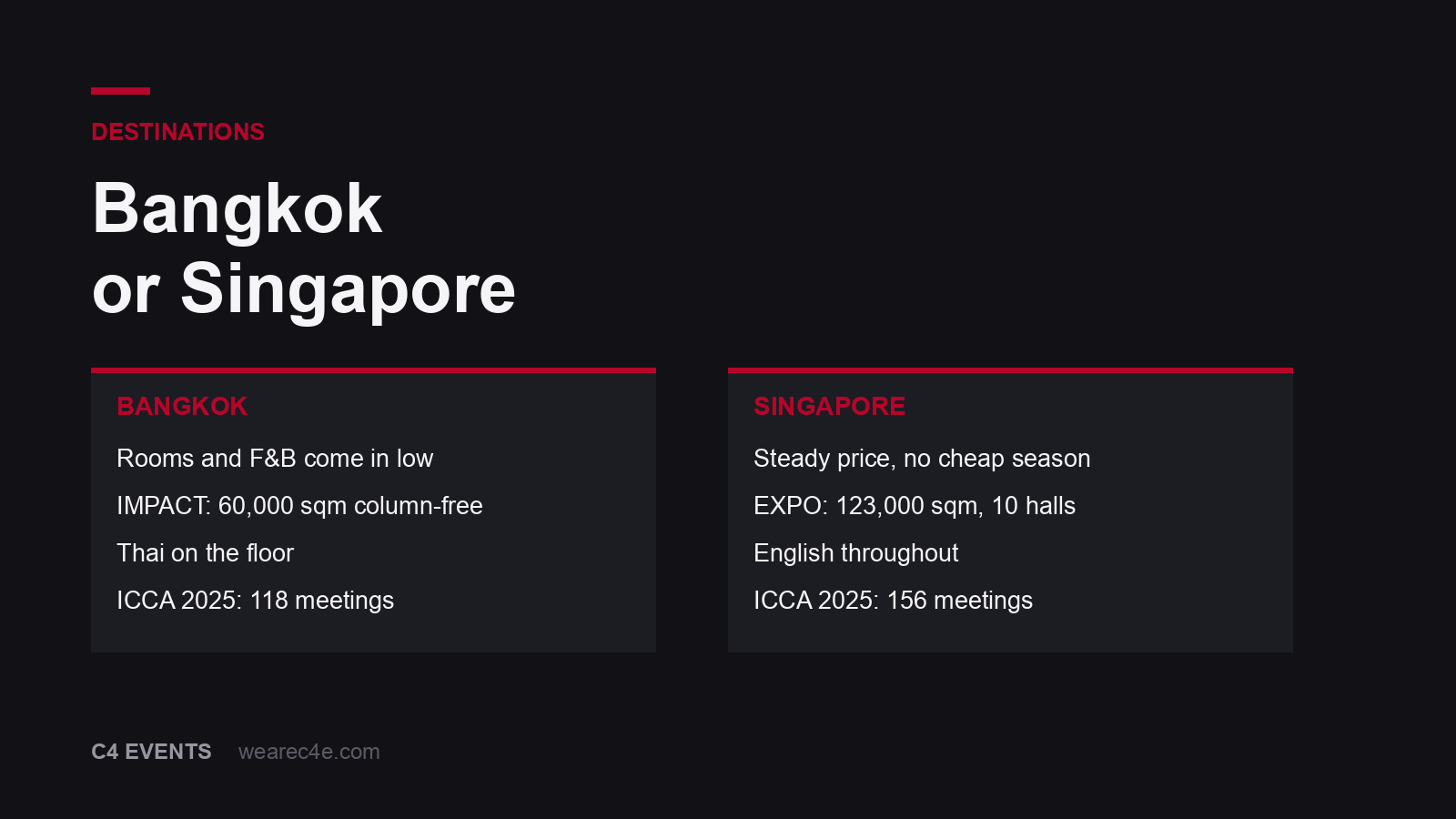
| Bangkok | Singapore | |
|---|---|---|
| Cost position | Lower on rooms, F&B and ground | Higher across the board, and steady |
| Production cost | Close to Singapore at the top end | Benchmark for the region |
| Venue anchor | IMPACT, 60,000 sqm column-free | Singapore EXPO, 123,000 sqm, 10 halls |
| Working language | Thai on the floor, English in the office | English throughout |
| Strongest formats | Dealer meets, incentives, launches, gala nights | Conferences, summits, regulated content |
| ICCA 2025 meetings | 118 | 156 |
| Permit lead time | 4 to 6 weeks | 4 to 6 weeks |
| Where it hurts | Language on site, traffic, vendor variance | Price, and no cheap season to retreat into |
The saving is real, and it is not where people look for it
Teams move an event to Bangkok expecting a third off everything. What they get is a large saving on hotel rooms, food and beverage, transfers and staffing, and a small one on production.
The reason is that stage, screen, audio and lighting are priced against a regional market. The good Bangkok vendors serve the same international clients as the good Singapore vendors, and they quote to match it. A 40-foot LED wall does not get cheaper because the hotel does.
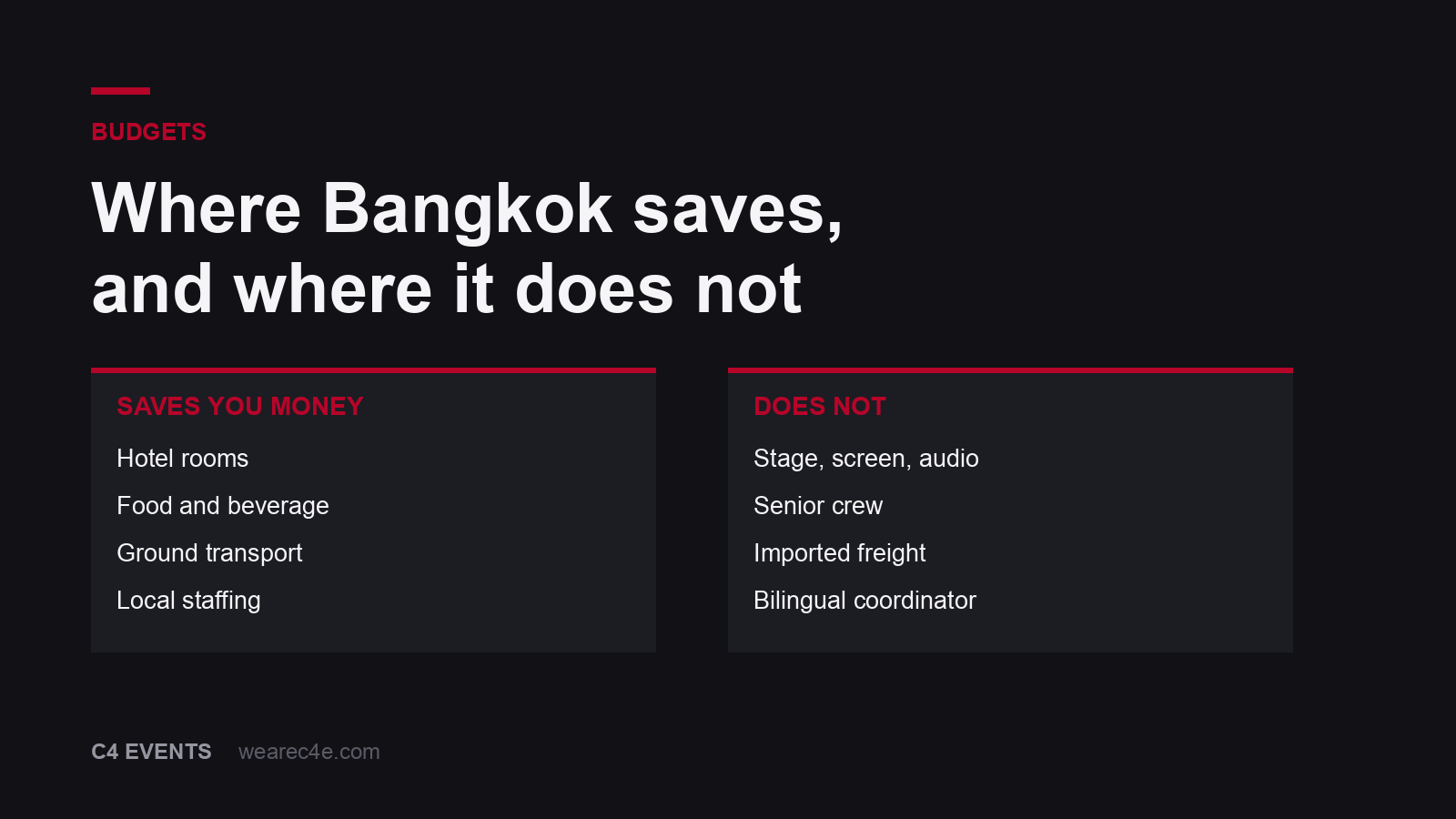
So the arithmetic depends on the shape of your event. A three-night dealer meet for 250 people, heavy on rooms and dinners and light on stage, saves a lot in Bangkok. A one-day conference for 250 with a full production build and no accommodation saves little. Run the split before you run the argument. Our conference production cost breakdown shows which lines move and which do not.
Language, and the role people forget to budget
Singapore runs on English from the contract to the crew call. That is not a small thing on a show day, and it is a large part of what the higher price buys.
Bangkok’s event industry sells and contracts in English. The load-in does not. Riggers, stagehands, drivers and hotel banqueting staff work in Thai, and a run sheet that only exists in English will drift by the second turnaround.
The fix is one line in the budget: a bilingual production coordinator whose only job is the floor. Skip it and you will spend the show day being the bottleneck between your showcaller and the room.
Venues
Bangkok’s inventory is deeper than its reputation. IMPACT sits north of the city with three interconnected halls giving 60,000 square metres of column-free space. QSNCC sits in the centre and takes the conference brief. Around both sits five-star ballroom stock at prices that read like a misprint next to Singapore’s.
Singapore’s set is tighter and better connected. Singapore EXPO carries 123,000 square metres across ten halls and 32 meeting rooms, Suntec adds 42,000 square metres with a stated capacity of 10 to 10,000 guests, and Marina Bay Sands and Sands Expo take the flagship brief.
The difference that matters is travel time. Singapore’s venues sit inside a city you can cross in half an hour. Bangkok’s do not, and traffic is a scheduling input rather than a nuisance. Put the delegate hotel and the venue in the same place or accept coaches, and build the coach wave into the registration plan. Our registration and badging guide covers what a coach arrival does to a desk.
What each city is for
Bangkok carries the formats with a social half. Dealer meets, channel partner events, incentive legs, gala nights, launches that want a room with atmosphere. The city gives delegates a reason to be pleased they came, and that reads as a reward without you paying for one.
Singapore carries the formats where the content is the product. Technical summits, regulated industries, investor days, anything where a translation error or a stream that drops is a business problem rather than an inconvenience.
Our Thailand events guide and Singapore events guide go deeper on each, and the ranked MICE destinations piece puts both against the rest of the region.
The Thailand tailwind
TCEB, Thailand’s business events agency, is targeting 10 percent growth and one million Singaporean business-event travellers by the end of 2026. That is a stated public target rather than a result, and it tells you something useful anyway: Bangkok is bidding for this business, and cities that are bidding are easier to negotiate with.
Ask what support exists for your event. Delegate welcome, airport handling, a subsidy against a qualifying headcount. It will not change the city you pick. It will change the number at the bottom of the page.
The hotel block, and where the Bangkok saving lands
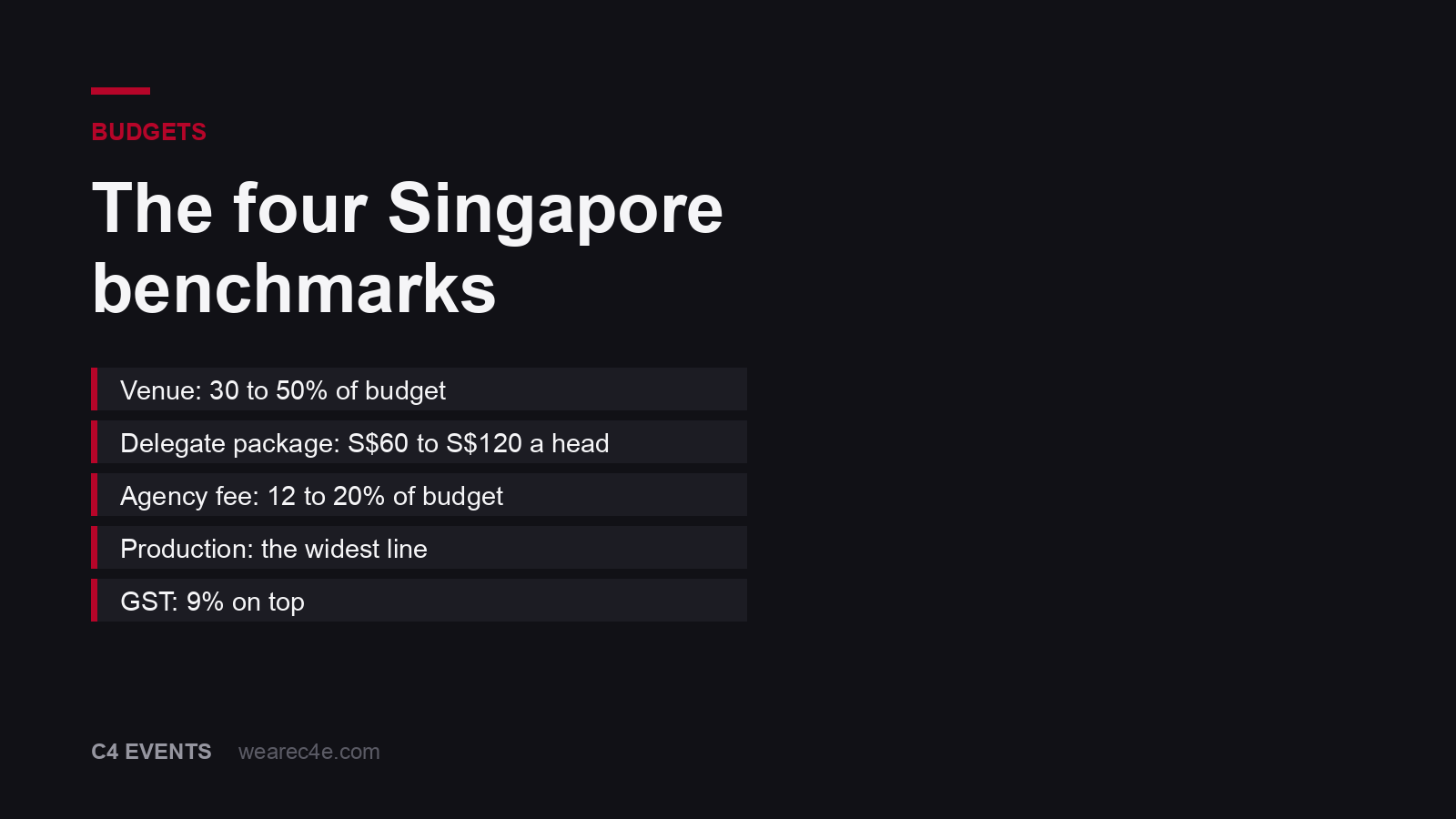
On a three-night dealer meet for 250 people, bedrooms are the biggest line in the budget. That is the line where Bangkok wins by a wide margin, and it wins again on food and beverage, where a Singapore delegate package sits between S$60 and S$120 a head for a full day and a Bangkok equivalent lands well under it.
Negotiate the block with care in either city. Ask for the release schedule, the cut-off dates and the attrition threshold in writing, then release rooms on the schedule instead of holding them out of hope. Unfilled rooms get billed. Our attrition and force majeure guide covers the clause that decides how much.
Two airports, and what that buys
Bangkok has Suvarnabhumi and Don Mueang, and the second one carries most of the low-cost traffic across the region. For a delegate list spread across Southeast Asia paying its own airfare, that is a real saving per head and a real widening of who can attend.
It is also a registration problem. Two airports, mixed arrival times and city traffic mean your arrivals do not come in one wave, and a desk plan built for one wave will fall over. Plan for staggered arrivals and a peak, and staff to the peak rather than the average.
Singapore has one airport, short transfers and predictable arrival windows, which is the quiet part of what its price buys.
Where each one breaks
Bangkok breaks on vendor variance. The spread between the best and the worst supplier in any category is wider than in Singapore, and a low quote is a signal to look harder rather than to celebrate. Reference every vendor on an event of your size, not on their showreel.
Singapore breaks on the budget conversation in month three. There is no cheap season, no cheap venue tier that still reads as premium, and no negotiating room that appears late. Whatever gets cut comes out of scope, and the rehearsal day is the line people reach for first. Protect it in the contract.
The one-day test
Here is a test that settles this faster than a spreadsheet. Ask whether your event survives being a single day with no overnight stay.
If it does, most of the Bangkok saving disappears, because you have removed the two lines Bangkok wins on. A one-day conference is stage, screen, crew, catering and a room, and those price close in both cities. What is left is the flight cost per delegate, which cuts in whichever direction your audience happens to sit.
If it does not, and the overnight is the point, Bangkok is holding a real advantage that grows with every night you add. Three nights for 250 people is a different arithmetic to one day for 400, and the same city comparison gives opposite answers to the two.
How to decide
1/ Split your budget into rooms and food against stage and crew. If the first half is bigger, Bangkok saves you real money. 2/ Ask whether an error on stage is embarrassing or expensive. Expensive points at Singapore. 3/ Check both cities against your delegate list for visas and flight cost, per market, not on average. 4/ Price the same brief in both, with a bilingual coordinator line in the Bangkok version so the comparison is honest.
That fourth point is where most comparisons go wrong. The Bangkok quote arrives without the roles that make Bangkok work, wins on price, and then those roles get added in month five as a variation.
In the end
Both cities will deliver your event. One of them will do it for less and ask more of your team. The other will do it for more and ask less.
Price the version of each that includes what it takes to run it well, then pick on the number you trust rather than the number you liked.
What did I miss? If you have run the same event in both cities and the numbers landed another way, tell us what you saw.
Frequently asked questions
How much cheaper is Bangkok than Singapore?
On hotels, food and ground costs, by a wide margin. On production, less than people expect, because the good vendors price against a regional market rather than a local one. Budget a real saving on rooms and F&B and a modest one on stage, screen and crew.
Which city has better conference venues?
Both are well served, in different shapes. IMPACT in Bangkok holds three interconnected halls with 60,000 square metres of column-free space, which the venue calls the world’s largest column-free hall. Singapore EXPO holds 123,000 square metres across ten halls. Bangkok has the bigger single room. Singapore has the tighter operation around it.
Is English enough to run an event in Bangkok?
At the venue and with the agency, yes. On the floor with crew, no. Budget for a bilingual production coordinator and do not treat that role as optional. Singapore removes the problem, which is part of what its price buys.
Which city is better for a dealer meet?
Bangkok, most of the time. The format rewards a room that feels like a reward, hotel stock at the right price for three nights, and a city delegates want an evening in. Singapore suits the dealer meet whose audience is senior enough that the venue is the message.
What about visas?
Check both against your delegate list before you choose. Thailand and Singapore are open to most passports in the region and slower with a few of the same ones. The answer changes with your audience, not with the city.
How far ahead do I need to book?
Six to nine months for a prime venue in either city. Bangkok’s beach alternatives need longer in the November to April window, and Singapore needs longer around its own show weeks.
Which city handles hybrid better?
Singapore, on bandwidth, crew depth and the number of producers who have done it before. Bangkok can deliver the same result with a partner who has the kit and the track record, and the bench is thinner.
Can I split the event across both?
Yes, and it works better than it sounds for a two-part programme: content and awards in Singapore, incentive leg in Thailand. It also doubles the freight and the crew, so price it as two events with one content build.