Dubai has a lot of event companies. Some of them are genuine operators with their own crew, their own kit and twenty years of relationships. Some of them are a laptop, a website and a subcontract.
Both send the same deck. Same stage photographs, same client logos, same three-word promise on the cover. The difference does not show up in the pitch. It shows up at 6am on build day, and by then you have signed.
What follows is the check we would run if we were buying rather than selling. It works whether you end up hiring us or somebody else.
Start with the licence
Every company trading in Dubai holds a licence, and the licence names the activities it is permitted to carry out. Event management is one of those named activities.
Ask for it. Then check three things.
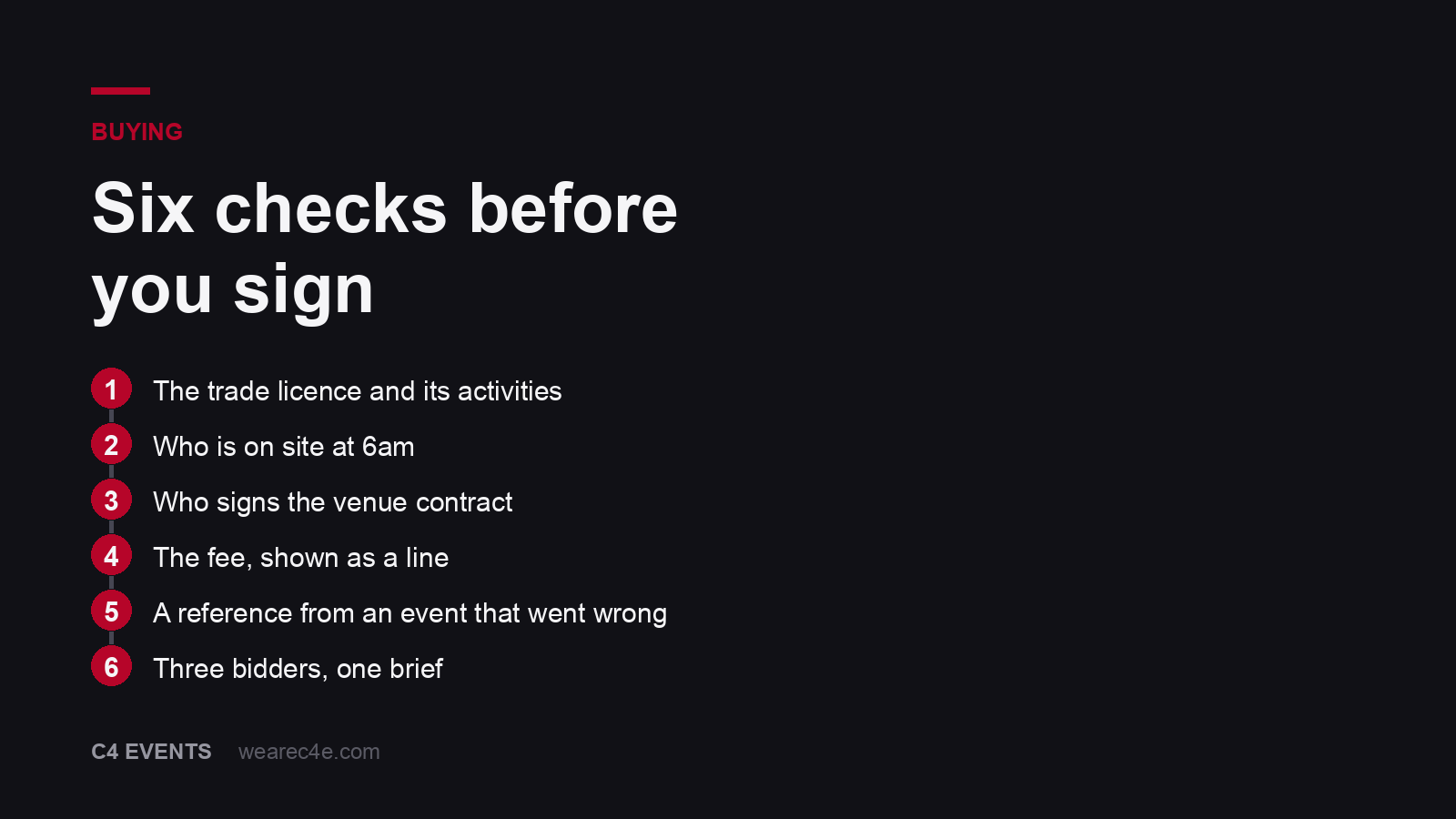
1/ The activity list covers what you are buying. A company licensed for advertising and marketing is not licensed to run your exhibition, whatever the deck says.
2/ The entity on the licence is the entity on the contract. These are often two different names, and the second one is sometimes registered somewhere else with different obligations and a different balance sheet.
3/ The licence is current. A lapsed licence is a company that cannot file your permit.
None of that is adversarial. It takes an email, and a real operator will send the document back the same day without asking why.
The ground-team test
This is the question that separates the field, and it takes one sentence.
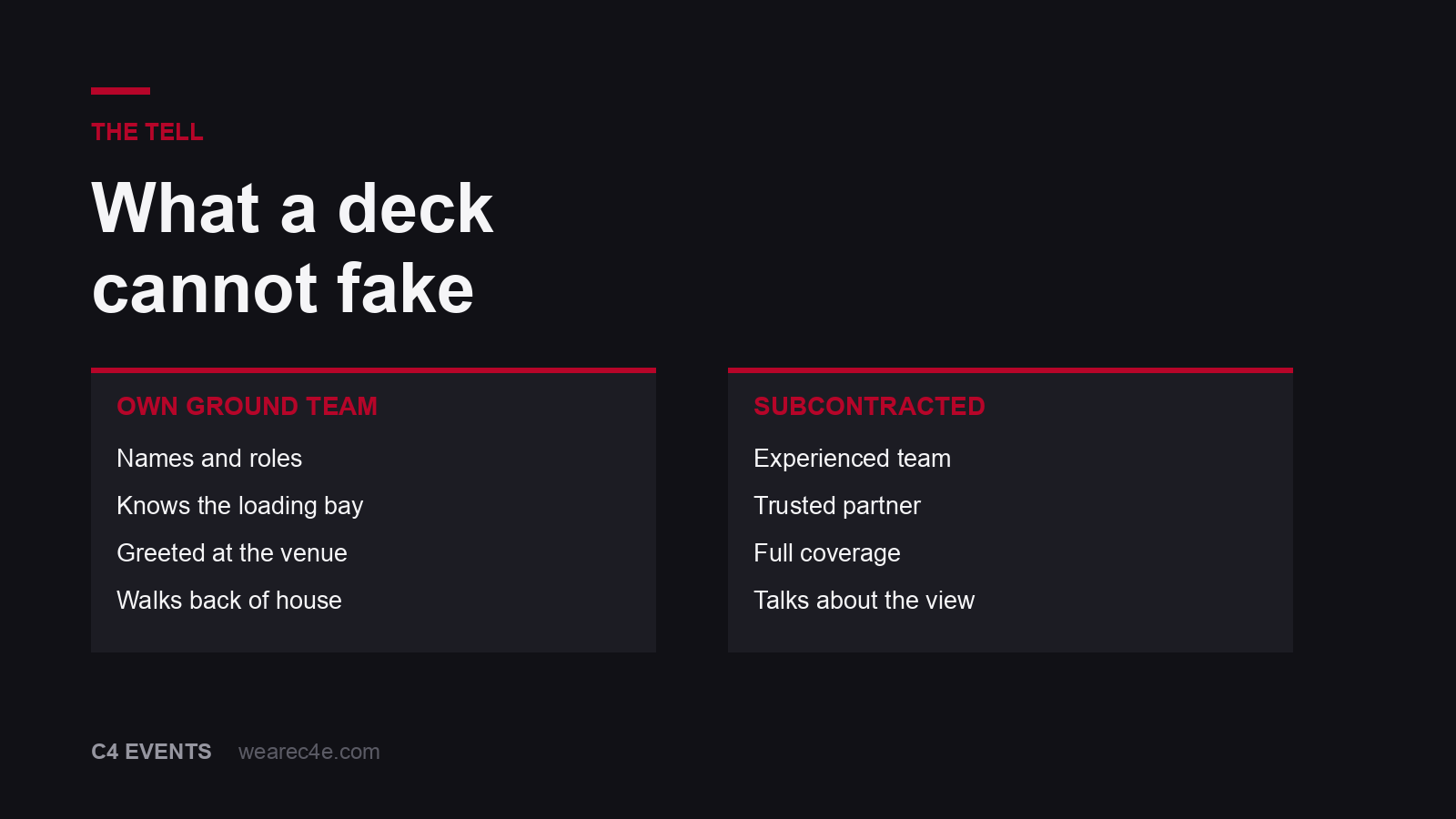
Ask who will be on site at 6am on build day, by name, and what else that person has on that week.
An agency with a real bench answers in specifics. A name, a role, the other event they hand over on the Tuesday. An agency that subcontracts answers in reassurance: an experienced team, a trusted partner, full coverage. Both answers can lead to a good event. Only one of them tells you who to call at 6am.
Subcontracting is not a sin. The whole industry does it and we do it. What matters is whether you were told. An agency that presents a subcontracted crew as its own is telling you how it will handle the next uncomfortable fact as well.
Who signs what
The single most consequential clause in a Dubai event is not in the agency contract. It is in the venue contract, and the question is whose name is on it.
| Agency signs the venue | Client signs the venue | |
|---|---|---|
| Attrition risk | Agency | Client |
| Cancellation exposure | Agency | Client |
| Fee | Higher | Lower |
| Control of the venue relationship | Agency | Client |
| Who the venue calls | Agency | Client |
Both columns are defensible. Signing the venue yourself and then paying a fee priced as if somebody else carried the risk is not. Decide on purpose, and if you are unsure what you are exposed to, the clauses are broken down in attrition and force majeure.
The same question applies to the permit. Ask who files it, and check the answer against what the venue tells you on the site visit. If the two answers differ, you have found something worth resolving before the deposit. The mechanics are in the Dubai event permit guide.
The fee, shown as a line
Dubai agency fees run 10 to 20 percent of budget. That band is two different products, not a negotiation range, and the way to find out which one you are being offered is to ask for the fee as a visible line rather than folded into supplier costs.
A folded fee is not dishonest. It is a pricing model, and plenty of good agencies use it. What it does is make comparison impossible, which is the point. When three proposals all fold, you are comparing totals rather than value, and the cheapest total is often the one with the thinnest crew.
Ask each agency for the same brief priced two ways: fee shown, and total. The one that cannot produce the first version is telling you something. The models are compared in event agency fee models, and the underlying species of supplier in DMC, event agency or PCO.
The reference that matters
Every agency will give you a reference from an event that went well. Those calls tell you nothing, because every agency has one.
Ask instead for a reference from an event where something went wrong.
The reaction is the data. An agency that has been running events for a decade has had a truck stuck at customs, a speaker miss a flight, a generator fail and a venue double-book a hall. If they cannot name one, either they are new or they are not going to tell you the truth about yours.
When you get the call, ask the client one question: what did they do in the first hour? Not what they fixed. What they did first, and whether you found out from them or from somebody else.
What the proposal has to contain
A proposal is a document, not a mood board. Ours has to contain these and so should theirs.
| Item | Why it matters |
|---|---|
| Named project lead | Somebody is accountable, and you know who |
| Supplier list, in-house marked | You know what is owned and what is bought |
| Fee as a visible line | You can compare |
| Payment schedule | You know your cash exposure by month |
| Who signs the venue | You know who holds the risk |
| Who files the permit | You know whose clock it is |
| Date-change terms | Because dates move |
Seven lines. If a proposal is missing four of them, the gap is the answer.
How many to invite
Three.
Two gives you no comparison, and a two-horse race is often a race one horse already won. Five or six means you have asked several companies to do free strategy work for a job they have a one-in-six chance of winning, which gets around a market as small as Dubai’s inside a month. The good agencies stop bidding, and you are left choosing between the ones with time on their hands.
Give the three the same brief, the same deadline and the same budget range. A tender that hides the budget produces three proposals for three different events, none of which you can compare. The full process is in the event RFP template.
Payment terms, and the thing to watch
An event agency is a cash-flow business. Money comes in from you and goes straight out to venues, hotels and production suppliers, often months before the event happens.
That is normal and it is also where the risk sits. If an agency takes a large deposit and pays suppliers late, the first you hear of it is a rigger refusing to unload. So ask two questions.
First, what does the payment schedule look like against the supplier payment schedule? A deposit that lands with you months before the venue needs it is a working-capital request wearing a project cost.
Second, can they show you supplier confirmations as the money moves? Not invoices from them to you. Confirmations from the venue and the production house saying they are paid and the date is held. A confident agency sends those without being asked twice.
The pattern that ends badly is a low fee, a heavy front-loaded schedule and no supplier confirmations. Any one of those alone is fine. All three together is a company funding last month’s event with this month’s deposit.
The site visit
Do one, and take the agency with you.
The visit tells you more about the agency than about the venue. Watch who they greet by name. Watch whether the banqueting manager knows them. Watch whether they ask about loading bays and power or about the view. Watch whether they walk the back of house at all.
An agency that has run twenty events in that building walks it in a different way from one that has seen the brochure. You will see the difference inside ten minutes and you will not be able to unsee it.
The things people check that do not matter
Office address. A shopfront in a tower tells you about a lease, not about a crew.
Client logo wall. Logos on a website belong to the individuals who ran those events, and individuals move. Ask which of the named team worked on the logo you care about.
Award shelf. Regional event awards are a real industry and a real marketing exercise at the same time. Treat them as a tiebreak, never as a filter.
Headcount. A forty-person agency with four good producers is a four-producer agency. Ask about the four.
Putting it together
Licence, ground team, who signs, fee as a line, a bad reference, three bidders. That is the whole check, and it takes about two hours spread across a fortnight.
Two hours against a budget that runs from AED 60,000 to well past half a million is the cheapest insurance in the project. The budget arithmetic is in what a corporate event costs in Dubai, and the market view of choosing a partner in an unfamiliar city is in choosing a destination event management company.
We are one of the companies you might run this check on. Run it. Then tell us what you are planning and see how the answers hold up, or read how we work in the market on the Dubai page first.
What did I miss?
Frequently asked questions
How do I check that a Dubai event company is legitimate?
Start with the trade licence. A company operating in Dubai holds a licence naming its permitted activities, and event management is one of those named activities. Ask for the licence, check the activity list covers what you are buying, and check the entity on the licence is the entity on the contract. Those are often two different names.
What questions should I ask a Dubai event agency?
Six: who signs the venue contract, who files the event permit, who is on site at 6am on build day and what else they have that week, what your fee covers and what it does not, which suppliers are theirs and which are subcontracted, and a reference from an event that went wrong. The last one tells you more than the first five.
Should the agency or the client sign the venue contract?
Whoever you want carrying the attrition and cancellation risk. If the agency signs, they hold it and price for it. If you sign, you hold it and pay a lower fee. Both are legitimate. What is not legitimate is paying a risk-carrying fee while signing every contract yourself.
What is a normal agency fee in Dubai?
Event management fees run 10 to 20 percent of budget. The band covers two different products. At the low end you are buying coordination of suppliers you chose. At the high end you are buying transferred risk and an owned outcome. Ask which one the number represents.
How do I tell if an agency has its own team in Dubai?
Ask for names and roles of the people who will be on your event, then ask what else those people are working on in your week. An agency with a real bench answers in specifics. An agency that subcontracts answers in reassurance. Neither is disqualifying, and knowing which one you have is.
What should a Dubai event proposal contain?
A named project lead, a supplier list with which ones are in-house, a budget with the fee shown as a line rather than folded in, the payment schedule, who files the permit, who signs the venue, and what happens if the date moves. A proposal with none of those is a mood board.
Does VAT apply to agency fees in Dubai?
The UAE applies VAT at 5 percent. Check whether a quoted fee is stated before or after tax, because two proposals that look five percent apart may be identical underneath.
How many agencies should I invite to pitch?
Three. Fewer and you have no comparison. More and you are asking several companies to work for nothing while you use their thinking, which gets around and costs you the good ones next time.