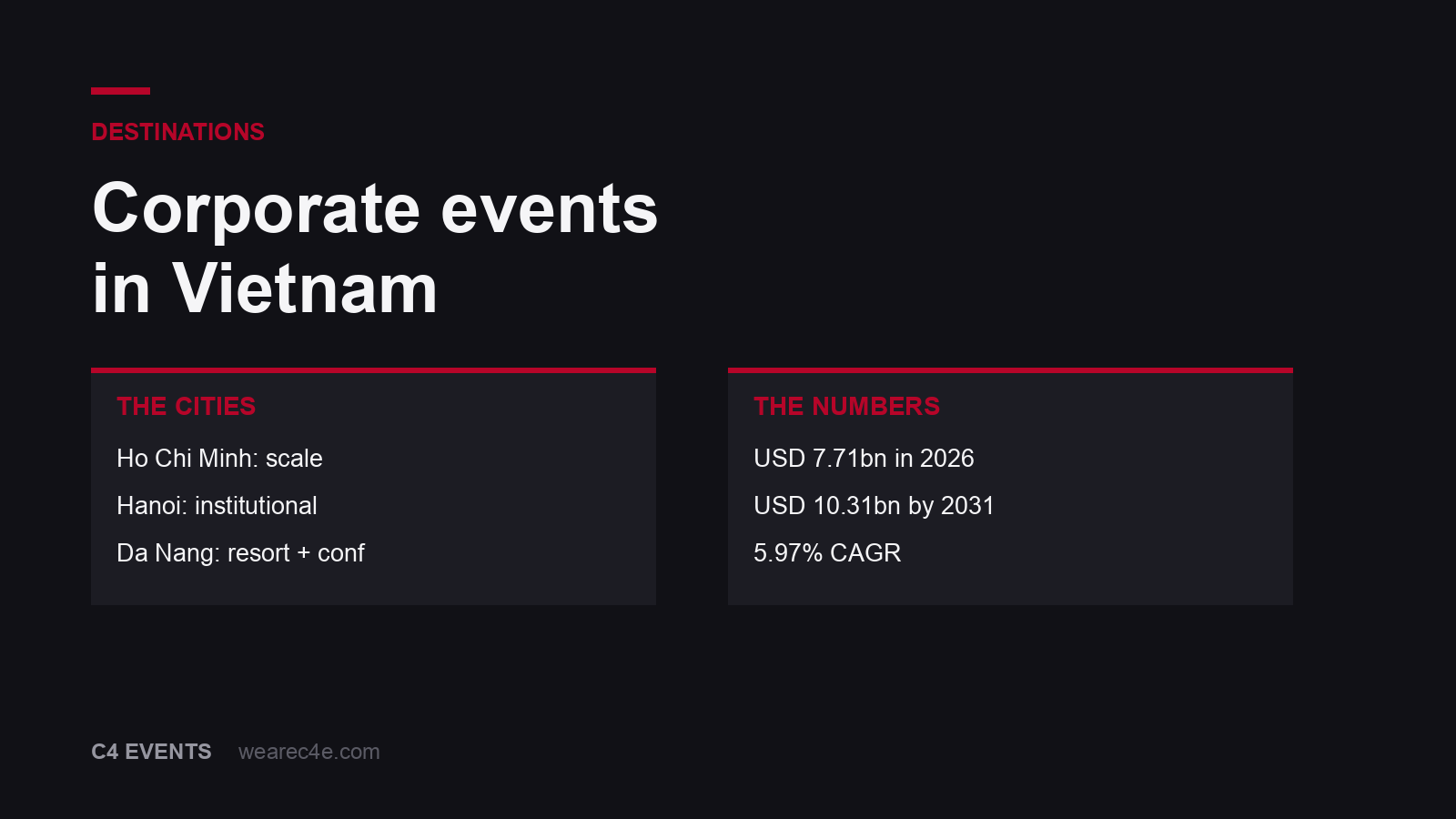
Vietnam’s MICE market is worth USD 7.71 billion in 2026, up from USD 7.28 billion the year before, and forecast to reach USD 10.31 billion by 2031 at a compound rate of 5.97 percent. Those are not the numbers of a frontier market. They are the numbers of a destination that has finished building and started selling.
For a buyer in Europe or the US, Vietnam still sits in the mental category of “somewhere we might look at”. For buyers inside Asia it stopped being that four or five years ago. If your programme is mid-size, cost-sensitive and wants a room nobody in the group has seen before, look here.
Here is the practical version: which city, which venue, what it costs, and what to plan around.
The three cities, and what each is for
Ho Chi Minh City. The commercial answer. The Saigon Exhibition and Convention Centre carries 40,000 square metres of exhibition space, which puts it in the same conversation as regional trade-show venues rather than hotel ballrooms. The city has the deepest supplier bench in the country, the most international hotel stock and the best air connectivity. If your event has an exhibition component, a trade audience or a large production, start here.
Hanoi. The institutional answer. The National Convention Center holds 3,000 to 3,800 delegates and the city carries the government and association weight. If your programme involves ministries, regulators or an association congress, Hanoi is the room. It is also the harder city to run a slick commercial production in, and the winter is cold, which surprises people who packed for Southeast Asia.
Da Nang. The one most buyers end up choosing. Beachfront, a proper convention venue in the Ariyana Convention Centre taking up to 2,500 guests, a resort strip along My Khe, and Hoi An 40 minutes down the road for the evening that has to be different. Da Nang does the thing Bali and Phuket do, with newer hotel stock and a conference venue attached. For an offsite, a dealer meet or an incentive with a working component, this is the strongest option in the country.
Phu Quoc and Nha Trang round it out for pure resort programmes with less conference need.
What it costs against the alternatives
Vietnam sits close to Thailand at the four and five-star level and often below it, though the gap has narrowed as Da Nang and Phu Quoc have built out and started pricing with confidence. Against Singapore it is a different budget in full.
What Vietnam gives you for the money is newer stock. A lot of the resort and convention inventory went up in the last decade, which means rooms, ballrooms and AV infrastructure that have not been through fifteen years of conferences. That matters more than it sounds when you are looking at ceiling heights, power provision and rigging points.
What Thailand still has that Vietnam does not: depth. More crew, more kit, more suppliers who have run a 600-person international convention and can prove it. On a large or technical production that depth is worth paying for, and it is the honest reason we still put some briefs into Bangkok rather than Ho Chi Minh City. Our Thailand page covers that side.
Season, region by region
Vietnam runs 1,650 kilometres north to south and does not have one climate. Planning it as a single country is the most common mistake.
- Da Nang and the central coast: February to May is the window. Typhoon season runs about September to November and it is real, not theoretical. A beachfront programme in October is a programme with a wet-weather plan and a contingency.
- Ho Chi Minh City and the south: driest December to April. The rainy season is afternoon downpours rather than washouts, which an indoor programme absorbs without trouble.
- Hanoi and the north: October to April is the comfortable stretch. January and February are cold and damp, which catches out groups who packed for the tropics.
One date overrides all of it. Tet, the lunar new year, shuts the country for a week and slows it for two either side. Suppliers, permit offices and crew are unavailable. Check the date, which moves each year, before you check anything else.
Three things to plan for on the ground
1/ Approval lead times run longer. Permits for outdoor events, imported material, drones, foreign performers and anything involving public space take more time than the equivalent in Thailand or the UAE. Build six to eight weeks rather than four, and start the paperwork before you finalise the creative, because the creative may have to change. See what each market across Asia and the Gulf requires.
2/ The technical bench thins outside Ho Chi Minh City. Da Nang has grown fast but a large multi-camera production with broadcast may still mean bringing crew and kit from Ho Chi Minh City or Bangkok. Ask the question early, because it is a cost and a logistics line, not a phone call.
3/ Content approval. Material shown in public can require review depending on subject matter, and the timeline for that is not something to discover in the final week. A local partner who has done this before will tell you which of your content needs it. One who has not will tell you it is fine.
What Vietnam is best at
The resort-plus-conference combination in Da Nang is the strongest thing the country offers a corporate buyer, and it is under-used by companies outside Asia.
You get a beachfront convention venue, resort rooms that hold a group without splitting it, an airport 15 minutes away, and a heritage town in Hoi An that gives you an evening the group could not have anywhere else. For a three-day offsite with real working sessions and a reward element, that combination is hard to beat at the price.
The second thing: novelty. 70 percent of incentive buyers say they want a destination they have not used before. Vietnam answers that for almost every group, and it answers it without the cost step-up that most often comes with going somewhere new.
Getting people in
Two practical items decide whether a Vietnam programme starts well.
Visas. Vietnam’s entry rules vary by passport and have changed several times in recent years. Some nationalities enter without a visa for a set period, some use an e-visa, some need a full application. Check every passport in your group as a spreadsheet column rather than assuming the majority case covers everyone. The two people whose nationality carries a different rule are the ones who get stopped.
Air. Ho Chi Minh City and Hanoi have the widest international connectivity. Da Nang has grown its Northeast Asian links and connects well within the region, and for groups arriving from Europe or the US it will most often mean a connection through Singapore, Bangkok, Seoul or Ho Chi Minh City. Count those connections into the arrival plan, because a group landing across a 12-hour window needs staffed transfers all day rather than two coach runs.
Worth adding: Vietnamese hospitality staff in the international properties are as good as anywhere in the region, and the service culture is warmer than the price suggests. That is not a line in a market report and it is one of the reasons groups come back.
Where I would be cautious
I would not put a first-time, high-stakes, large-production event into Vietnam without a partner with people in the country. That is true of anywhere, and it is more true here because the supplier bench is younger and the recovery options when something breaks are thinner. The ground-team test applies with more force, not less.
I would also be careful about assuming Vietnam is the cheap option by default. It was. It is now priced like a destination that knows what it has. Get the quote before you build the business case on a number from three years ago.
Our own gap here, since I keep asking buyers to be honest about theirs: Vietnam is a market where we work through in-country partners rather than a standing office, and we say so at pitch stage. That is a different proposition from Bangkok or Dubai, where the team is ours. It has not stopped programmes running well. It does change who you should ask for on the reference call.
Three rules for a Vietnam programme
1/ Pick the city from the format. Exhibition or scale means Ho Chi Minh City. Institutional means Hanoi. Everything else means Da Nang.
2/ Plan the season by region, not by country. February to May on the central coast. Avoid Tet everywhere.
3/ Start the permits before the creative. The approval timeline is the constraint, and it is easier to design inside it than to redesign around it.
See how we run events across Asia and the Gulf, or compare against Phuket and Bali if the brief leans toward reward rather than work.
Tell us the brief and we will tell you whether Vietnam is the right answer, including when it is not.
What would you add? Do you agree?
Frequently asked questions
Is Vietnam good for corporate events?
Yes, and it is the fastest-improving option in Southeast Asia for mid-size programmes. Vietnam’s MICE market is worth USD 7.71 billion in 2026 and is forecast to reach USD 10.31 billion by 2031, a 5.97 percent compound rate. The infrastructure is newer than Thailand’s, the costs are lower than Singapore’s, and the coastal resort stock in Da Nang and Nha Trang is built for groups.
Which Vietnamese city is best for a conference?
Ho Chi Minh City for scale and commercial access, with the Saigon Exhibition and Convention Centre offering 40,000 square metres of exhibition space. Hanoi for government and institutional events, where the National Convention Center holds 3,000 to 3,800 delegates. Da Nang for anything that combines sessions with a resort setting, with the beachfront Ariyana Convention Centre taking up to 2,500 guests.
How does Vietnam compare on cost to Thailand?
Close, and often below it at the four and five-star level, though the gap has narrowed as Da Nang and Phu Quoc have built out. Where Vietnam wins is newer stock for the money. Where Thailand still wins is depth of supplier bench, crew availability and the number of properties that have run large international groups before.
What should I plan for when running an event in Vietnam?
Three things. 1/ Longer permit and approval lead times than Thailand or the UAE, above all for anything outdoors, imported or involving foreign performers. 2/ A thinner technical supplier bench outside Ho Chi Minh City, so large productions may need crew and kit brought in. 3/ Typhoon season on the central coast, about September to November, which affects Da Nang and Hoi An.
When is the best time for an event in Vietnam?
It depends on the region, because the country runs 1,650 kilometres north to south. Da Nang and the central coast are best February to May, with typhoon risk September to November. Ho Chi Minh City is driest December to April. Hanoi is most comfortable October to April. Avoid Tet, the lunar new year, when the country closes for a week or more.