
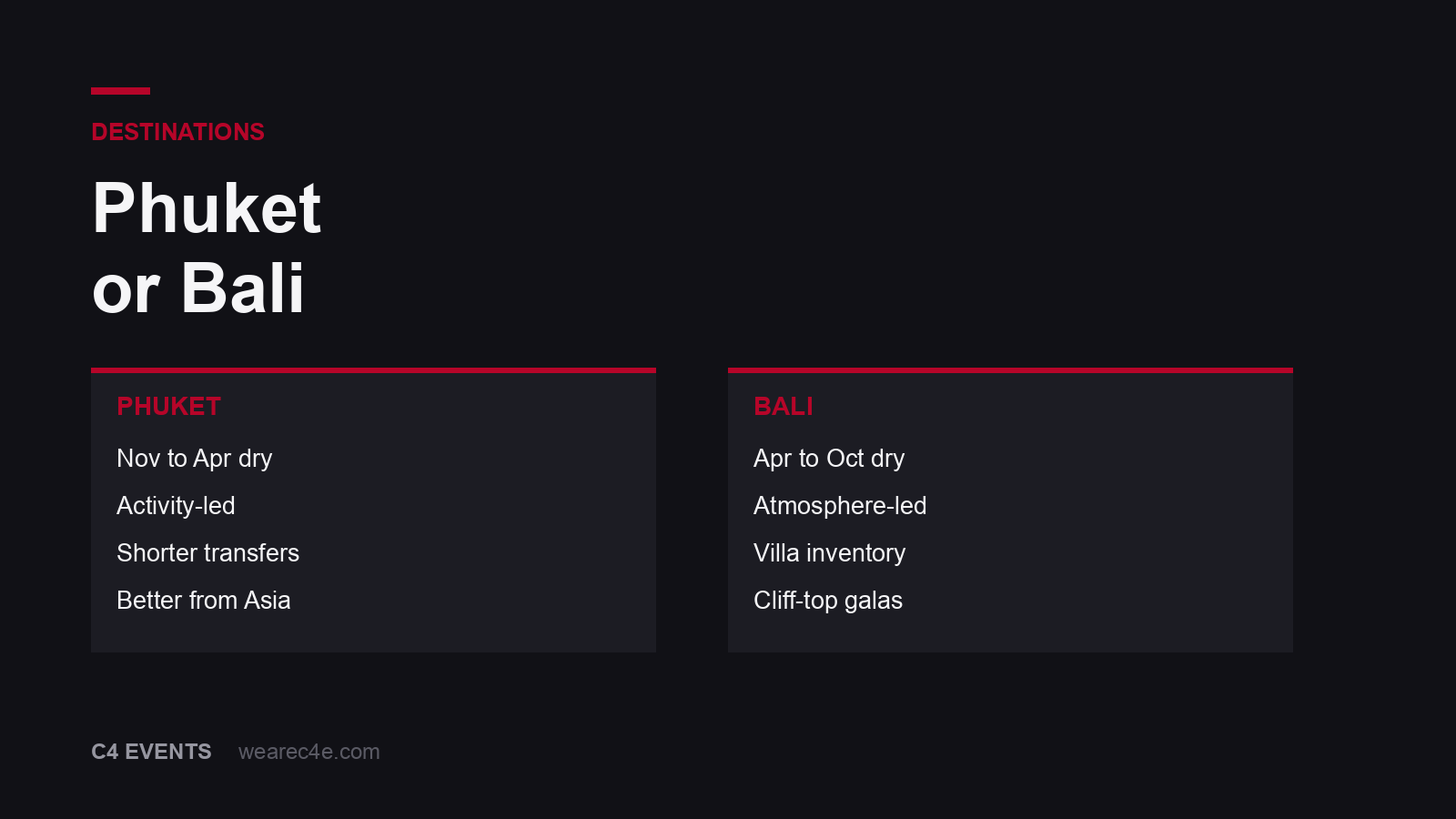
Bali’s dry season runs April to October. Phuket’s runs November to April. They are close to opposite, and for a lot of programmes that one fact settles the argument before anyone opens a brochure.
Both islands do the same job: a five-star reward in Southeast Asia at a price that would buy something ordinary in Europe. Both handle several hundred people. Both have resorts, beaches, boats and a gala venue worth flying for.
They are not interchangeable. Here is the honest comparison, and a rule at the end for which brief goes where.
Season: the first filter
Bali: April to October dry. May, June and September are the value window inside it. Watch for Nyepi, the day of silence, when the island stops and the airport closes.
Phuket: November to April dry, with the peak around December to February. May to October brings the southwest monsoon, which does not mean constant rain but does mean a wet-weather plan for anything outdoors and rougher water for boat days.
If your qualification period ends in December, you are looking at Phuket. If it ends in June, you are looking at Bali. A lot of destination arguments resolve themselves at this line.
Access: check the routing, not the map
Airfare is the line that decides an incentive budget, and it moves more than hotel rate does. Compare the actual routing for your actual group.
Phuket is better connected from mainland Asia, India and the Gulf. Direct services from Bangkok, Singapore, Hong Kong, Dubai and several Indian cities. For a group assembling from across Asia, Phuket is often one flight for most of them.
Bali is better connected from Australia, and strong from Singapore, Jakarta and Kuala Lumpur. From Europe and North America both islands are long-haul with a connection, and the difference between them is small.
Then check the transfer at the other end. Phuket airport to the main resort strip runs 30 to 60 minutes. Bali’s airport is 15 minutes from Nusa Dua, 45 to Seminyak, and 90 or more to Ubud. If your resort is in Ubud, a shorter flight can turn into a longer door-to-door.
What each one is good at
Phuket does activity. Island-hopping to Phi Phi and James Bond island, longtail boats, sea kayaking, diving, Phang Nga Bay. If your programme is built around doing things together, Phuket has more of them within reach and the logistics are simpler. The west coast resort strip means most properties sit within 20 minutes of each other, which makes multi-hotel groups workable.
Bali does atmosphere. The cliff-top dinner at Uluwatu, the villa in Seminyak, the rice-terrace retreat in Ubud, the temple at sunset. Bali’s signature moments are settings rather than activities, and they photograph well enough to keep the programme alive in people’s memories long after. If the reward is meant to feel special rather than energetic, Bali wins.
Put another way: Phuket is where the group does something together. Bali is where the group is somewhere together. Both work. They suit different qualifier populations.
Cost: close on the ground, decided in the air
Ground cost between the two is close, and both sit well below Singapore or Dubai for the same standard of programme. Thailand’s overall value case is strong enough that TCEB is targeting one million Singaporean business-event travellers by the end of 2026, and Bali’s villa market gives you a category with no real equivalent elsewhere.
Where they diverge:
- Villas. Bali’s villa inventory is deeper and prices by the villa. For a top-tier group of 12 to 20 this is a real advantage.
- Large resort ballrooms. Phuket’s west coast and Bali’s Nusa Dua both deliver. Nusa Dua is more concentrated.
- Boats. Phuket’s boat programmes are better and cheaper. Bali’s water is not the draw.
- Food and beverage. Close. Both have a dining scene that will carry a free evening without you programming it.
The global benchmark for the whole programme is USD 5,100 per person, from the 2025 Incentive Travel Index. Both islands deliver above that benchmark’s expectation, which is why 70 percent of buyers looking for a destination they have not used before keep landing on Southeast Asia.
Group size and lead time
Both handle several hundred. Above about 400 the shortlist narrows fast in both places, and you should be booking nine to twelve months out for peak season.
Below 30, Bali’s villa option gives you something Phuket cannot match: a whole property to yourselves, which changes the feel of a leadership incentive.
Between 100 and 300, both are comfortable, and the decision falls back to season, routing and what the programme is meant to feel like.
Which is easier to run
Phuket, by a margin. Shorter transfers, a more compact resort strip, simpler activity logistics. Bali carries more moving parts, and the biggest one is traffic. I have written about how that traffic changes a Bali programme, because it caught us once and cost us the ending of an event.
Neither is hard with a ground team that knows the island. Both are unforgiving without one. That is the argument for a partner with people in the market rather than a contact in it.
The activities, compared
The two islands separate most on this, and it is worth being specific rather than trading adjectives.
Phuket. Phang Nga Bay by longtail or speedboat. Phi Phi for a day. Sea kayaking through the limestone caves. Diving and snorkelling that a beginner can do. Thai cooking schools that work for a group. Muay Thai sessions for the teams that want them. Most of this sits within an hour of the west coast resorts, which is what makes a full activity programme workable rather than aspirational.
Bali. Rice terrace walks in Ubud. Temple visits at Tanah Lot and Uluwatu. Surf lessons in Canggu. Silver-smithing, batik and offering-making with local artisans. Sunrise at Mount Batur for the groups with the appetite. Bali’s activities lean cultural and reflective where Phuket’s lean physical and social.
The distinction that matters: Phuket activities work for a whole group at once. Bali activities are often better in small parallel groups, which needs more coordination and more hosts. Budget for it.
The gala venue question
Every incentive programme has one night that carries the whole thing. Both islands can deliver it and they deliver something different.
Bali’s cliff-top venues at Uluwatu give you an ocean drop behind a stage, a sunset that arrives on schedule, and a setting nobody in the group will have seen at a work event. It is the strongest single gala setting in Southeast Asia and I have yet to find a group it did not land with.
Phuket answers with beach and boat. A private beach dinner with fire and a Thai band, or a sunset cruise into Phang Nga Bay that ends with dinner on the water. Warmer, less dramatic, more social.
If the brief is “they should come back talking about one night”, Bali has the edge. If it is “they should come back having done something together”, Phuket does.
One practical difference worth knowing before you shortlist. Phuket’s resort strip means a group can split across two or three properties and still function as one group, because the transfers are 15 minutes. Bali’s areas do not allow that, so a headcount that outgrows your property means splitting the group in a real sense. If your numbers are uncertain, Phuket gives you room to move.
On weather risk, both islands need a wet-weather plan for any outdoor element even inside the dry season, and the plan costs money whether you use it or not. Budget it once and stop arguing about it. The alternative is a cliff-top dinner with no cover and a forecast you cannot control.
And on group size drift, which happens on every incentive: confirm your final numbers against the property’s release dates rather than against your own deadline. Both islands run near capacity in season, and a bed released on Tuesday is gone by Wednesday.
The rule
1/ Season decides first. November to April, Phuket. April to October, Bali. Fight this only if you have a strong reason.
2/ Then routing. Count the connections for your real group from their real origins. One connection saved across 80 people is worth more than any rate negotiation.
3/ Then the feeling. Activity programme, Phuket. Atmosphere programme, Bali. If the brief says “they should come back talking about one night”, that is Bali and the night is on a cliff.
One honest caveat on my own bias here. I find Bali’s signature moments stronger and I have to correct for that when I advise, because a programme that runs in January and flies in from Delhi has no business being in Bali whatever the sunset looks like. Season and routing beat taste. They beat mine too.
See how we run incentive programmes across Asia, our Bali page, and Thailand.
Tell us the group, the window and the origins and we will tell you which island, with the reasons.
Do you agree? Lemme know what you think.
Frequently asked questions
Is Phuket or Bali better for a corporate incentive trip?
Phuket suits activity-led programmes, island-hopping and groups arriving from across Asia, and its airport-to-resort transfers are shorter. Bali suits atmosphere-led programmes, cliff-top dinners, villa groups and anything where the setting is the reward. For a mixed group with no strong preference, Phuket is easier to run and Bali is more memorable.
Which is cheaper, Phuket or Bali?
They are close on ground cost, and both sit well below Singapore or Dubai for the same standard. Airfare decides it. Phuket is better connected from mainland Asia and the Gulf. Bali is better connected from Australia. Compare the routing for your actual group before you compare hotel rates.
What is the best season for Phuket and Bali?
Bali’s dry season is April to October. Phuket’s is November to April. They are close to opposite, which is useful. A programme that has to run in January should be looking at Phuket. A programme in July should be looking at Bali.
How large a group can each destination handle?
Both handle several hundred. Phuket has more large resort ballrooms clustered on the west coast. Bali’s Nusa Dua enclave is purpose-built for large groups. Above about 400, both work but the property shortlist narrows fast and you should be booking nine to twelve months out.
Which destination is easier to run an event in?
Phuket, by a margin. Shorter transfers, a more compact resort strip and simpler logistics for activity programmes. Bali carries more moving parts, above all traffic between areas, and rewards a partner who knows the island. Neither is difficult with the right ground team.