Dubai has two peak seasons, one shoulder month, a quiet summer and about eight weeks a year when the city is full and you will pay for it.
Most of that is knowable in advance. Almost none of it shows up in a venue proposal. What follows is the calendar as an event planner needs it, with the dates verified against the source rather than remembered.
The four windows
| Window | Weather | What works | Booking lead time |
|---|---|---|---|
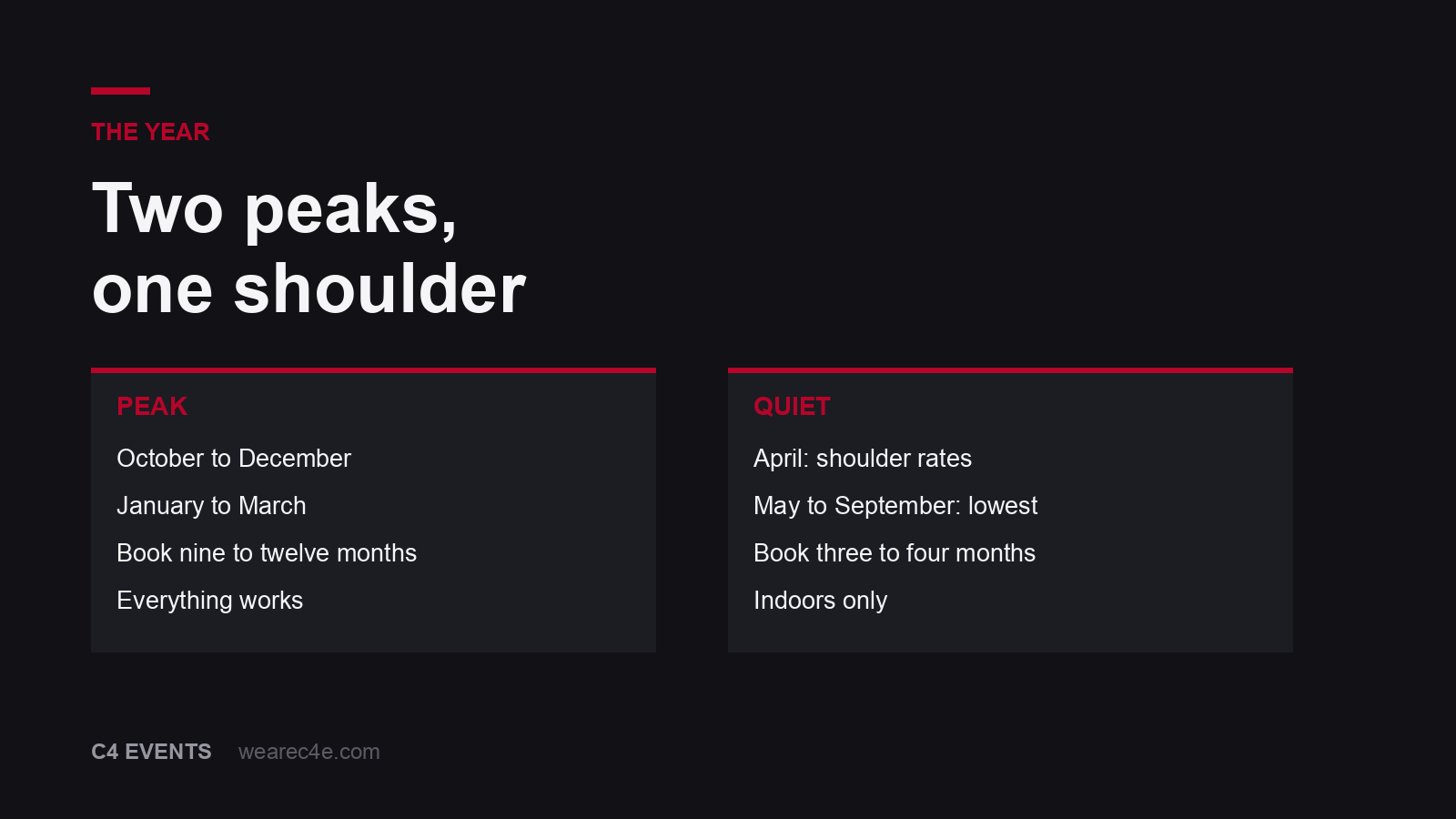
| October to December | Turning good | Everything, including outdoors | Nine to twelve months |
| January to March | Best of the year | Everything, densest show season | Nine to twelve months |
| April | Warming | Indoor, and most outdoor formats | Four to six months |
| May to September | Hot | Indoor conferences and dinners | Three to four months |
The commercial consequence of that table is the largest single lever a Dubai budget has, and it is worked through in what a corporate event costs in Dubai.
The shows that take the city
Dubai’s big trade shows do not compete for your audience. They compete for your hotel rooms, your crew, your trucks and your rigging. In their weeks, room rates across the city move and the good suppliers are already committed.
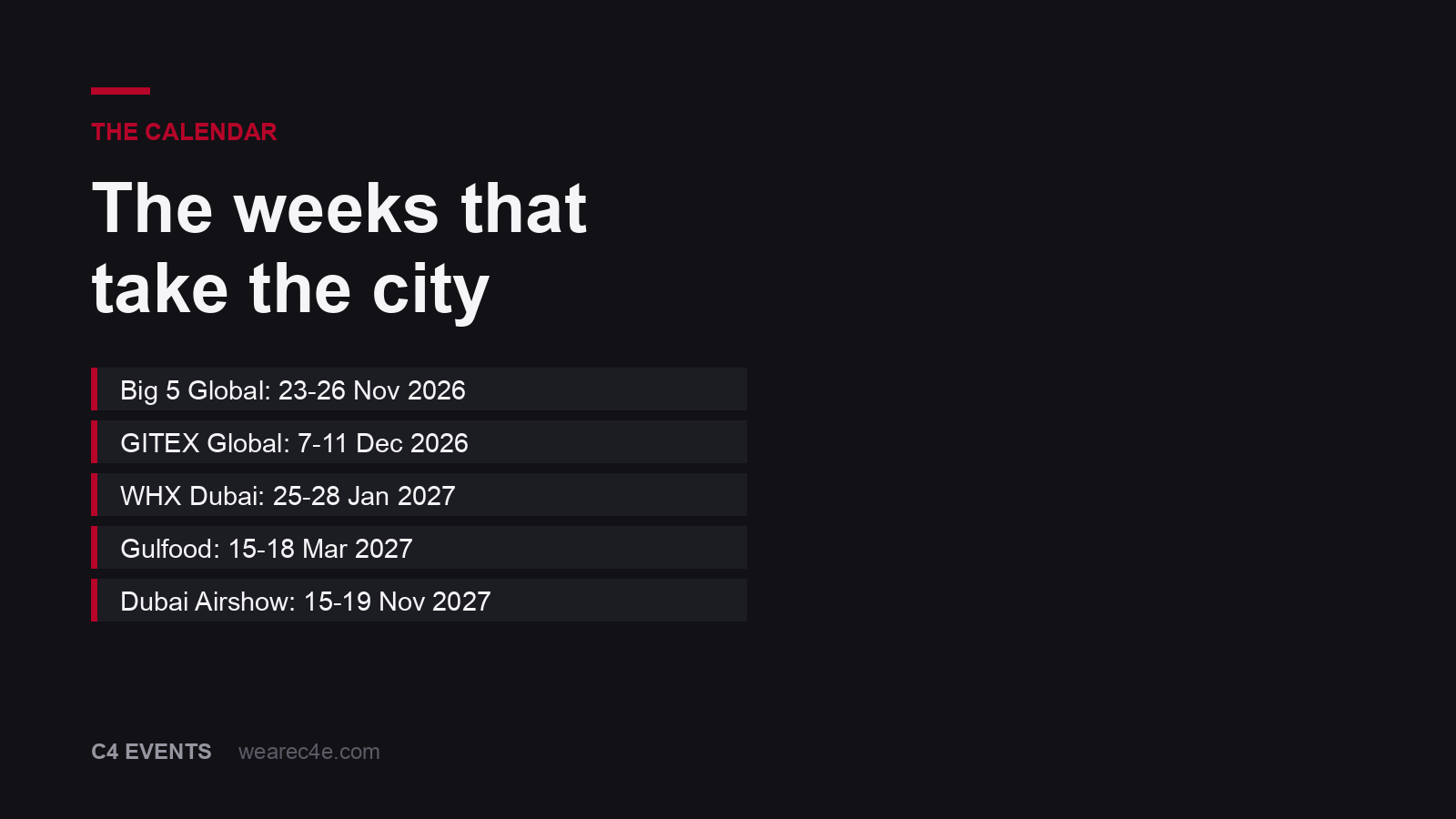
These are the four that move the market most, with the dates each show publishes.
| Show | Dates | Where |
|---|---|---|
| Big 5 Global | 23 to 26 November 2026 | Dubai World Trade Centre |
| GITEX Global | 7 to 11 December 2026 | Dubai |
| WHX Dubai, once Arab Health | 25 to 28 January 2027 | Dubai Exhibition Centre |
| Gulfood | 15 to 18 March 2027 | Dubai |
| Dubai Airshow | 15 to 19 November 2027 | Dubai World Central |
One of those deserves a flag. GITEX has moved. The show that anchored October for years sits in December for 2026, which redraws the back end of the year for anyone who had learned the old pattern. If your annual event has always been in early December because GITEX was in October, check the date before you repeat it.
The Abu Dhabi Grand Prix belongs on the same list even though it is in a different emirate. The 2026 race runs 4 to 6 December, it pulls hotel demand across the UAE, and it lands beside the National Day holiday. The first week of December is a crowded week to be planning an arrival.
The holidays
The UAE publishes its public holidays as a mix of fixed Gregorian dates and Islamic dates set by moon sighting.
| Holiday | When |
|---|---|
| Gregorian New Year | 1 January |
| Eid Al Fitr | 1 to 3 Shawwal, four days |
| Arafah Day | 9 Thu Al Hijjah |
| Eid Al Adha | 10 to 12 Thu Al Hijjah, three days |
| Hijri New Year | 1 Muharram |
| Prophet Mohammed’s birthday | 12 Rabi’ Awwal |
| National Day | 2 and 3 December, two days |
The Islamic dates move against the Gregorian calendar and are confirmed close to the time. That is a planning fact, not an inconvenience: it means a date eighteen months out cannot be checked against Eid with certainty, and it means the check gets repeated as the date approaches.
National Day is the one people underestimate. Two public holidays on 2 and 3 December, in a week the country celebrates hard, in a window that already carries peak pricing. It is a wonderful week to be in Dubai and a difficult week to be running someone else’s conference in it.
Ramadan, and the month that changes the format
Ramadan moves about eleven days earlier each Gregorian year. In 2027 it falls across February and March, which puts it inside one of the two peak windows.
What changes during Ramadan is not whether you can hold an event. It is the shape of the event you are holding.
1/ The working day shortens, which compresses the window a business audience can give you and makes a two-day agenda a harder ask than it looks.
2/ Daytime hospitality is restrained. A conference with a buffet lunch and an afternoon coffee theatre is the wrong shape for the month, whatever the venue tells you it can arrange.
3/ The evening becomes the event. Iftar and suhoor gatherings are a real corporate format in the Gulf, with their own timing, their own hospitality and their own energy. Built for the month, a Ramadan event can outperform the ordinary version. Planned as a normal conference with the food moved, it will not.
The practical rule is to decide early. Either build for the month on purpose or move the date. The failure mode is discovering the constraint in week eight and negotiating with it.
The regional calendar your delegates live in
A Dubai event seldom draws from Dubai alone. If your audience travels from India, Saudi Arabia, Egypt, Pakistan or East Africa, their calendars decide your attendance as much as the UAE’s does.
| Market | What to check | Effect on attendance |
|---|---|---|
| India | Diwali, the wedding season, financial year end in March | Senior travel dries up around all three |
| Saudi Arabia | Ramadan, Eid, national day in September | Whole weeks unavailable |
| Europe | August, and the fortnight around Christmas | Headquarters approvals stall |
| North America | Thanksgiving week, year-end budget cycles | Late confirmations and late cancellations |
The failure here is subtle. The date clears every Dubai check, the venue is available, the price is fine, and then registration comes in at 60 percent of the target because a third of the list is in a market that does not travel that fortnight. Check the passports on your invite list against their own calendars before you lock a week.
Booking windows, by format
Different formats need different lead times, and treating them all the same is how a good date gets lost.
| Format | Peak season lead time | Summer lead time |
|---|---|---|
| Meeting room, under 80 | Six to eight weeks | Three weeks |
| Ballroom conference, 150 to 400 | Six to nine months | Three months |
| Gala in a landmark venue | Nine to twelve months | Four months |
| Exhibition hall | Twelve months or more | Six months |
| Anything outdoors | Nine months, and only in season | Not available |
The bottom row is the one to internalise. Outdoor space in Dubai is not a year-round product. It is a five-month product with a queue in front of it, and the queue forms while you are still deciding whether the event needs a terrace.
How the calendar interacts with the permit
Peak weeks do not slow the approvals down. They slow down the people who answer the approvals: the venue operations team, the rigger who has to produce a load calculation, the supplier who needs an accreditation processed. All of them have four other events that week.
Which is why the permit advice in the Dubai event permit guide is to start the week the venue is signed, and why it matters more in February than in July.
A working method
Here is the sequence we run on every Dubai brief before a venue is contacted.
| Step | Check | Outcome |
|---|---|---|
| 1 | Which of the four windows is the date in? | Sets the budget shape |
| 2 | Does it collide with Ramadan or Eid? | Sets the format, or moves the date |
| 3 | Does it collide with a major show week? | Sets the room rate and the supplier bench |
| 4 | Is it inside a public holiday? | Attendance risk, both local and regional |
| 5 | Does the format need outdoors? | If yes, months five to nine are gone |
Five questions, twenty minutes, and they will save you more money than any other twenty minutes in the project.
The weeks nobody warns you about
Two more windows catch people, and neither appears on a venue calendar.
The first is the fortnight either side of a school term change, when families travel and senior people take leave. The second is the run-up to a fiscal year end, which for a lot of the companies attending your event falls in December or March. Budget holders in that fortnight are approving nothing and travelling less.
Neither makes a week impossible. Both change what registration looks like, and both are worth knowing before you set an attendance target that somebody will be measured against.
If the date cannot move
Sometimes it cannot. The leadership team is only free in that week and the event is happening then.
In that case, move the things that can move. Book earlier than you think you need to. Take the shoulder days either side of a show week rather than the middle. Choose a venue outside the district the show is in. Lock your production supplier before the show organisers do. And put the room-rate risk in the budget as a line rather than as a hope.
If Dubai in that week is going to be expensive and difficult, it is also worth pricing the same brief in Abu Dhabi or against the wider region in the Gulf city comparison. Sometimes the answer is ninety minutes down the road.
The point
Dubai rewards planning ahead more than almost any market we work in, because the gap between a well-timed date and a badly-timed one is measured in tens of thousands of dirhams before anybody has negotiated anything.
Check the window, check Ramadan, check the shows, check the holidays, check whether you need sky. Then brief the venues.
How we run events here is on the Dubai page, the rooms are in the venue comparison, and if you want us to check a specific week against all of it, send us the date.
What did I miss?
Frequently asked questions
What are the worst weeks to hold a corporate event in Dubai?
The weeks of the largest trade shows, because they take hotel inventory across the city and push room rates up hard for everyone else in town. Gulfood, GITEX Global, WHX Dubai and Big 5 Global are the four that move the market most. Ramadan is a separate consideration, and so is the National Day period at the start of December.
When is Ramadan in 2027?
Ramadan moves about eleven days earlier each Gregorian year and the start is confirmed by moon sighting rather than by calendar, so the exact date is announced close to the time. For 2027 it falls in the February to March window. Check it against your dates before you hold a venue, because it changes what is appropriate, what is available and what your local attendance will be.
Can you hold a corporate event during Ramadan in Dubai?
Yes, and plenty happen. What changes is the shape. Daytime hospitality is restrained, the working day is shorter, and the evening becomes the event: iftar and suhoor gatherings are a genuine format rather than a compromise. What does not work is a daytime conference with a lunch buffet and a drinks reception. Design for the month or move the date.
What are the UAE public holidays?
The UAE lists Gregorian New Year on 1 January, Eid Al Fitr from 1 to 3 Shawwal, Arafah Day on 9 Thu Al Hijjah, Eid Al Adha from 10 to 12 Thu Al Hijjah, the Hijri New Year on 1 Muharram, the Prophet Mohammed’s birthday on 12 Rabi’ Awwal, and National Day on 2 and 3 December. The Islamic dates are set by moon sighting.
When is Dubai’s peak event season?
October to December and January to March. Both are peak, for different reasons. The first is when the weather turns and the outdoor season opens. The second is the densest stretch of the trade-show calendar. Prime venues in either window are held nine to twelve months out.
Is summer a bad time for an event in Dubai?
It is the cheapest time and the most workable one for anything indoors. May to September rates fall across venues and hotels, and a conference or a ballroom dinner runs well. Outdoors does not, so if the format needs sky the month has already been chosen for you.
Do the Dubai and Abu Dhabi calendars clash?
They interact. The Abu Dhabi Grand Prix at the start of December pulls hotel demand across the UAE rather than in Abu Dhabi alone, and it sits close to the UAE National Day holiday. If your event is in the first week of December, check both before you commit.
How far ahead should we lock a Dubai date?
Nine to twelve months for the two peak windows, and three to four for the summer. The gap between those two numbers is the whole argument for checking the calendar before the brief goes out rather than after.