Singapore ran 156 international association meetings in 2025 and held first place in Asia Pacific for the twenty-third year running. Dubai World Trade Centre ran 71 events in the first six months of 2026 alone, across 145,000 square metres of hall.
Both numbers are true. Neither one answers your question, because your conference is not an association congress and it is not a trade show. It is 400 people who have to get on a plane.
The short answer
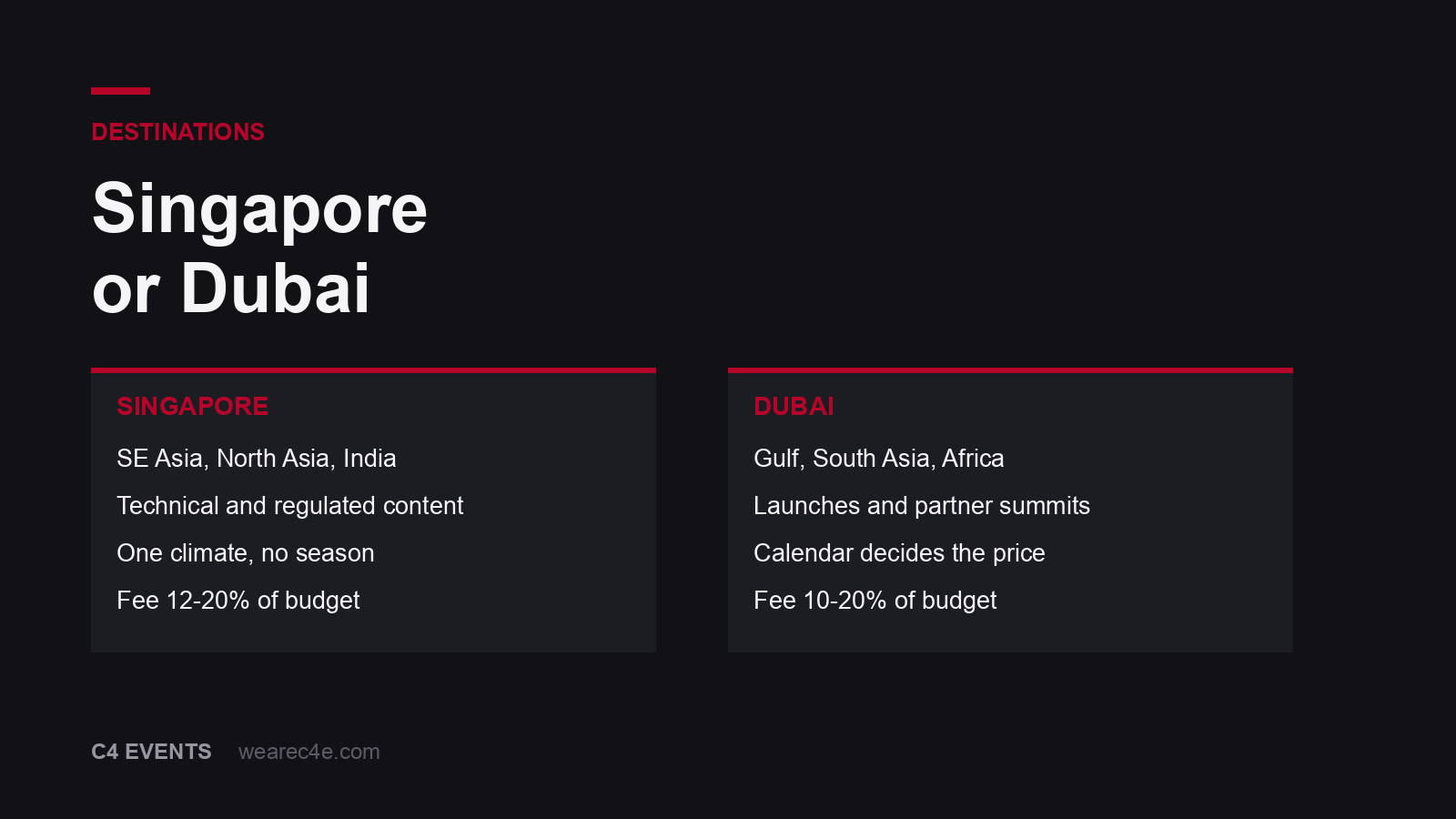
Pick Singapore when the audience sits in Southeast Asia, North Asia and Australia, when the content is technical or regulated, and when you want a city that runs without you watching it.
Pick Dubai when the audience spans the Gulf, South Asia, Africa and Europe, when the format is a launch or a partner summit that needs scale, and when your dates can bend around the calendar.
| Singapore | Dubai | |
|---|---|---|
| Delegate catchment | Southeast Asia, North Asia, Australia, India | Gulf, South Asia, Africa, Europe, India |
| Strongest formats | Conferences, technical summits, regulated industries | Launches, partner summits, exhibitions, gala nights |
| Venue anchor | Singapore EXPO, 123,000 sqm, 10 halls | Dubai World Trade Centre, 145,000 sqm |
| Agency fee band | 12 to 20 percent of budget, in the proposals we see | 10 to 20 percent of budget, in the proposals we see |
| Delegate package | S$60 to S$120 per head, full day | Wide spread. Venue and ambition drive it |
| Season risk | Low. One climate, all year | High. May to September is indoor only |
| Permit lead time | 4 to 6 weeks | 4 to 6 weeks |
| Where it hurts | Room rates in peak weeks. No cheap season | The calendar, and crew supply in show season |
Start with the passport map, not the venue
Most teams open this decision with a venue shortlist. That is the third question, not the first.
Build the delegate list. Sort it by nationality. Count the seats in each column. Then check what each of those passports needs to enter each city, and how long the slowest one takes.
A regional conference for a business whose sales force sits in Indonesia, Vietnam, the Philippines and Thailand belongs in Singapore, and the flight map says so before the venue tour does. A partner summit for distributors across Saudi Arabia, Egypt, Pakistan, Nigeria and Turkey belongs in Dubai for the same reason in reverse.
The mistake that costs the most is picking the city the head office likes and discovering in month four that a fifth of the audience cannot clear immigration in time.

What each city costs
The two markets price on different logic, and comparing a single quote from each will mislead you.
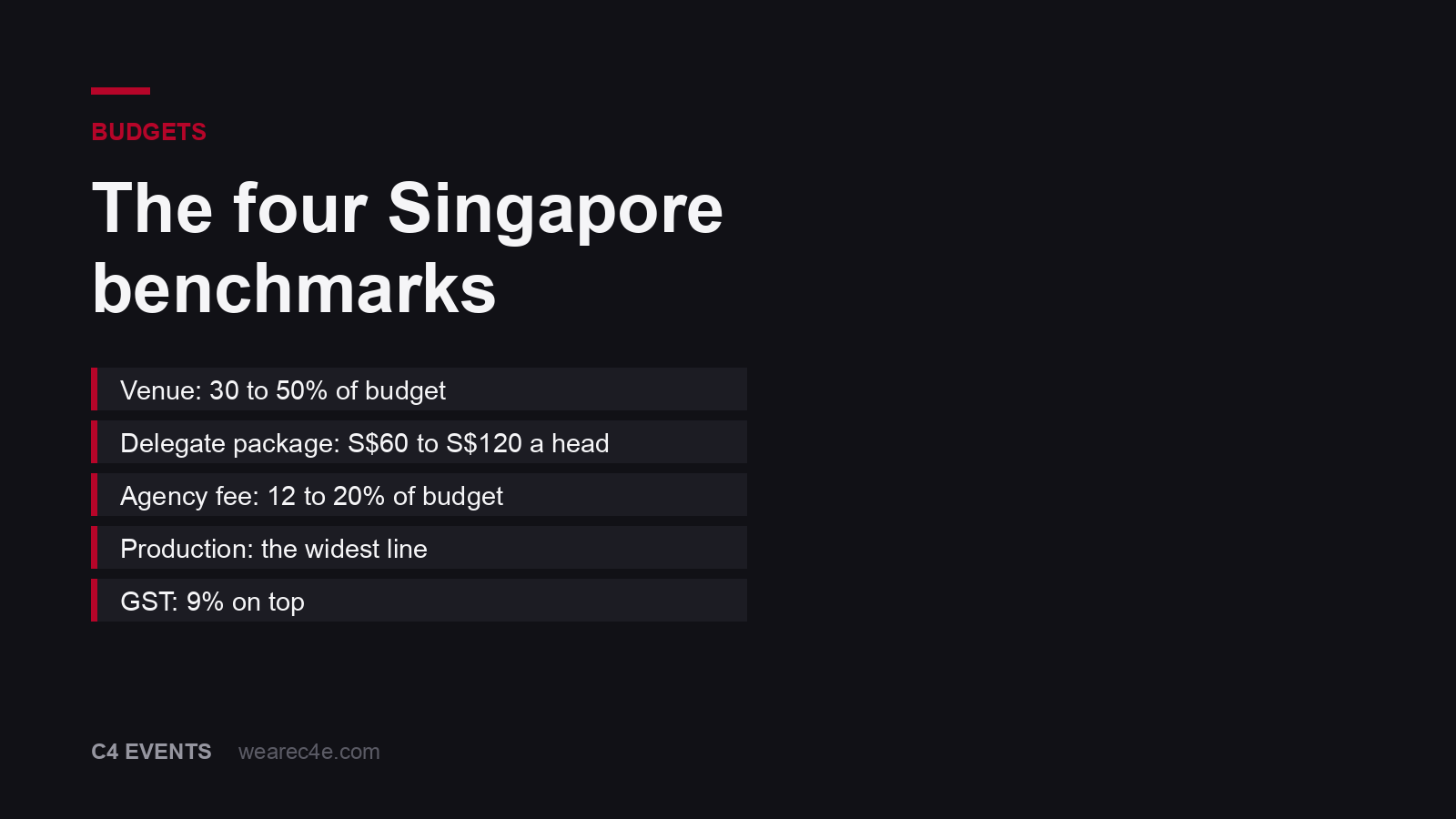
In Singapore, venue is 30 to 50 percent of a corporate event budget, agency fees run 12 to 20 percent in the proposals we see, and full-day delegate packages sit between S$60 and S$120 a head. Those bands hold across the year, which is the real advantage. A budget written in January survives to October.
In Dubai, the total moves with the season more than with the headcount. The same conference in February and in July is two different invoices. Our Dubai events guide works through what each window buys, and the Dubai cost breakdown goes line by line.
For the shape of the budget itself, in either city, our corporate event budget guide has the split that holds across the region.
The venue inventory
Dubai has more hall, and it is not close. Dubai World Trade Centre carries 145,000 square metres of event space, with the Za’abeel Halls adding 15,500 more, and around it sits five-star ballroom stock across Downtown, Business Bay, Jumeirah and the Palm.
Singapore’s anchor is Singapore EXPO at 123,000 square metres across ten halls and 32 meeting rooms, with Suntec Singapore adding 42,000 square metres and a stated capacity of 10 to 10,000 guests. Marina Bay Sands and Sands Expo sit alongside them, and Resorts World Sentosa takes the resort-format brief. Our Singapore venue comparison puts the numbers side by side.
Under 2,000 delegates, this whole paragraph stops mattering. Both cities have more ballrooms in the right size band than you will shortlist. Hall inventory decides a trade show. It does not decide a conference.
The calendar, and what it does to your budget
Singapore has one climate and no season. Dubai has four windows and they are not equal.
October to March is show season in Dubai: everything works, including outdoors, and everything costs peak. April is the shoulder month and the best value in the year. May to September is indoor only, and the rates fall far enough that a ballroom conference in July is the cheapest good option in either city.
Ramadan moves about eleven days earlier each Gregorian year. Check it against your dates before you hold anything, because it changes what is appropriate, what is open and who attends.
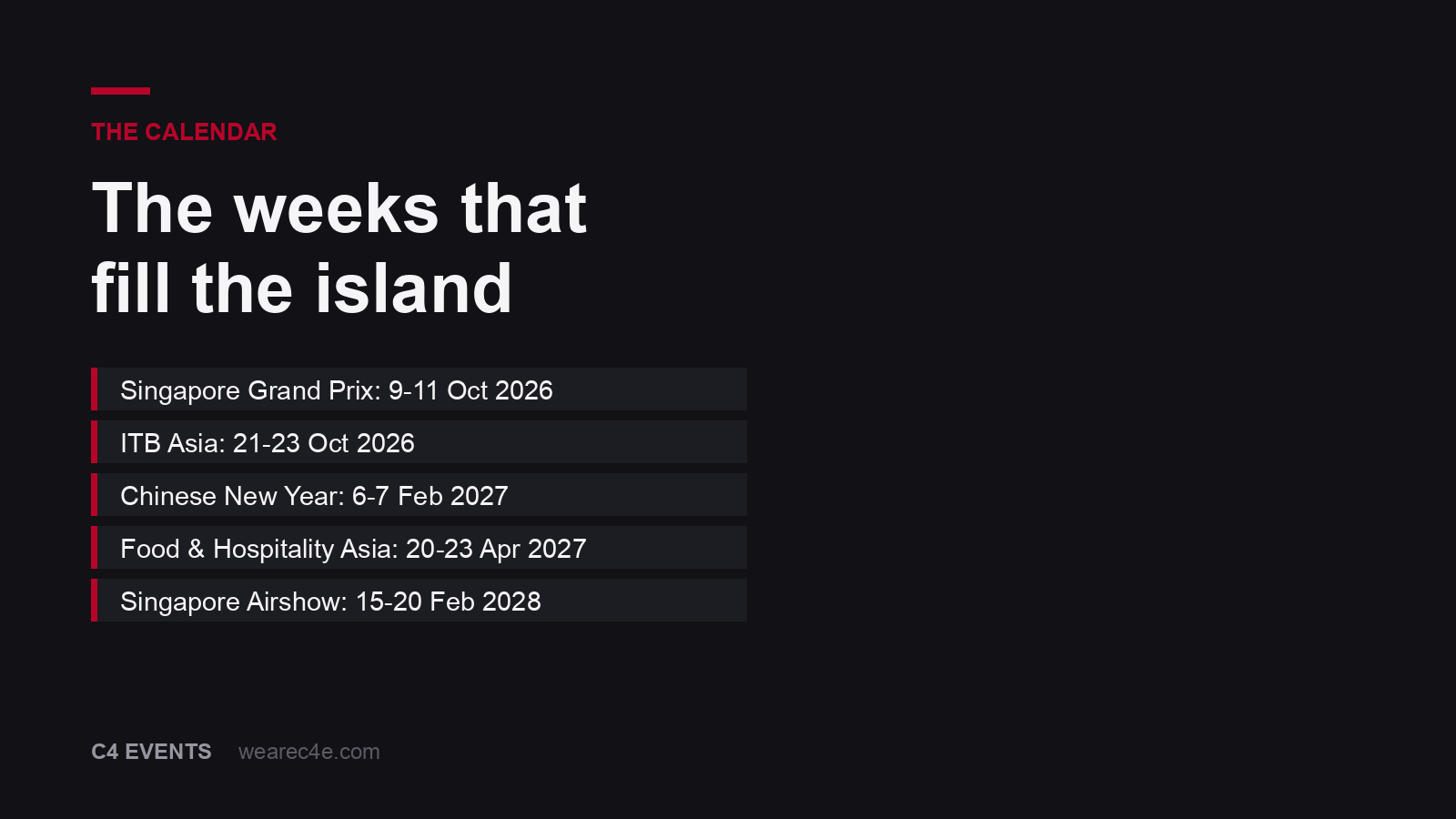
Singapore’s constraint is different and quieter. The city fills around its own show calendar, and room rates in those weeks climb without warning anyone outside the industry. Check what else is in town on your dates before you sign a hotel block.
Permits and the paperwork clock
Both cities sit in the same band: four to six weeks for event permits. Both are well documented, and both take the time they take.
The triggers are the same in each. Public space, alcohol outside a licensed venue, anything that flies, anything that burns, foreign performers, imported material. Read that list against the creative in week one rather than week nine. Our permit lead times guide has the market-by-market detail.
Drone approval near an airport is close to impossible in Dubai, and Dubai has a lot of airspace under that constraint. If the reveal depends on drones, decide the city on that fact alone.
The hotel block is the line that moves
Venue hire gets the argument. The hotel block decides the budget.
On a two-night conference for 400 people, bedrooms are the largest single block of spend in both cities, and they are the line with the most negotiating room in it. Ask for the block in writing with a release schedule, a cut-off date and an attrition threshold you can live with. Then release rooms on the schedule rather than holding them out of optimism, because unfilled rooms are billed either way. Our guide to attrition and force majeure covers what those clauses do.
Singapore’s blocks are harder to move on rate and easier to trust on quality. Dubai’s move a long way on rate depending on the month, and the same property in July and in February is two different negotiations. That single fact is worth more than any venue comparison in this article.
Where each city breaks
Singapore breaks on cost predictability at the top end. There is no cheap window to retreat into when the budget gets cut in month three, so the scope has to give instead. Teams that plan for a discount that never arrives end up removing the rehearsal day, which is the wrong line to lose.
Dubai breaks on crew supply. In February, every good showcaller, LED vendor and stream producer in the city is booked, and the ones still free are free for a reason. Book the key crew when you book the venue. A showcaller you trust is harder to replace than a screen.
Both cities break the same way on freight. Anything shipped in needs a customs plan with a named broker and a date, and the plan has to survive one delay. Build the buffer into the schedule, not into your nerves.
How to settle it in one afternoon
1/ Sort the delegate list by nationality and check the slowest visa. 2/ Put your dates against the Dubai calendar and against Ramadan. 3/ Ask whether the format needs outdoors. 4/ Price the same brief in both cities from a partner who works in both, with venue, production and fee split out. 5/ Pick the city where the risk you are worst at managing is smallest.
That fifth one decides more of these than anyone admits. A team that is good at content and bad at logistics should pick the city that carries them. A team with a strong ground partner can pick either.
What we would do
For a regional conference of 300 to 600 people with a Southeast Asian sales audience and technical content, Singapore, in a shoulder week, at Suntec or a Marina Bay hotel, with the rehearsal day protected in the contract.
For a partner summit of the same size drawing from the Gulf, Pakistan, Egypt and East Africa, Dubai, in April or in the summer window, in a five-star ballroom rather than a hall, with the crew locked nine months out.
For anything where half the audience is in each catchment, run it twice. Two 300-person events in two cities beat one 600-person event that half the room resents flying to. The second one costs less than the first, because the content and the set are already built.
In the end
The city is a logistics decision wearing a marketing costume. Your delegates will remember whether the room was full, whether the content was worth the flight, and whether anything broke on stage. None of those three live in the postcode.
Pick the city your audience can reach without resentment, then spend the argument you saved on the rehearsal.
What did I miss? If you have run the same conference in both cities and the comparison reads wrong from where you sit, tell us.
Read next
- What a corporate event costs in Dubai, in dirhams
- What a corporate event costs in Singapore, in Singapore dollars
- Singapore event grants: BEiS, tax deductions and the schemes nobody mentions
Frequently asked questions
Is Singapore or Dubai cheaper for a conference?
Dubai in its summer, Singapore across the year. Dubai’s May to September window carries the lowest hotel and venue rates in either city, and nothing outdoors works in it. Singapore has no cheap season, but it has no expensive one either, which makes a budget written nine months out survive contact with the invoice.
Which city is better for delegates flying from India?
Dubai, on flight frequency and on cost. Both cities are inside four to five hours of the major Indian metros, and Dubai carries more daily seats from more Indian cities. Singapore wins the return leg for anyone continuing into Southeast Asia.
Do I need a visa to run an event in either city?
Your delegates might, and that is the number to check first. Both cities are open to most passports, and both have passports they are slower with. Build the delegate list, sort it by nationality, and check the slowest one before you hold a venue. A conference that loses a fifth of its audience to visa refusals was decided by the city choice.
How far ahead should I book?
Nine to twelve months for a prime Dubai venue in the October to March window. Six to nine months for Singapore. Both shorten if you accept a shoulder date, and neither shortens if you want a specific ballroom on a specific Thursday.
Which city has the bigger venues?
Dubai. Dubai World Trade Centre holds 145,000 square metres of event space with the Za’abeel Halls adding 15,500 more. Singapore EXPO holds 123,000 square metres across ten halls, and Suntec adds 42,000. For anything under 2,000 delegates the difference stops mattering.
Is English enough in both cities?
Yes, for the event itself. Singapore runs on English as a working language, which shows up in signage, crew briefings and vendor contracts. Dubai’s event industry works in English too, and the government paperwork around it does not always.
Which city suits a hybrid conference better?
Singapore, on bandwidth and on crew depth for streaming. Dubai has the same capability and a thinner bench of stream producers who are free in show season, so book that role earlier than you think you need to.
Can I run the same conference in both cities in one year?
Yes, and the second one costs less to produce than the first if you keep the same production partner and the same set design. The saving lives in content, rehearsal and crew familiarity, not in freight. Shipping a set between the two seldom pays.