
Three agencies quote your conference. One says 12 percent. One says a fixed fee of USD 45,000. One says a number at the bottom of a page with no split.
The third one is not cheaper. It is the same money with the split hidden, and you have lost the ability to cut scope without reopening everything.
The four models
| Model | How it works | Rewards the agency for | Ask for it when |
|---|---|---|---|
| Management fee | A percentage of total event spend | A bigger budget | Scope is unclear and speed matters |
| Cost-plus / pass-through | Costs at cost, fee stated as a number | Delivering the agreed scope | Procurement will audit, scope is defined |
| Fixed fee | One number against a written scope | Efficiency, and tight scope control | You have run this event before |
| Commission | Supplier pays the agency a share of your spend | Steering you to commissioning suppliers | Never on its own. Ask for disclosure |
Management fee on budget
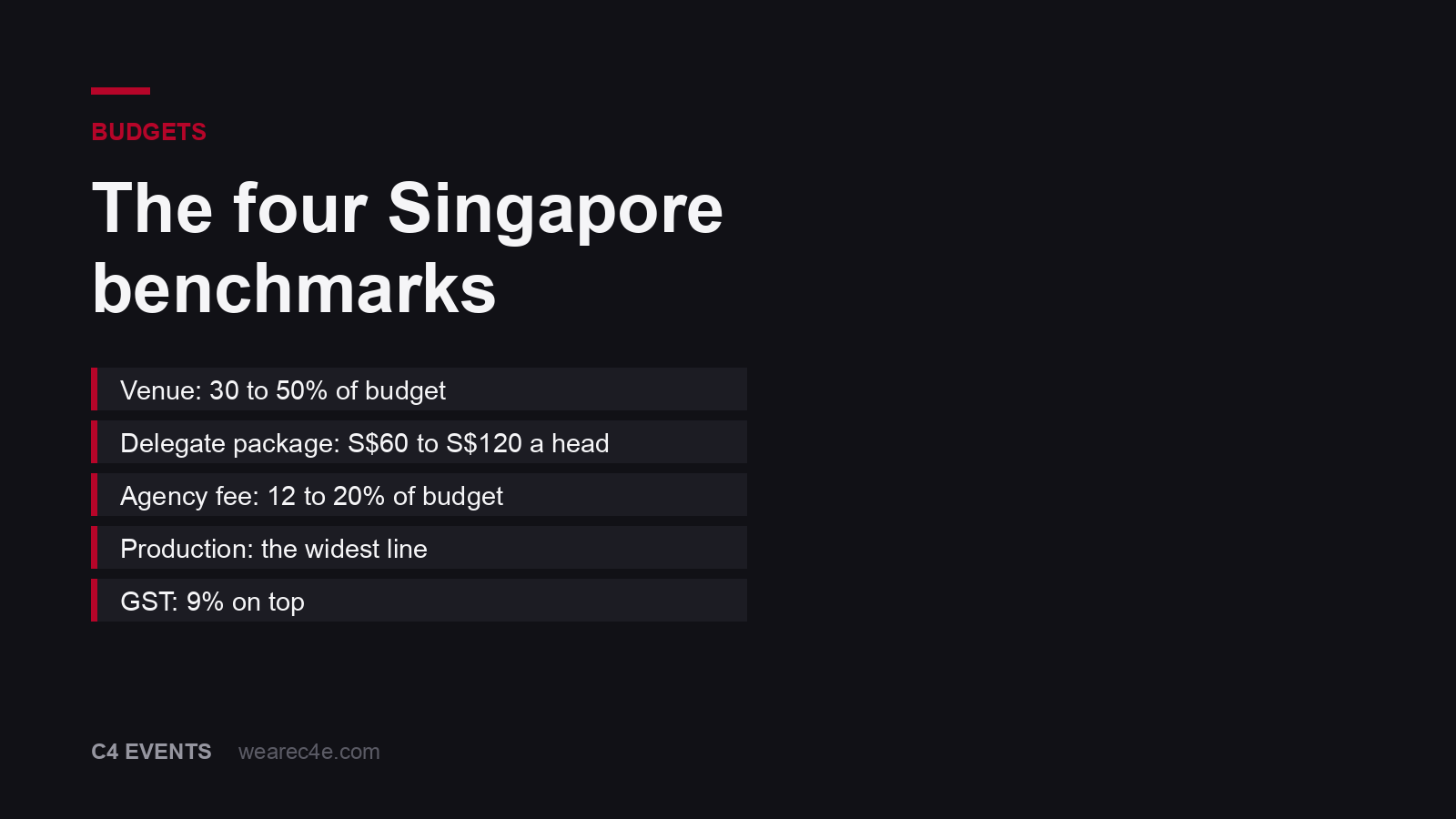
The default across most of Asia and the Gulf. The agency charges a percentage of total event spend: 12 to 20 percent in Singapore, 10 to 20 percent in Dubai, 10 to 15 percent in India.
It is popular because it is fast. Nobody has to define scope in week one to get a number, and the number scales with the event as it changes, which removes an argument every time the brief moves.
The problem is the incentive. Your agency earns more when your event costs more. Most agencies do not abuse that, and the pull still shows up in small decisions: the larger screen, the extra crew day, the venue at the top of the shortlist rather than the middle. Nobody is being dishonest. The model is pointing that way.
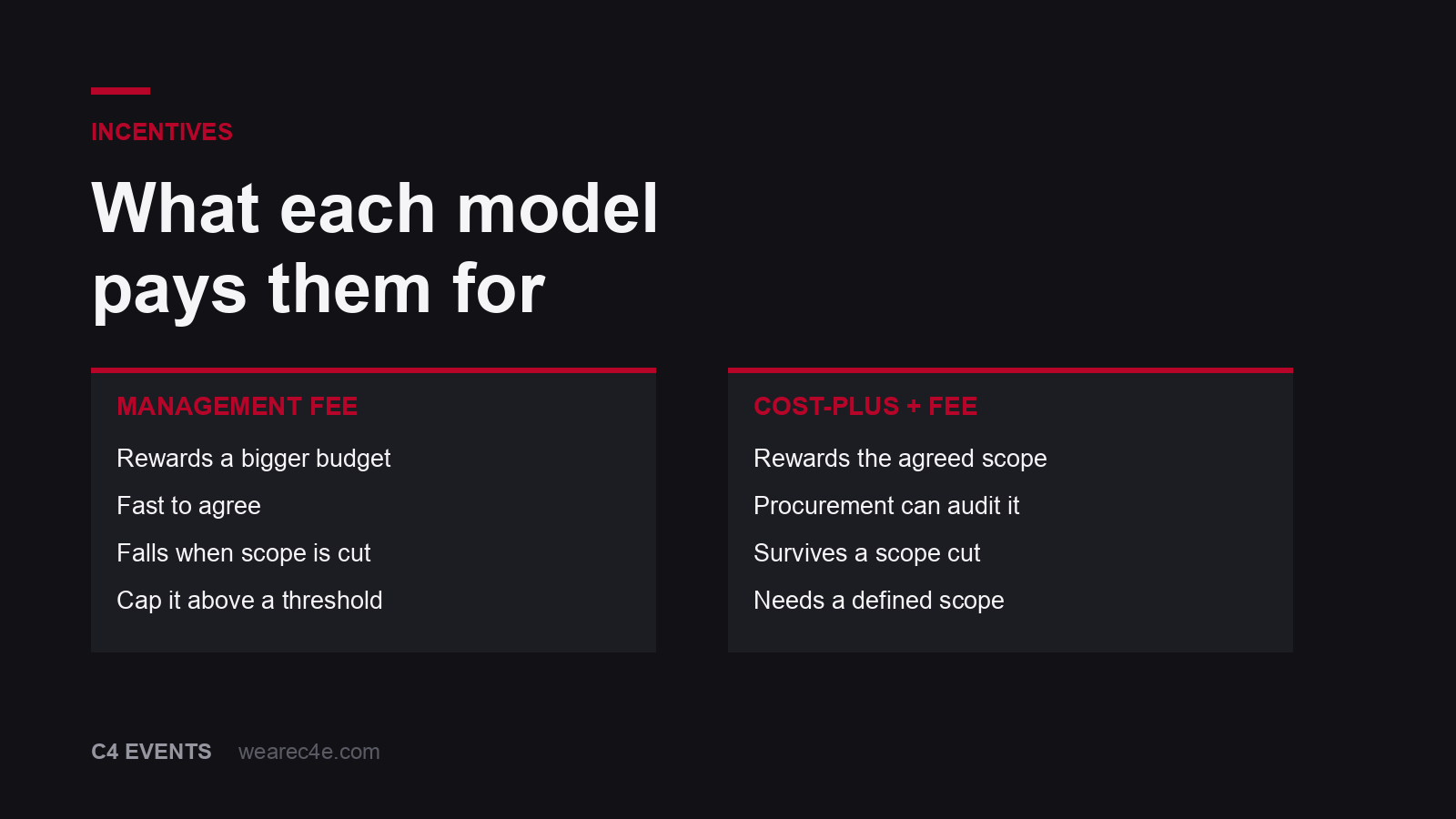
Two fixes make it workable. Cap the fee in absolute terms above an agreed budget, so growth past a threshold stops paying more. And ask for the fee to be quoted as a number alongside the percentage, so everyone can see what it is in money.
Cost-plus, or pass-through plus fee
Vendor costs pass through at cost with documentation, and the agency’s fee sits on top as a stated number.
This is the model we would ask for as a buyer. The agency is paid for the work rather than for the size of the budget, procurement can audit every line, and cutting scope in month three cuts cost without a renegotiation.
It also protects the agency, which is worth saying. When a client removes the gala dinner in week eight, a percentage fee falls with it and the agency’s work does not. A stated fee survives that conversation, and an agency that is not sitting on a resentment about a scope cut is a better agency to work with in the last fortnight.
The cost is precision. Cost-plus needs a defined scope, a documented change process and someone on your side who will read the pass-through documentation. If nobody on your team will do that, you have bought the paperwork of an audit without the audit.
Fixed fee
One number for a written scope. Best when you have run this event before and the shape is known: the annual sales conference, the recurring dealer meet, the quarter-end leadership offsite.
Fixed means fixed against that scope, and the sentence that matters in the contract is the one describing what happens when the scope moves. Agree the change-order process before the first invoice: what counts as a change, who approves it, and how the fee moves.
Without that, a fixed fee turns into an argument in month four, and the argument arrives at the worst point in the schedule for both sides.
Commission, and the question to ask out loud
Commission is money paid to your agency by a supplier, most often a hotel or venue, as a percentage of what you spend with them. It is common, legal in most markets, and invisible unless you ask.
It is not wrong on its own. In some markets it is the normal way ground services are funded, and an agency taking hotel commission may be charging you a lower fee because of it.
What matters is disclosure. Ask three questions in the first meeting. Do you take commission from any supplier on this event? From whom, and at what rate? Is it rebated to us, offset against your fee, or retained?
Any of those three answers is workable. What is not workable is finding out in month five that the venue on the shortlist was there because of a rate you were not told about.
Comparing three quotes without being fooled
Most bid comparisons go wrong the same way. Three agencies price three different events and the cheapest total wins.
The fix is one document. Write the line-item list yourself: headcount, room nights, catering standard, production spec including screen size and crew numbers, number of rehearsal days, registration scope, staffing on site, contingency. Send the same list to all three. Ask each to price every line and to name any line they have excluded.
Then compare line by line before you look at the total. Our RFP question set covers what belongs on that list, and the budget guide has the shape a real event budget takes.
The line most often missing from the cheap quote is the rehearsal day. The second is on-site staffing. Both get added in month five as a variation, at which point the cheap quote is no longer the cheap quote and you have already signed.
Contingency, and who owns it
Every event budget needs 8 to 10 percent contingency as a visible line. The question nobody asks in the fee conversation is who controls it.
If contingency sits inside the agency’s number, they will use it and you will not see what for. If it sits on your side, it stays yours, and the agency has to come and ask, which is the conversation you want to be having.
Put it on your side, name the person who approves a draw, and agree that anything unspent stays unspent. On a percentage fee model, also agree whether the fee applies to contingency spend. That single sentence is worth writing down.
The number below which you should worry
A bid that comes in under 8 percent of budget on a management fee model is telling you something, and it is worth working out what.
There are three honest explanations. The agency is buying the relationship on a first event and has decided to. The agency takes supplier commission that funds the gap. Or the scope in their quote is thinner than the scope in the others, and the difference will arrive as variations.
All three are workable if you know which one you are looking at. Ask straight, in the meeting: at this fee, what are you not doing that your competitors are? A good agency will answer that question, because they wrote the number and they know what is in it.
The dishonest fourth explanation is a fee that assumes variations. The bid wins on price, the scope gaps surface from month three, and each one arrives as a change order at a rate nobody negotiated. By the time the total matches the higher bid you have already signed and the schedule has no room to retender.
What to ask, in order
1/ Which model is this quote, and what is your fee as a number rather than a percentage? 2/ Are vendor costs at cost or marked up, and will you show the documentation? 3/ Do you take supplier commission on this event, from whom, and is it rebated? 4/ What is excluded from this number that a working event needs? 5/ How does the fee move when the scope moves?
Five questions, one meeting. An agency that answers all five straight is one you can work with on the model of their choosing. An agency that gets vague on the second or third has told you which model you should insist on.
Get it in the contract, not the email
Whichever model you land on, three sentences belong in the signed document rather than in a thread nobody can find in month five.
What the fee covers and what it does not. How the fee changes when the scope changes, with the approval route named. And whether supplier commission is taken, from whom, and what happens to it.
Those three sentences take one meeting to agree at the start and settle every fee argument that would otherwise arrive in the last fortnight, which is the point in the schedule where neither side has the time to have it.
In the end
No fee model is honest or dishonest on its own. Each one pays your agency to do something, and the only mistake is not knowing which something you are paying for.
Ask for cost-plus with a stated fee, put contingency on your side, and ask the commission question out loud in the first meeting. The rest of the negotiation gets easier after that.
Setting these fees rather than paying them? How to start an events business works the same models from the agency side of the table.
What did I miss? If you buy events for a living and there is a model that works better from your side of the table, tell us what it is.
Frequently asked questions
Which event agency fee model is best for the buyer?
Cost-plus with a fixed fee, in most cases. Costs pass through at cost, the fee is a number you agreed, and the agency has no incentive attached to your budget going up. It also demands more of your procurement team, which is why the percentage model survives.
What is a normal event management fee?
10 to 20 percent of event budget across the markets we work in. Singapore sits at 12 to 20 percent, Dubai at 10 to 20 percent, India at 10 to 15 percent. Below 8 percent, ask where the rest of the margin is coming from.
What is wrong with a percentage fee?
It pays your agency more when your event costs more. Most agencies do not abuse this and the incentive still points the wrong way, and it shows up in small decisions rather than large ones: the larger screen, the extra crew day, the venue at the top of the shortlist.
What is commission, and should I care?
Commission is money paid to your agency by a supplier, most often a hotel or a venue, as a percentage of what you spend. It is common and legal in many markets. What matters is disclosure. Ask whether they take supplier commission, from whom, and whether it is rebated to you.
How do I stop a low quote from being a trap?
Compare like for like on scope, not on total. Ask every bidder to price the same line-item list with the same headcount, the same production spec and the same number of rehearsal days. Most low quotes are low because something was left out.
Is a fixed fee risky for the agency?
Yes, and that is why it comes with a defined scope and a change-order process. Fixed means fixed against a scope. Change the scope and the fee moves, and both sides should have agreed how before the first invoice.
What should I never accept?
A single blended number with no line items. You cannot audit it, you cannot compare it, and you cannot cut scope from it without renegotiating the whole thing. Ask for the split every time.
Do agencies mark up production?
Some do, and it is a legitimate model when disclosed. Ask straight: are vendor costs passed through at cost, or marked up? Both answers are workable. An evasive answer is the problem.