
The events business looks like a creative business and runs like a logistics business with a cash flow problem.
You get paid after the event. You pay vendors before it. That gap is where most new event companies die, and it has nothing to do with talent.
What follows is the version nobody puts in the brochure. How the money moves, what belongs in the contract before you sign it, when to raise permits, and which hire to make first. It holds whether you are starting in Dubai, Singapore, Bangkok, Mumbai or Ho Chi Minh City. The shape of the problem does not change with the postcode. The tax rate does.
A short prologue
C4E has run corporate events for twenty years, across 40+ countries. Conferences, dealer meets, incentive travel, offsites, exhibitions. Long enough to have made most of the mistakes twice.
Here is what nobody tells you when you start. The hard part of an event is not the idea. It is the Tuesday three weeks out when the venue moves your load-in window by four hours, the LED vendor wants a second advance, and the client asks whether you can add a gala dinner for 200 more people.
Everyone can picture the show. Almost nobody can picture the cash flow.
What changed between 2019 and 2026
Four shifts, and each one moves where a new company should point itself.
Hybrid stopped being a feature and became a line item. Clients expect a stream. That means cameras, a switcher, an encoder, redundant bandwidth and a person whose only job is the stream. It is a production department, not a laptop.
Destination events came back harder than they left. Dubai, Singapore, Bangkok, Bali and Vietnam now absorb budgets that used to stay in the client’s home city. If you cannot deliver across a border, you are bidding for a shrinking half of the market. Our guide to MICE destinations across Asia covers how the markets differ.
Procurement got sharper. Clients now ask for line-item budgets. The old model of a single blended number with margin buried inside it does not survive a modern RFP.
AI ate the deck, not the show. Proposals, moodboards, run sheets and first-draft scripts now take hours instead of days. That lowered the cost of pitching, which means your client is comparing more bids than before. It did not touch the part where 400 people need to be fed at 1pm.
Lesson 1: This is a cash flow business wearing a creative costume
Why do profitable event companies still run out of money?
Because profit and cash are different, and events separate them by 90 days.
A typical corporate event: the client signs, pays 30% or 40% on booking, and settles the balance 30 to 60 days after the event. Your vendors want it sooner. Venues want a deposit to hold the date. AV wants 50% before trucks move. Talent wants payment before they walk on.
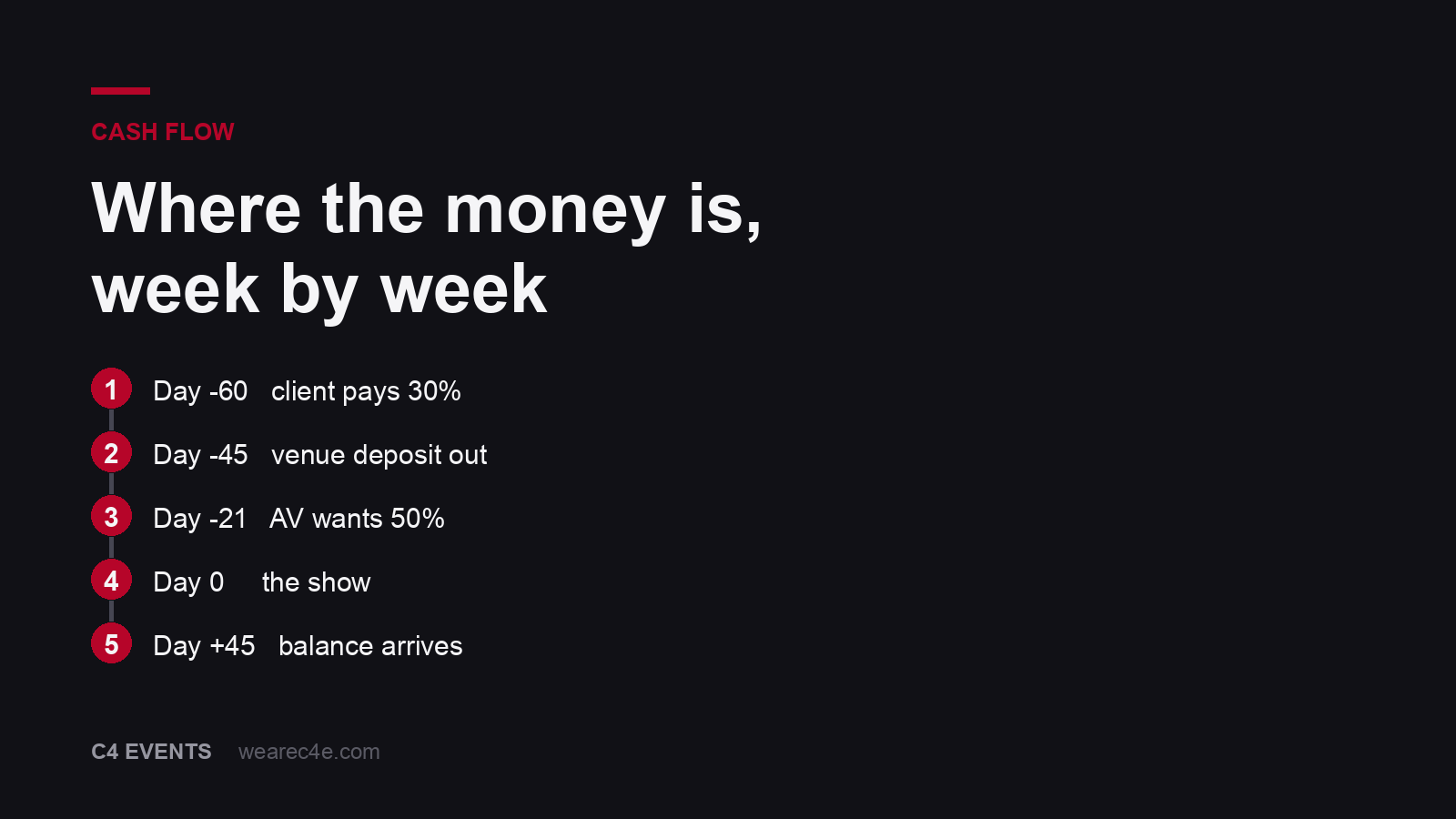
Run the arithmetic on a USD 250,000 event carrying a healthy 15% margin. The client advance at 30% gives you USD 75,000. The venue deposit and the 50% due to AV can take USD 110,000 back out before a truck has moved. You are USD 35,000 of your own money into an event that is profitable on paper, and you stay there for six weeks. Two of those running at once and you are borrowing to stay solvent.
Three rules fix most of it. 1/ Never sign a client contract whose payment terms are slower than your vendor terms without pricing that gap in. 2/ Take the booking advance before you commit to any vendor, with no exceptions for clients you like. 3/ Keep one month of vendor float in the bank that you never touch for salaries.
PS: the fastest route to a cash crisis is a big win. Growth eats working capital, and it eats it before the invoice clears.
Lesson 2: Pick a format before you pick a city
Should I specialise or take any event that comes?
Specialise, then widen.
“We do all events” tells a buyer nothing and prices you against everyone. “We run dealer and channel meets for auto and FMCG across South and Southeast Asia” tells a buyer you have done their event before. That sentence wins bids.
The formats worth choosing between: conferences and conventions, dealer and channel partner meets, incentive travel, corporate offsites, product launches, exhibitions, gala and awards nights. Each has a different cost shape, a different lead time and a different buyer inside the client company. Dealer meets sit with sales. Offsites sit with HR. Exhibitions sit with marketing. Those three people do not talk to each other, and they do not buy alike.
Take the format you have delivered most and write everything you know about it in public. Then let the second format arrive through a client who already trusts you.
Lesson 3: Price on scope, not on your day rate
How should I price an event in 2026?
Two models dominate, and you should know which one you are in before the first meeting.
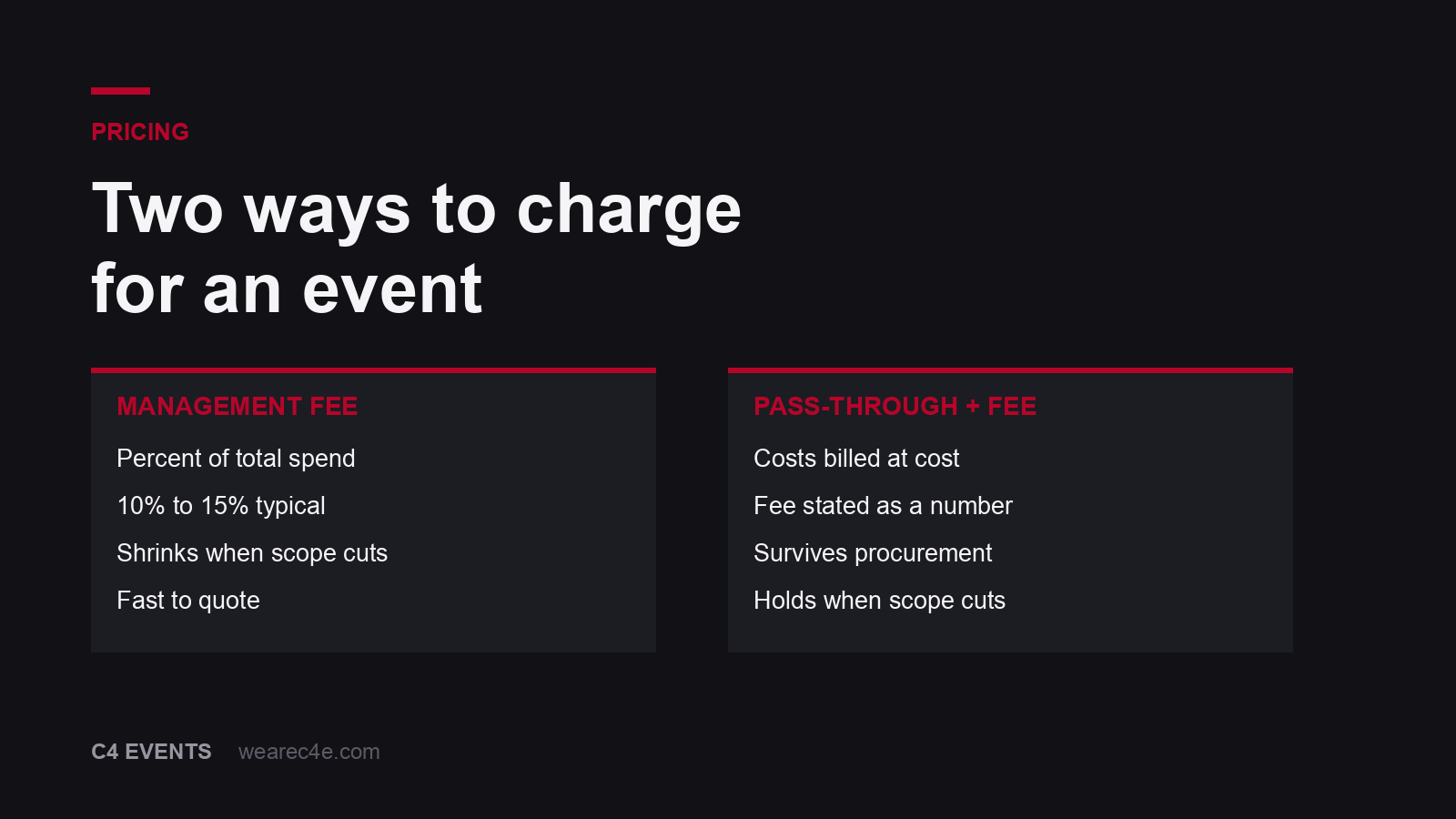
Management fee on budget. You charge a percentage of total event spend. Across India this sits around 10% to 15%. In Dubai it runs 10% to 20%, with minimum project fees from about AED 10,000 to AED 25,000 for small corporate functions. In Bangkok, planner fees cluster at 10% to 15% with minimums attached to the smaller formats.
Pass-through plus fee. Vendor costs pass through at cost and your fee sits on top as a stated number. Procurement teams prefer this because they can audit it. It also protects you when the client cuts scope, because your fee is not a percentage of a shrinking number.
The trap is the day rate. An event is not billable hours. You are selling a delivered outcome on a fixed date that cannot slip, and the risk of that date is most of what the client is buying. Price the risk.
For reference points, a dealer meet in the Indian market runs from about USD 25,000 to USD 180,000 depending on headcount, city and production scale, which is the range our dealer meet cost breakdown walks through line by line. Incentive travel worldwide averages around USD 5,100 per person. Use ranges like these to sanity-check a brief. Never quote from them.
Lesson 4: Your margin lives in production, not in your fee
Where does the money go on an event?
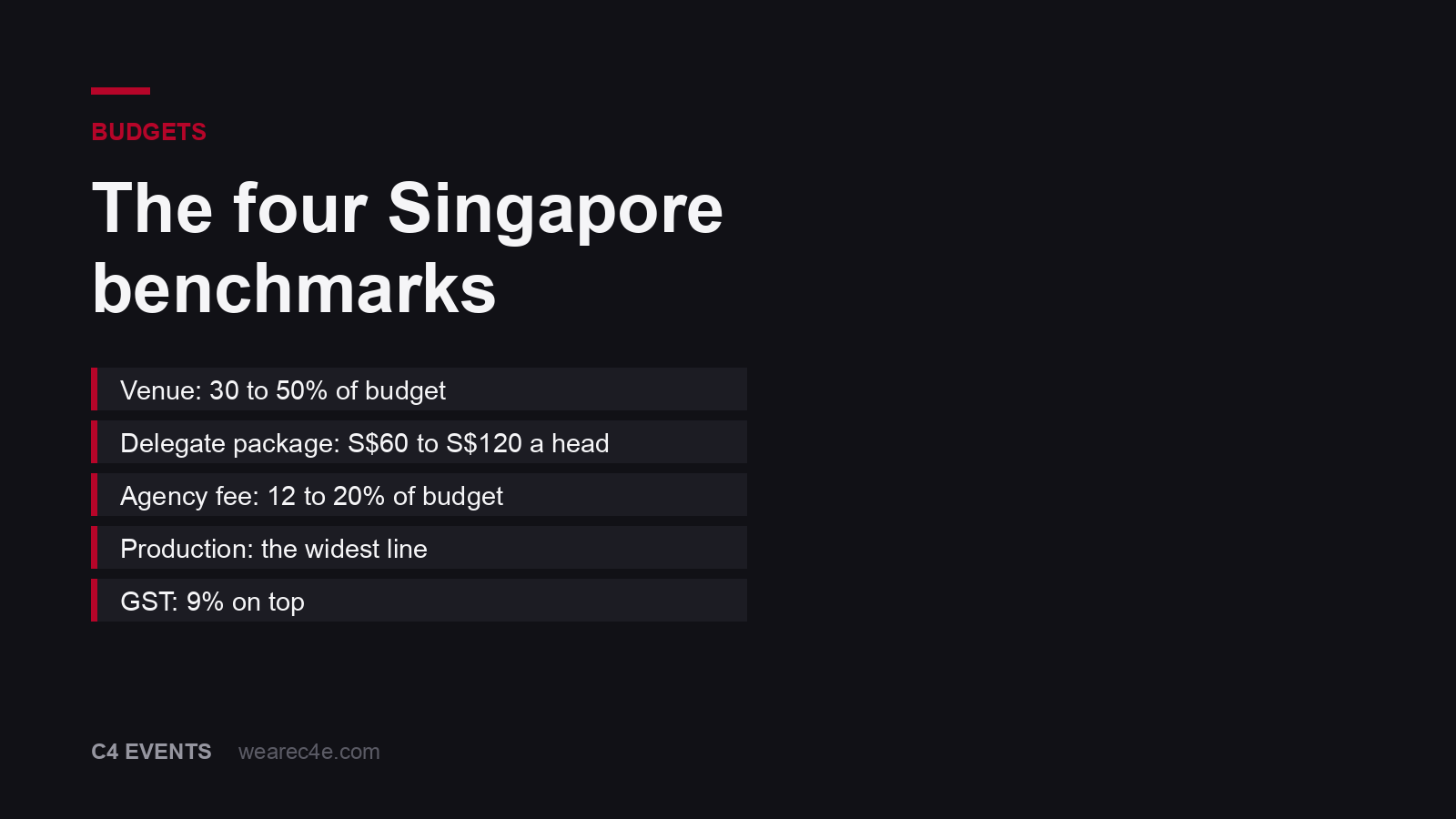
Rough shape for a mid-size corporate conference: venue and F&B is the largest single block, production (stage, LED, audio, lighting, crew) is next, then travel and accommodation, then content and talent, then your fee, then contingency. The full split sits in our corporate event budget guide.
Two lines decide whether you make money.
Production. This is the block where quotes vary most between vendors, where scope creeps hardest, and where a client change on Wednesday costs real money on Friday. Get production quoted line by line from day one, and read our breakdown of what conference production costs before you accept a blended number.
Contingency. Carry 8% to 10% and write it into the budget as a visible line. Clients accept contingency when it is named. They do not accept a surprise invoice after the event.
The rehearsal is the line everyone cuts and everyone regrets. A full technical rehearsal costs a day of crew and venue. Skipping it costs the keynote.
Lesson 5: Vendors are your balance sheet
How do I build a vendor bench I can trust?
Over time, and by paying on the date you said you would.
You do not own trucks, LED walls or kitchens. You own relationships with the people who do. In a peak week in any event city, inventory runs out. The company that gets the last LED wall is the one that paid its last three invoices on the date it promised.
Build a bench of at least two vendors per category before you need them. One is a single point of failure. Three is a discount you have not earned yet.
Ask every vendor for a named person who will be on comms during your show. A company name is not accountability. A phone number is.
PS: pay small vendors first and fast. They remember it for a decade, and they are the ones who save you at 2am.
Lesson 6: Three clauses decide what you owe
What do I need in an event contract?
Attrition, force majeure and cancellation. Learn these three before you learn anything else about contracts. We go deeper on all three in the event contract guide.
Attrition is the penalty when you book 300 room nights and fill 240. Hotels bill the shortfall. Negotiate the threshold and the review dates so you can release rooms before the penalty bites.
Force majeure decides who pays when the event cannot happen. Post-2020 contracts are tighter and less generous than people assume. Read what counts as a triggering event and what does not.
Cancellation is a sliding scale by date. Know your cut-off dates and put them in your own client contract, matched to the ones your venue holds over you.
The rule underneath all three: never accept terms from a venue that you have not passed through to your client. If the hotel can charge you for 60 empty rooms, your client contract must say the client carries that. Otherwise you are underwriting their headcount forecast with your own balance sheet.
Lesson 7: Permits are a week-one conversation
What approvals do corporate events need?
Inside a licensed hotel or venue, running a standard programme, the venue’s licence covers you. Your own approvals start the moment any of these become true.
- The event uses public space: a beach, a park, a street, a heritage site
- Alcohol is served outside a licensed venue
- Anything flies, drones above all
- Anything burns: fireworks, pyrotechnics, open flame
- Foreign performers or foreign technical crew are working
- Material is imported: stands, product, gifts, printed graphics
- The gathering crosses a public-safety threshold
Read that list against the creative in week one. Almost every permit crisis starts as a creative decision taken without a permit conversation.
Lead times vary by market and they are real. Our permit lead times guide has the market-by-market numbers. Dubai’s system is mature and well documented, and the approvals still take the time they take. Drone approval near airports is close to impossible, and Dubai has a lot of airspace under that constraint.
Lesson 8: The client is buying certainty, not creativity
What do corporate clients want from an event partner?
They want to stop worrying.
The person who hires you has their name against this event inside their company. Their fear is not that the show will be plain. It is that something will break in front of 400 people and their boss.
So sell the boring parts. A named showcaller. A written run of show with hard and soft timings. A redundancy plan for the stream. A risk register with owners. A single phone number on the day. Even the small tools read as competence: a visible countdown on stage, run from a proper event timer, tells a room full of speakers that somebody is holding the schedule.
The agency that shows a client its rehearsal schedule wins against the agency that shows a better moodboard. Every time.
Lesson 9: Be findable on Google and inside AI assistants
Do event companies still need SEO in 2026?
Yes, and now you need a second discipline next to it.
Buyers still search. “Event management company in Dubai”, “corporate event budget”, “dealer meet cost” are real queries with real intent behind them. Write the page that answers each one with actual numbers. Most agency websites are a logo wall and a contact form, which is why the ones that publish costs get the enquiry.
The new part: buyers also ask ChatGPT, Claude, Perplexity and Google’s AI answers. Those systems cite pages that state facts, answer questions in the words people use, and carry clean structured data. A brochure page gives them nothing to quote.
Practical version. Publish guides that answer one question each. Put the price ranges in. Add FAQ schema. Keep a plain-language page that says what you do and what you do not do, addressed to machines as much as people.
Lesson 10: Build for the second event, not the first
How do event companies grow?
Through repeats, not pitches.
A corporate client who runs one annual conference also runs quarter-end sales meetings, a dealer meet, an offsite and a launch. The first event is an audition for a portfolio you cannot see yet.
Which means the debrief matters more than the pitch. Send the post-event report inside 72 hours, with attendance against registration, session retention, feedback and photographs. Say what broke and what you would change. Clients rebook the agency that tells them the truth about their own event. Our guide on measuring event ROI covers what to put in that report.
The economics are stark. Winning a new client costs pitches, decks and site visits. Winning the second event from an existing client costs one email.
Lesson 11: Hire crew before you hire staff
How big should my team be?
Smaller than you want, for longer than is comfortable.
Event work arrives in spikes. You have four events in March and one in July. A salaried team sized for March loses money for the rest of the year, and a team sized for July cannot deliver March.
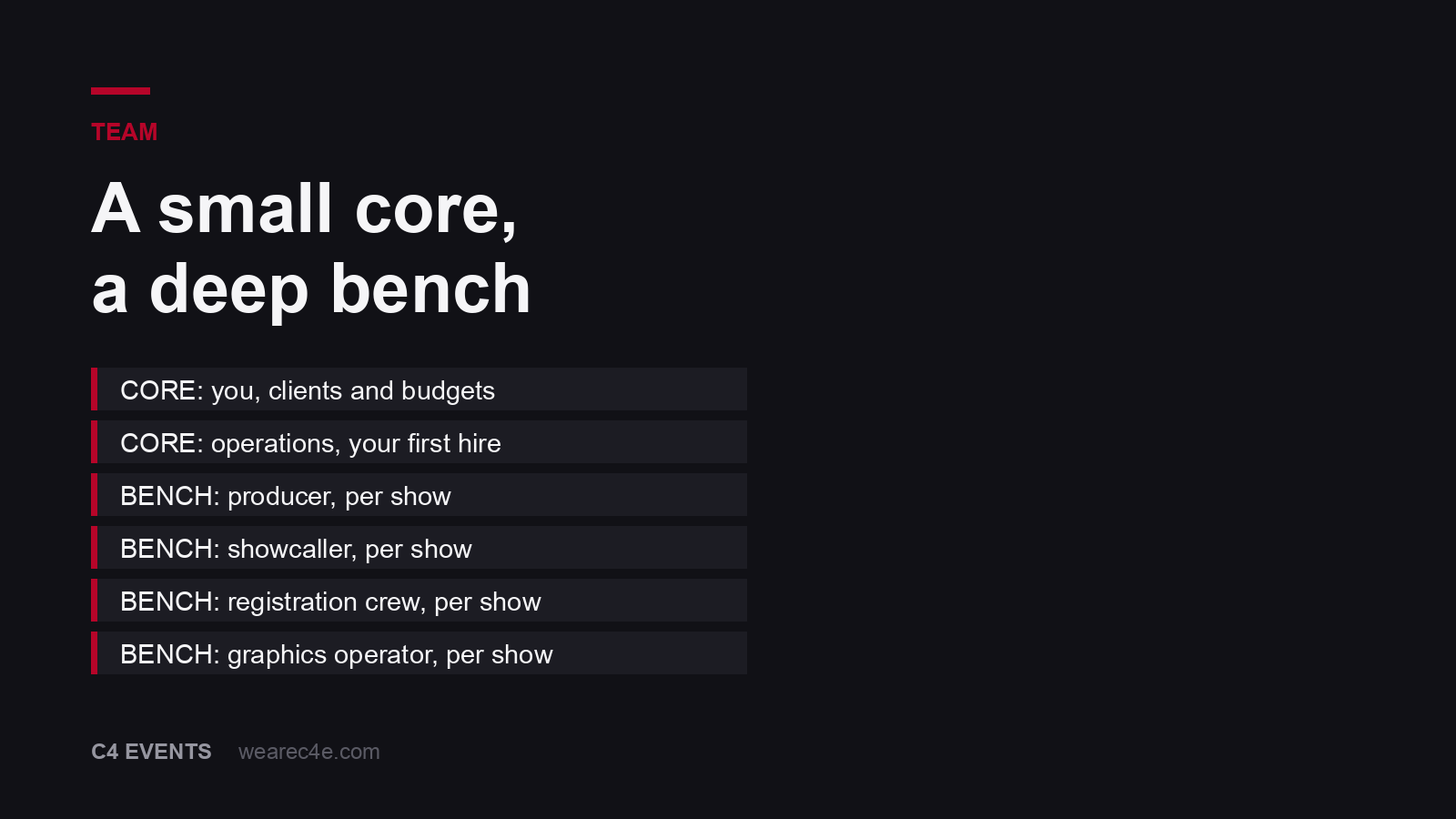
So the shape that works is a small core and a deep freelance bench. The core is the people who hold client relationships and own budgets: two or three, including you. Everyone else is booked per show. Producers, showcallers, stage managers, registration staff, content and graphics operators all work on that basis across the industry, and the good ones are booked months out.
Which changes what you compete on. You are not competing for employees. You are competing for the same forty freelancers as every other agency in your city, in the same peak weeks. They pick based on three signals: do you pay on time, is your run sheet any good, and does the client shout.
Book your key crew when you book the venue, not when the brief firms up. A showcaller you trust is harder to replace than an LED wall.
The first full-time hire is almost never a creative. It is the person who chases vendor quotes, tracks the budget and files the paperwork. Hire your operations before your ideas.
PS: write down what each freelancer costs per day and keep it current. Half of underpriced events are underpriced because the crew line was guessed.
Structure, tax and insurance: settle these before the first invoice
Directional, not advice. The specifics change with your country, your turnover and your client mix, so confirm all of it with an accountant in your market before you act.
Structure. Most operators start as a sole proprietorship or a partnership and move to a limited company when clients start asking. Large corporates, banks and state-owned buyers often will not onboard a proprietorship as a vendor at all, which decides the question for you the moment you want a buyer of that size. Incorporate before the RFP, not during it.
Indirect tax. Every market taxes event services somewhere: GST in India and Singapore, VAT across the Gulf, sales tax elsewhere. Two things matter more than the rate. First, corporate clients want an invoice carrying a valid tax number, so you register earlier than the turnover threshold forces you to. Second, place-of-supply rules decide which jurisdiction the tax belongs to when the event happens somewhere you are not registered. That second one is the most common mistake in this industry, and it surfaces at audit rather than at invoice.
Withholding. In many markets the client deducts tax before paying you. Budget for the deduction in your cash flow rather than meeting it as a surprise, and reconcile what was withheld against your own records every quarter.
Vendor advances. Most production vendors want 50% to book and the balance before dispatch. Your client advance has to cover this, or you are funding the event. Read your vendor terms and your client terms side by side before you sign either.
Insurance. Public liability for the event, and equipment cover for anything you hire in. Venues now ask for a certificate before load-in, and a missing certificate stops a truck at the dock.
Cross-border work. An event in another country brings foreign exchange exposure, invoicing questions, local vendor payment and sometimes a requirement for a local entity or a local partner of record. Have the export-of-services conversation with your accountant before the first one, not after. Our guide on choosing a destination event partner covers the operational half of that decision.
In the end
The events business rewards the same quality every year, and it is not imagination. It is the person who says a number, writes it down, and delivers on the date.
You will lose bids to cheaper agencies. Some of those agencies will not exist in three years, because they bid at a number that carried no contingency and one bad event closed them.
Do it in the order that works. Pick one format. Price on scope. Pay vendors on time. Read the three clauses. Write down what you learn and publish it. Then do the second event for the same client.
The show is the part everyone sees. The business is the part on the spreadsheet. That is the part you are starting.
What did I miss? If you are running an event company and something on this list reads wrong from where you sit, tell us.
Credits and disclaimers
Cost ranges come from C4 Events’ published guides on the Indian, Gulf and Southeast Asian markets and reflect observed market ranges, not price lists. Every number moves with headcount, city, season and production scale.
Nothing here is legal, tax or financial advice. Company structure, indirect tax and withholding change with your turnover, your jurisdiction and your client mix. Speak to a qualified accountant in your own market before acting on any of it.
Frequently asked questions
Is the events business still worth entering in 2026?
Yes, with a narrower entry point than a decade ago. Generic full-service agencies compete on price against everyone. Operators known for one format in one region compete on proof, and proof is the only thing a corporate buyer can defend to their boss.
How much capital do I need to start an event company?
Less than people think, if you never fund an event from your own pocket. The capital requirement is not equipment. It is the float between paying vendors and being paid, which on a mid-size corporate event runs six to ten weeks. Start with events small enough that the client advance covers the vendor advances.
Should I buy AV equipment or rent it?
Rent for the first several years. Equipment ties up capital, ages against the spec clients ask for, and commits you to one inventory when the next show needs another. Own relationships with vendors, not trucks.
How do I get my first event client?
Deliver someone else’s event first. Work with an established agency as a freelance producer or coordinator for a season. You learn the failure modes on their insurance rather than yours, and the client relationships that follow are real ones.
What margin should an event company expect?
On a management-fee model, 10% to 15% of event budget is the working range, and net margin lands lower once your own overhead is counted. Anyone promising more is either operating at a scale you are not, or has not yet counted the cost of the event that went wrong.
Do I need an office to start an events business?
No. You need a warehouse relationship, a laptop and a phone. The office matters later, when you are hiring and clients want to visit. It is a hiring tool, not a sales tool.
What kills new event companies?
In order: cash flow, one client who is more than half of revenue, and accepting venue contract terms without passing them through to the client. The third one is the quiet killer, because it looks like nothing until a headcount forecast misses and the hotel bills you for empty rooms.
How far ahead do corporate clients book events?
Large conferences and dealer meets, three to six months. Destination and incentive programmes, six to twelve. Small internal events, three to six weeks, which is the hardest kind to price because the lead time removes your ability to shop the production.