
A hotel ballroom quotes you a room. A convention centre quotes you a floor. A heritage building on the water quotes you a fee and a set of problems that will not appear until month three.
All three can hold your event. They do not cost what their quotes say, and the gap between the three quotes is not the gap between the three totals.
The short version
| Hotel ballroom | Convention centre | Unique venue | |
|---|---|---|---|
| Best headcount | 100 to 1,200 | 800 and up | 50 to 600 |
| Comes with | Furniture, kitchen, staff, power, rooms | Floor, power, dock, in-house AV list | The space |
| You buy on top | Production, content | Furniture, catering, dressing, production | Everything |
| Load-in | Restricted, often overnight | Dock access, generous windows | Survey it before you believe it |
| Permits | Absorbed by the venue licence | Absorbed in most cases | Yours, and add 4 to 8 weeks |
| Contracts to manage | One or two | Three to six | Six and up |
| Best for | Conferences, dealer meets, dinners | Exhibitions, large conferences, launches | Awards, launches, leadership dinners |
The rule underneath all of it
The venue fee is not the cost. What the venue does not include is the cost.
A ballroom at a higher hire fee arrives with tables, chairs, linen, a kitchen, service staff, power, toilets, a licence and a loading route. A field with a view arrives with a view.
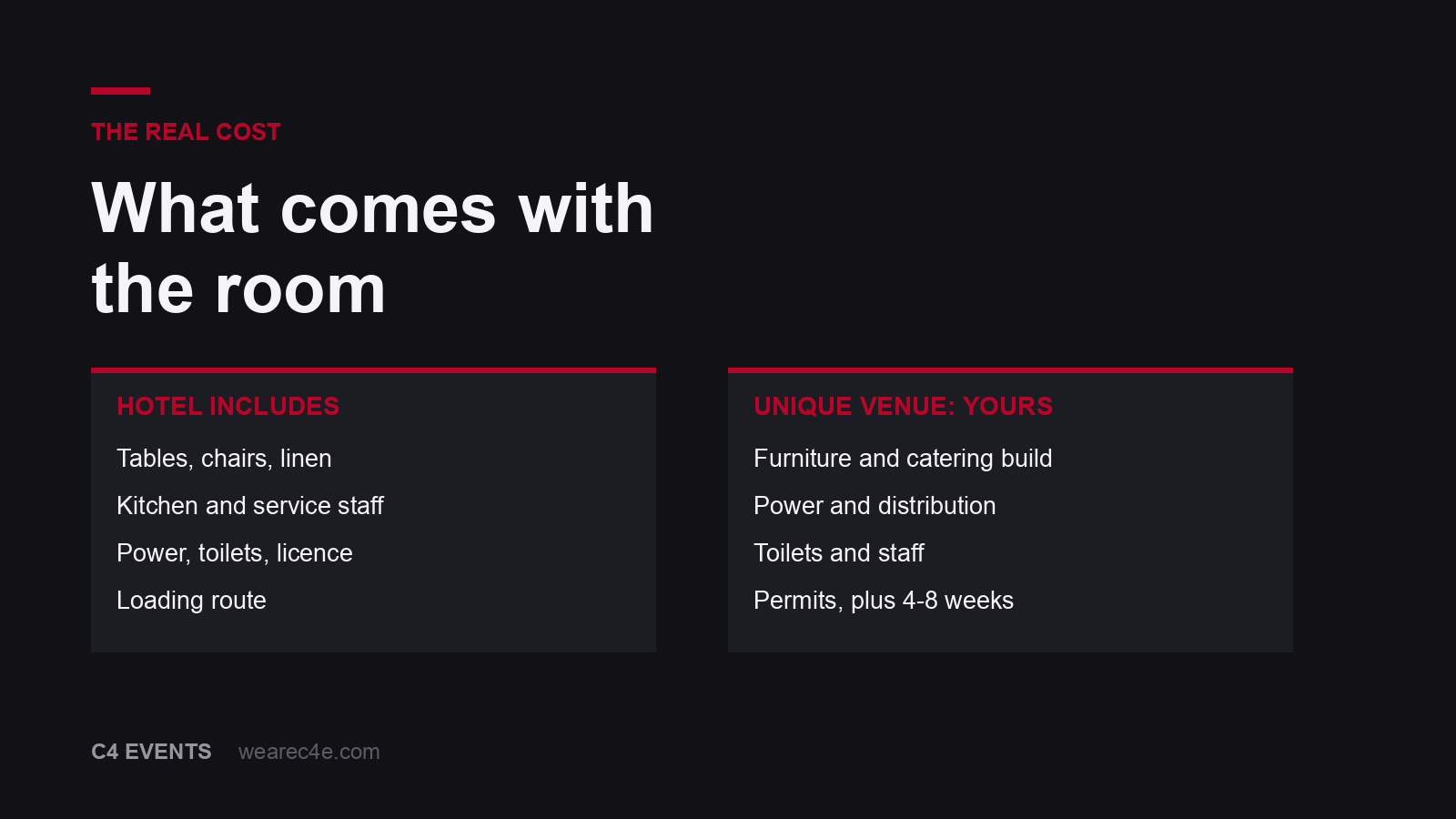
So the only comparison that works is a line-item one. Write down everything the event needs. Send the same list to all three venues and ask which lines they include, which they can supply at a price, and which are yours to solve. Compare the totals. This takes an afternoon and settles most of these decisions before anyone books a site visit.
The hotel ballroom
The default, and the right answer more often than the deck admits.
For 100 to 1,200 people, a hotel gives you the room, the catering, the delegate bedrooms and the pre-function space under one contract with one operations team accountable for all of it. On a two-day agenda that is worth real money, because every interface between suppliers is a place where the plan can fail.
What to check before you sign. Ceiling height and rigging points, because they decide whether your screen can exist. How the room divides, because breakouts live or die on it. What else the hotel has booked that week, because a shared pre-function space is a problem you find on the day. And the load-in window, because a room released at 6am has decided your rehearsal for you.
What the hotel will sell you and you should price outside: in-house AV. Sometimes it is competitive. Often it is not, and the contract makes it compulsory without saying so. Read that clause before you sign, not after your production partner quotes.
The convention centre
The scale answer, and the wrong answer at the wrong size.
Above about 800 people, when you need several halls at once, when an exhibition runs alongside the conference, or when the build is bigger than a hotel dock can take, a convention centre is the only room that works. Dock access, floor loading, power and load-in windows are built for it.
The trap is the empty-room effect. Three hundred and fifty people in a hall built for 3,000 read as an under-attended event however good the content is. Making it feel full costs drape, lighting, staging, floor plan and often a false ceiling, and that spend often exceeds the difference to a ballroom.
The second trap is what a bare floor does not include. Furniture, catering infrastructure, dressing, cleaning and sometimes power distribution all arrive as separate contracts. Count them before you compare the hire fee to a hotel’s.
The unique venue
A warehouse, a museum, a rooftop, a heritage house, a beach. The room is the message, and for the right format that is worth paying for.
It is worth paying for on an awards night, a launch, a leadership dinner, a reveal where the setting does the work a set would otherwise do. It is seldom worth it on a working conference with a full agenda, where the same money buys better content and a rehearsal day.
Here is what a unique venue costs. The hire fee, plus power, plus a kitchen or a catering build, plus furniture, plus toilets, plus staff, plus licences, plus a floor if the ground is uneven, plus a wet-weather plan that is contracted rather than hoped for. Two to three times the hire fee before production is a working starting point, and the range is wide because the venue decides it.
Get a site survey with your production partner before you sign anything. Power capacity, access dimensions, floor loading, noise limits and curfews are the five that kill events, and all five are visible on a survey and invisible in a photograph.
Permits, and the four to eight weeks nobody counts
A licensed hotel absorbs most of the approvals your event needs. A convention centre absorbs most of them too.
A unique venue hands them back to you. Public or non-standard space, alcohol served outside a licensed venue, temporary structures, capacity thresholds, anything that flies or burns, all trigger their own approvals with their own clocks. Across Asia and the Gulf that runs four to eight weeks depending on the market, and our permit lead times guide has the numbers.
Read the trigger list against the creative in week one. Almost every permit crisis starts as a creative decision taken without a permit conversation.
Match the format to the room
Conference with a full agenda and breakouts: hotel ballroom under 800, convention centre above it.
Dealer or channel meet: hotel, every time. The format needs bedrooms, a dinner and a room that feels like a reward, and one contract holding all three. Our dealer meet guide covers the shape.
Awards night or gala: hotel ballroom for reliability, unique venue when the setting is the story and the budget can carry what that costs. Our gala and awards guide has the run of show either way.
Product launch: unique venue or convention centre, depending on whether the message is intimacy or scale. See the product launch guide.
Exhibition alongside a conference: convention centre. Nothing else takes both. Our exhibition guide covers the build.
In-house AV, and the clause to read first
Hotels and convention centres both carry an in-house AV supplier, and the contract often makes using them compulsory or charges a fee if you do not.
Sometimes the in-house team is competitive and knows the room better than anyone you could bring, which has real value on a tight load-in. Sometimes the pricing sits well above market and the exclusivity clause is the reason it can.
So read that clause before you sign, not after your production partner quotes. Ask three questions. Is in-house AV compulsory, or is there a fee to bring your own? What does that fee cost? And can we get the in-house quote line by line rather than as a package number?
A line-item quote is the tell. A supplier confident in their pricing will give you one. A package number that cannot be broken down is a negotiation you have already lost.
Four questions that settle it
1/ What does each venue include, line by line, against one list you wrote first? 2/ What is the ceiling height and where are the rigging points? 3/ What time can you load in, and what does an extra day cost? 4/ Which approvals become yours if you take this room?
Ask those four before the site visit. They eliminate venues faster than price does, and they are the four that get asked in month four when the answer is expensive.
The mistake that repeats
The pattern we see most is a venue chosen in week two on a photograph, and a format designed in week six that the venue cannot hold.
It shows up the same way every time. The screen is bigger than the ceiling. The breakout rooms are on another floor. The load-in window is four hours and the build needs twelve. The catering flow crosses the delegate flow. None of these is a disaster on its own, and together they cost a set redesign and a schedule rewrite in the month you had least room for either.
The fix costs nothing. Design the format first, in outline: headcount, stage, screen, breakouts, catering, registration. Then take that outline to the venues. A room chosen against a format is a decision. A room chosen against a photograph is a bet.
In the end
The room your delegates remember is the one that was full, sounded good and started on time. All three venue types can deliver that. Only one of them will deliver it for the money you have.
Write the line-item list first. The venue argument answers itself once everyone is comparing the same page. Our RFP question set is a good place to start that list.
What did I miss? If you have taken a unique venue and found a cost nobody warned you about, tell us what it was.
Frequently asked questions
Which venue type is cheapest?
A hotel ballroom, once you count what it includes. The room fee is seldom the cheapest line, and the tables, chairs, power, kitchen, staff and toilets that come with it are the reason it wins on total cost.
When is a convention centre the right answer?
Above about 800 people, when you need multiple halls at once, when there is an exhibition alongside the conference, or when the build is large enough that a hotel’s load-in cannot take it.
What does a unique venue cost in total?
The hire fee plus everything a venue includes as standard. Power, kitchen or catering infrastructure, furniture, toilets, staff, licences and often a floor. Budget two to three times the hire fee before production, and get a site survey before you sign.
Can I put 300 people in an exhibition hall?
You can, and it will read as empty unless you spend on drape, lighting, staging and floor plan. That spend often exceeds the difference to a ballroom, so check the arithmetic before choosing the hall.
What is the single most missed question on a site visit?
Ceiling height and rigging points. The screen in the creative deck has to hang from something rated to hold it, and finding out otherwise in month four is an expensive redraw.
Do unique venues need more permits?
Almost always. Public or non-standard space, alcohol outside a licensed venue, temporary structures and capacity thresholds all trigger approvals that a licensed hotel absorbs for you. Add four to eight weeks depending on the market.
How do I compare quotes across the three types?
Build one line-item list of everything the event needs, then ask each venue which lines they include. Compare the totals, never the hire fees. This one exercise settles most of these decisions in an afternoon.
Is a unique venue ever worth it?
Yes, when the room is part of the message: a launch, an awards night, a leadership dinner where the setting is the reward. For a working conference with a full agenda, the money buys more as content and rehearsal.