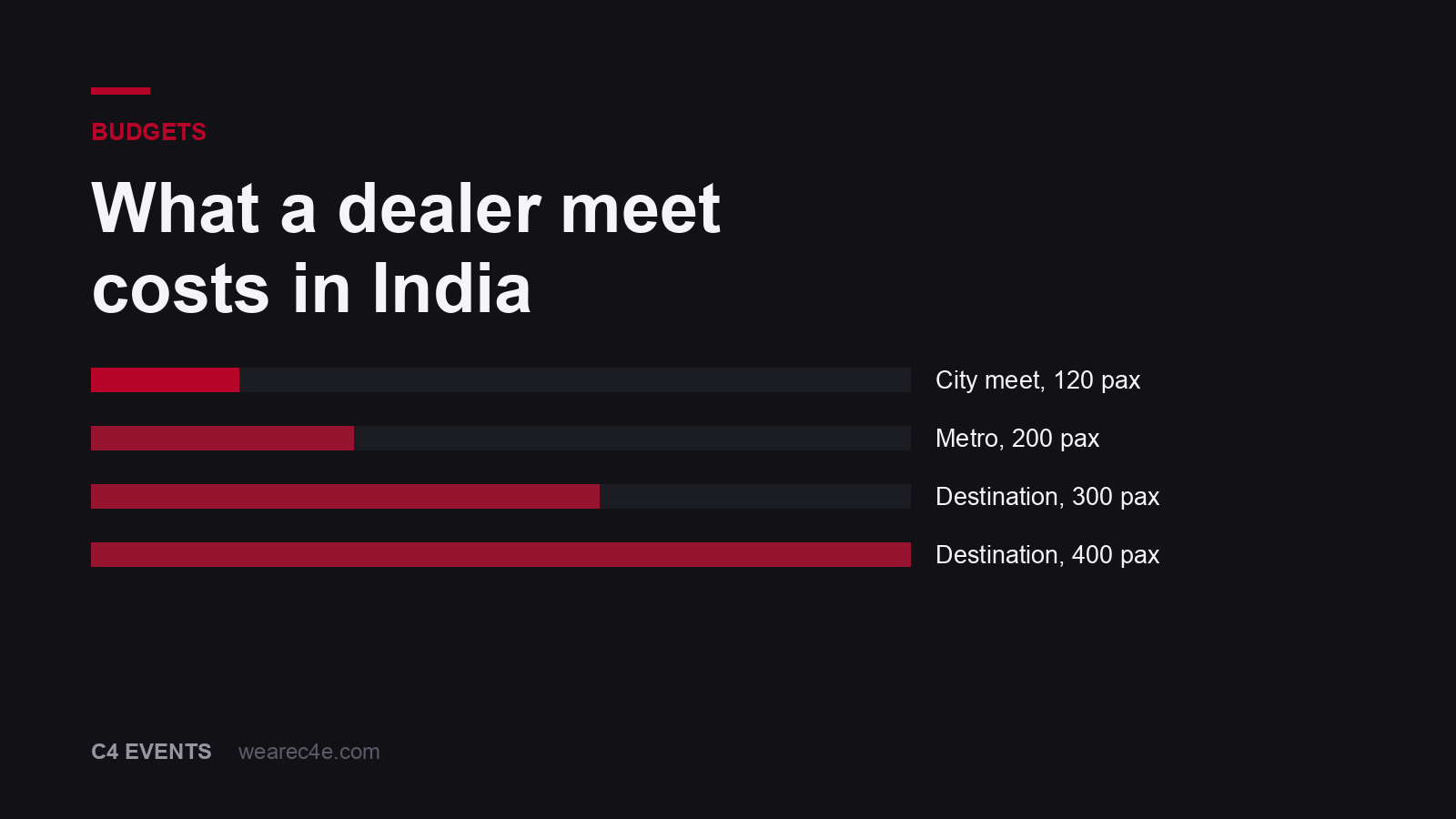
Rs 20 lakh to Rs 1.5 crore and above. That is the honest range for a dealer meet in India, and the spread is not vagueness. It is the distance between two events that share a name and nothing else.
A single-city meet for 120 dealers in a Mumbai ballroom, one day, one dinner, one product walkthrough, lands near the bottom. A three-day destination convention for 400 channel partners in Goa with a covered reveal, an awards night, inbound flights and a spouse programme lands past the top. Same category. Different businesses.
So the useful question is not what a dealer meet costs. It is what drives the number. Here is the answer, from the floor.
The one decision that sets your budget
Metro or destination. Everything follows from it.
A metro meet puts your money into the room. Stage, screen, reveal mechanic, content, catering. Dealers travel in, some drive, most go home the same night or the next morning. Your travel line is small. Your production line can be ambitious.
A destination meet inverts it. Flights, rooms, transfers and food swallow the budget, and production has to fit what is left. That is a real trade, not a failure. You are buying something a ballroom cannot sell: three days where the partner is nowhere near their showroom, their phone or their competitor.
Both work. What does not work is briefing a destination meet on a metro budget and then asking why the reveal looks thin. See how we run dealer and channel-partner meets for how the two shapes differ in delivery.
The line items, in the order they get signed
Venue and rooms. For a destination meet this is one negotiation, not two. Hotels price meeting space against room nights, so a 400-person meet holding 800 room nights has bargaining room a day-conference does not. Use it.
Travel. Domestic flights for 300 dealers out of 40 cities is a logistics job before it is a cost. Fares move, some partners book late, some bring a spouse. Build a per-head travel band rather than a fixed number and hold the variance in contingency.
Production. Stage, audio, lighting, LED, camera, playback, and a rehearsal day that is a full production day. If there is a product reveal, add the reveal mechanic: a drape, a lift, a projection map, a vehicle turntable. Reveals are where dealer meets earn their reputation and where budgets go missing.
Content. The MD’s address, the channel policy deck, the target rollout, the product film, the awards VT. Somebody has to write and build all of it. This line is absent from most first budgets.
Awards. Trophies, citation copy, photography, and the framed pictures that go up in 200 showrooms. The cheapest high-return line in the whole event.
Food and evenings. Two evening events, and the second one always costs more. Entertainment, artist, sound, bar.
Staffing and hospitality desks. Registration, help desk, room drops, transport coordination. On a 400-person destination meet this is a team, not a person.
Contingency. 10 to 15 percent.
Lead times, and what breaks when you compress them
The market standard is clear. 45 to 60 days for a city meet of 100 to 200 attendees. 90 days for a destination conference of 300 or more.
Those are numbers for the event. They are not numbers for what the event depends on. Three things run longer and they set the date.
1/ Product. If the meet exists to reveal something, the reveal date is set by manufacturing and legal, not by you.
2/ Travel inventory. Peak-season rooms in Goa or Udaipur go early. So does Bangkok in the first quarter.
3/ The network’s own calendar. Dealers have quarter-ends, festivals and local selling seasons. A meet that clashes with a selling week gets a thin room whatever you spend on it.
Compress a dealer meet and the first casualty is rehearsal. The second is content. Both show on the day, and both show to the exact audience you needed to impress.
The agenda shape that works
Most dealer meets are over-programmed. The instinct is to fill every hour because the network has travelled. The result is a room that has stopped listening by the second afternoon.
A shape that holds across formats: business content in the morning while attention is high, product and reveal before lunch on day one, recognition on the final evening, and one long unstructured block where dealers talk to your regional managers without an agenda. That unstructured block is where the meet earns most of its value, and it is the first thing cut when the schedule tightens.
Three rules I would hold. 1/ No session over 40 minutes without a break. 2/ The MD speaks once, early, and does not close the event. 3/ Recognition gets a ring-fenced block that cannot be borrowed from.
Where destination meets go abroad
Once a dealer meet crosses out of India, the calculus changes. Bangkok and Singapore carry the large-convention infrastructure. Bali and Phuket carry the reward feeling. Dubai carries the status.
Bangkok is the value play for scale. It placed 11th in the 2025 ICCA city rankings with 118 international association meetings, so venues, crew and freight handling are proven at volume. Singapore sits 5th worldwide with 156 meetings and has held the top Asia-Pacific position for 23 consecutive years, which is why it wins the meets where the network needs to feel senior.
For the reward-shaped meet, Phuket and Bali split along a clean line. And if the meet doubles as a partner incentive, the economics sit closer to incentive travel than to conference production.
The three outcomes that justify the spend
The strongest dealer meets deliver three things at once. A budget conversation that has not named them is a budget conversation about hotels.
1/ Renewed commitment. The partner leaves believing the company is investing in them. This is bought with time and attention, not with gifting.
2/ Strategic clarity. New products, revised targets, channel policy, margin structure. Said once, in one room, to everyone, so the network cannot run on rumour for the next two quarters.
3/ Personal recognition. Named, on stage, in front of peers. The trophy costs a few thousand rupees and carries more weight than the gala around it.
Here is the honest part. We have run meets where the content was strong, the room looked good, and the recognition block got squeezed to 12 minutes because the MD’s session ran long. The dealers who did not get called forward remembered that longer than they remembered the stage. We now ring-fence the awards block and cut elsewhere. That rule came from a bad Saturday, not from a template.
How to measure whether it worked
Most dealer meets are measured with a feedback form collected while people wait for their transfer. That measures the catering.
Better: pick three numbers before the meet and read them at 60 and 120 days. Order volume from attending dealers against non-attending dealers. Adoption of whatever you launched. Attrition in the network across the following two quarters. If the meet did its job, those three move and the feedback form is decoration. More on this in how to measure event ROI.
The spouse question
Somebody will ask whether spouses come. Answer it in the brief, not in month two, because the answer changes the budget, the venue and the agenda all at once.
Spouses raise per-head costs across rooms, food and transfers, and they add a parallel programme that needs its own hosts and its own transport. They also change the tone of the meet. A dealer who has brought their partner is not going to sit through a four-hour margin discussion, and should not be asked to.
Where spouses come, the shape that works is a compressed business block, a full spouse programme running against it, and evenings built for both. Where they do not, you can run longer sessions and a tighter schedule. Both are fine. Deciding halfway through is not, because the room inventory and the food guarantees are already committed by then.
Three ways to spend less without the network noticing
1/ Shorten by a night, not by a notch. Two nights done well beats three nights done thin. The rooms and food saved fund the reveal.
2/ Move the date, not the venue. Shoulder season at the same property saves more than dropping a star rating, and nobody feels downgraded.
3/ Cut gifting before you cut recognition. A branded bag is forgotten in a week. Being called to the stage is not.
One last thing worth saying to anyone building their first meet. The network is not an audience. Every dealer in that room runs a business, carries your stock, funds your working capital and could carry a competitor next year instead. They have travelled because you asked. A meet designed as a broadcast wastes that. A meet designed as a conversation, with room for them to talk back and senior people who stay to listen, earns the two quarters that follow. The budget line for that is zero. The design cost is the whole agenda.
Planning a dealer meet in India, Southeast Asia or the Gulf? Tell us the network size, the message and the window, and we will come back with a costed plan rather than a rate card.
What would you add? Do you agree?
Frequently asked questions
How much does a dealer meet cost in India?
Between Rs 20 lakh and Rs 1.5 crore and above. A single-city meet for 100 to 150 dealers at a good hotel sits at the lower end. A three-day destination convention for 400 partners with a product reveal, an awards night and inbound travel sits at the upper end and past it.
How far in advance should a dealer meet be planned?
45 to 60 days for a city-based meet of 100 to 200 attendees. 90 days for a destination conference of 300 or more. If the meet includes international travel, visas, or a reveal that depends on manufacturing timelines, work backwards from the longest of those, not from the event date.
What is the biggest cost in a dealer meet?
Travel and accommodation once the meet leaves the city, and production once it does not. A local meet spends on stage, screen and reveal. A destination meet spends on flights and rooms, and the production budget gets squeezed to pay for them. Decide which event you are running before you build the budget.
Should a dealer meet be in a metro or a destination?
It depends on what you need from the network. A metro meet is cheaper, shorter and better for dense commercial content. A destination meet costs more and buys two things a metro cannot: uninterrupted time, and the sense that the company invested in the partner. Goa, Jaipur and Udaipur do this inside India. Bangkok, Bali and Dubai do it when the reward has to feel bigger.
What makes a dealer meet work?
Three things at once. Renewed commitment, so partners leave feeling invested in. Strategic clarity, so they know the targets, the products and the channel policy. Personal recognition, so top performers are named in front of their peers. Miss any one and you have run a conference, not a dealer meet.