
Every destination guide in this category is written by someone selling the destination. So here is one built on the two data sets that are not: the ICCA rankings of international association meetings, and the Asia Pacific MICE market forecast.
The Asia Pacific MICE market stands at USD 231.49 billion in 2026 and is forecast to reach USD 352.25 billion by 2031, a compound rate of 8.75 percent. Southeast Asia is the fastest-growing sub-region at 12.41 percent. Convention and exhibition centres hold 44.85 percent of venue share. Large enterprises account for 58.15 percent of spend.
Now the cities.
The ICCA table, and what it does and does not tell you
ICCA counts rotating international association congresses. Meetings that move between at least three countries, run on a regular cycle, and clear a participant threshold. Published May 2026 for the 2025 year, the Asia Pacific entries in the global top 20 are:
- Singapore, 156 meetings, 5th worldwide
- Seoul, 121, 9th
- Tokyo, 119, 10th
- Bangkok, 118, 11th
- Hong Kong, 102, 15th
Europe holds 14 of the global top 20. Asia Pacific holds five. Lisbon leads worldwide with 188.
What this measures is association business, which is a proxy for a city’s infrastructure, air access, safety and credibility with an international committee. What it does not measure is corporate demand, resort programmes or incentive travel. A destination can be perfect for your event and absent from this list. Bali is. So is Phuket. Use the table for what it is.
Singapore: the one to beat
Top of Asia Pacific for the 23rd consecutive year, with 156 meetings in 2025, up 8 percent on 2024. MICE receipts hit S$2.3 billion, up 35 percent from S$1.7 billion. Fifth in the world, ahead of Prague, Copenhagen and London.
What you buy: certainty. Venues that work, crew who have done it, permits that behave, an airport that connects to everywhere, and a city where a global committee will approve the destination without argument. For a flagship conference, a regional headquarters event or anything where the audience is senior and international, Singapore removes risk you would otherwise carry.
What you pay: the highest costs in the region by a distance. See our Singapore page, and the two existing pieces on choosing a planner there.
Bangkok: the value play at scale
118 international association meetings in 2025, one behind Tokyo. That number matters more than the ranking, because it means the venues, the crew, the freight handlers and the hotel inventory have all been tested at international volume.
Thailand is also pushing hard. TCEB is targeting one million Singaporean business-event travellers by the end of 2026 and has set a 10 percent growth target for the country’s business events sector.
What you buy: proven capability at a cost well below Singapore, Tokyo or Hong Kong. Large ballrooms, a deep supplier bench, and a city that delegates enjoy being sent to. For a large dealer meet, a regional convention or a conference where budget matters, Bangkok is most often the right answer. See Thailand and our piece on what event planning costs in Bangkok.
Tokyo and Seoul: strong, and harder for outsiders
Tokyo at 119 and Seoul at 121 are serious conference cities with first-rate infrastructure. Both are underused by companies outside Northeast Asia, and both carry a real operating premium for a first-time organiser: language, contracting conventions, and a supplier culture that expects more detail earlier than Southeast Asia does.
Worth it when the audience is Northeast Asian or the sector is technical. A harder sell when the group is flying from Europe and the budget is the constraint.
Hong Kong: still there, changed role
102 meetings, 15th worldwide. Excellent venues, excellent access, and a position that now leans toward finance, trade and Greater China audiences rather than general international congresses. For the right sector it remains one of the best rooms in Asia.
Dubai: outside the table, inside the shortlist
Dubai does not appear in the ICCA global top 20, and treating that as a verdict would be a mistake. ICCA counts association congresses. Dubai’s strength is corporate: exhibitions, trade events, incentives and commercial conferences, which this table does not measure.
For a Gulf audience, for an event that needs delegates to fly in from many markets without connecting, and for anything where the destination has to pull attendance on its own, Dubai is on the shortlist. So is Abu Dhabi, for a different audience.
Bali, Phuket and the resort tier
Absent from the rankings, and right for a large share of corporate briefs.
These destinations do incentives, offsites and reward programmes, which is a different job from hosting a congress. The measure that matters there is not meeting count. It is what USD 5,100 per person buys, and on that measure Southeast Asia leads the world. Our Phuket versus Bali comparison and the Bali offsite guide cover this tier.
Vietnam: the one to watch, and to price with care
Vietnam’s MICE market is worth USD 7.71 billion in 2026, heading for USD 10.31 billion by 2031. Da Nang’s beachfront convention capability and Ho Chi Minh City’s 40,000 square metres of exhibition space put it in real contention for mid-size programmes. The full picture is here, including where I would be cautious.
What the rankings do not capture
Three things decide destinations in practice and appear in no table.
Visa friction. A city that requires visas for a third of your delegates carries a real attendance cost that no meeting count reflects. Singapore, Dubai and Bangkok all do well here for most passports. Check yours against your actual list before shortlisting.
Crew and kit availability in your week. A city can have the deepest supplier bench in Asia and still have none of it free, because a larger event took the trucks and the technicians. This catches out planners more than any structural constraint. Ask what else is on that week.
Whether people want to extend. Delegates who add two days at their own cost arrive in a better mood and speak well of the event afterwards. It also lifts attendance for voluntary events. Singapore, Bangkok, Dubai and Tokyo all do this. A convention centre in an industrial district does not, whatever the venue specification says.
A note on cost bands
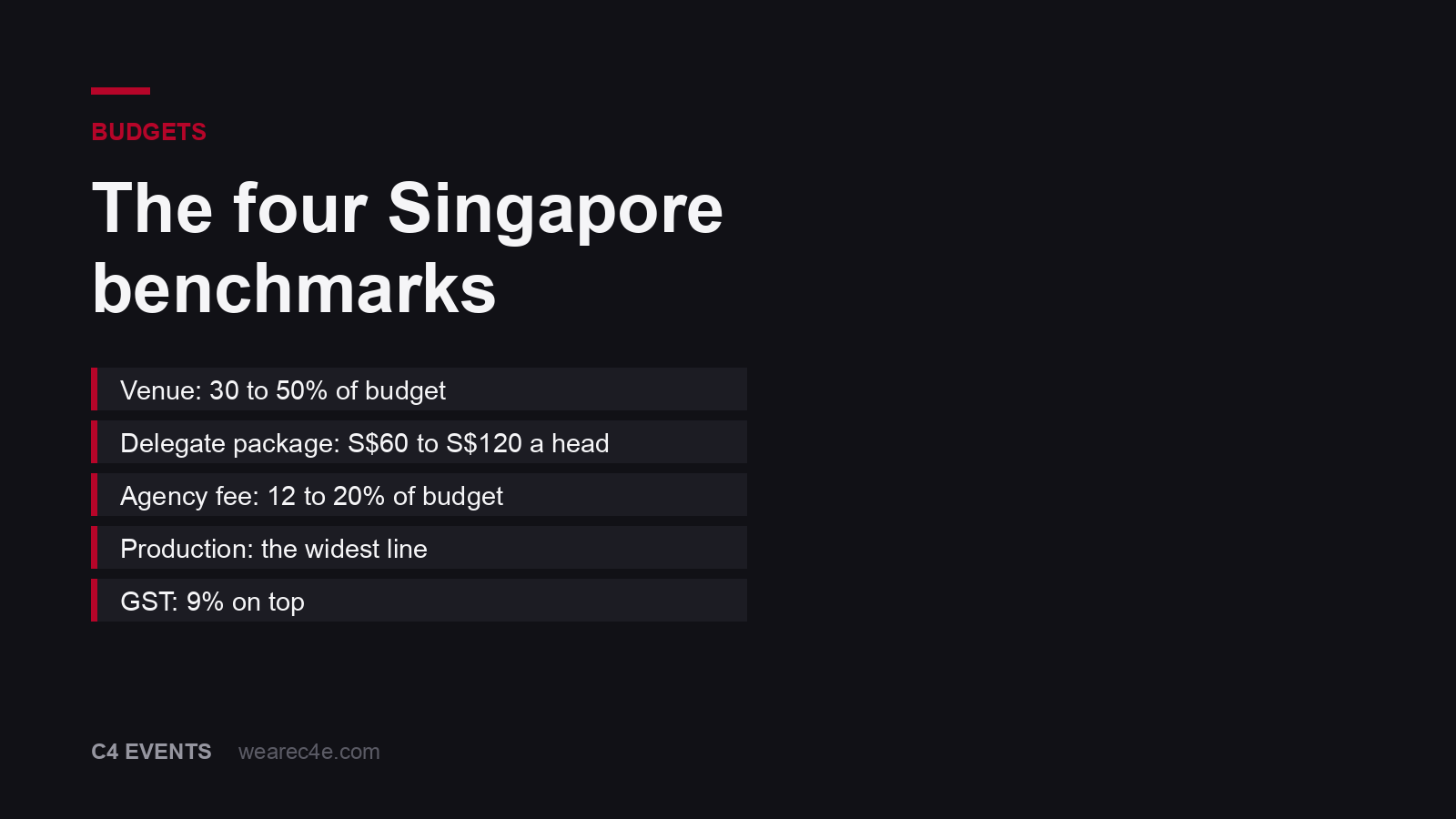
As a rough ordering for the same standard of programme, from most to least expensive: Singapore, Tokyo, Hong Kong, Dubai, Seoul, Bangkok, Bali and Phuket, Vietnam. The gap between the top and the bottom of that list is wide enough to change the format of your event rather than its price alone. Treat the band as a design input, not as a discount.
What the ordering hides is that the cheapest destination is seldom the cheapest programme, because air is the largest line and it does not follow ground cost. A Bangkok programme for a group flying from Frankfurt can cost more than a Singapore programme for a group already in Asia. Run the arithmetic on your actual origins before you let the band decide anything.
One more filter people skip: how long the working day can run. A destination where the group has to travel 40 minutes each way between hotel and venue loses 80 minutes of programme a day. Across three days that is a session and a half you paid for and did not get.
A final filter: how much of the city your delegates will see. Some destinations sell themselves in the transfer from the airport. Others need a programme to reveal anything. That difference decides how much of your agenda has to carry the destination and how much the destination carries for you.
Where the growth is going
Two shifts worth planning around. Southeast Asia is the fastest-growing sub-region at 12.41 percent compound, which means supply is being added in Vietnam, Thailand and Indonesia faster than demand in those markets, and that is good for buyers. And hybrid formats are growing at 11.72 percent, faster than the market around them, so venues that have invested in broadcast infrastructure will separate from those that have not.
How to choose
Three questions, in this order.
1/ Does the destination have to pull attendance? If yes, you are buying air access and appeal. Singapore, Bangkok, Dubai. If no, the field opens and the budget goes further.
2/ What is the production risk? A large technical build needs a deep crew bench. Singapore, Bangkok, Tokyo, Hong Kong. A resort programme with a stage and a screen does not.
3/ Where are they flying from? Count the connections. A destination that saves one connection for 200 people beats a destination that saves 10 percent on rooms.
Here is the caution I would give against my own table. Rankings measure what a city has done, not what it will do for you. A committee choosing between Lisbon and Singapore is solving a different problem from a company running a 300-person dealer meet. Use the data to filter and then argue about the brief, because the brief is where the answer is.
See where we run MICE programmes across Asia and the Gulf.
Tell us the audience, the format and the origins and we will shortlist three cities with the reasoning attached.
What would you add? Lemme know what you think.
PS: ICCA figures are for 2025, published May 2026. Market figures are the Asia Pacific MICE forecast for 2026 to 2031. Both are worth reading in full rather than through a summary, including this one.
Frequently asked questions
What is the top MICE destination in Asia?
Singapore, and it is not close on the data. It hosted 156 international association meetings in 2025, ranking 5th worldwide and 1st in Asia Pacific for the 23rd consecutive year, per ICCA. Its MICE receipts reached S$2.3 billion, up 35 percent on the year before.
How is the ICCA ranking calculated?
ICCA counts rotating international association congresses: meetings that move between at least three countries, are held on a regular basis, and have a minimum number of participants. It measures association business, not corporate events, so it is a proxy for a city’s infrastructure and credibility rather than a direct measure of corporate demand.
Which Asian city is best value for a large conference?
Bangkok. It placed 11th worldwide in the 2025 ICCA rankings with 118 international association meetings, so the venues, crew and freight handling are proven at volume, and it costs well below Singapore, Tokyo or Hong Kong for comparable delivery.
Is Asia growing as a MICE region?
Yes, faster than the rest of the world. The Asia Pacific MICE market is worth USD 231.49 billion in 2026 and is forecast to reach USD 352.25 billion by 2031, a compound rate of 8.75 percent. Southeast Asia is the fastest-growing sub-region at 12.41 percent.
Which destination should I choose for an incentive rather than a conference?
Bali, Phuket or Krabi, none of which appear high in the ICCA rankings because they host resort programmes rather than association congresses. That absence is a feature, not a weakness. Use the ICCA data to choose conference cities and use it for nothing else.