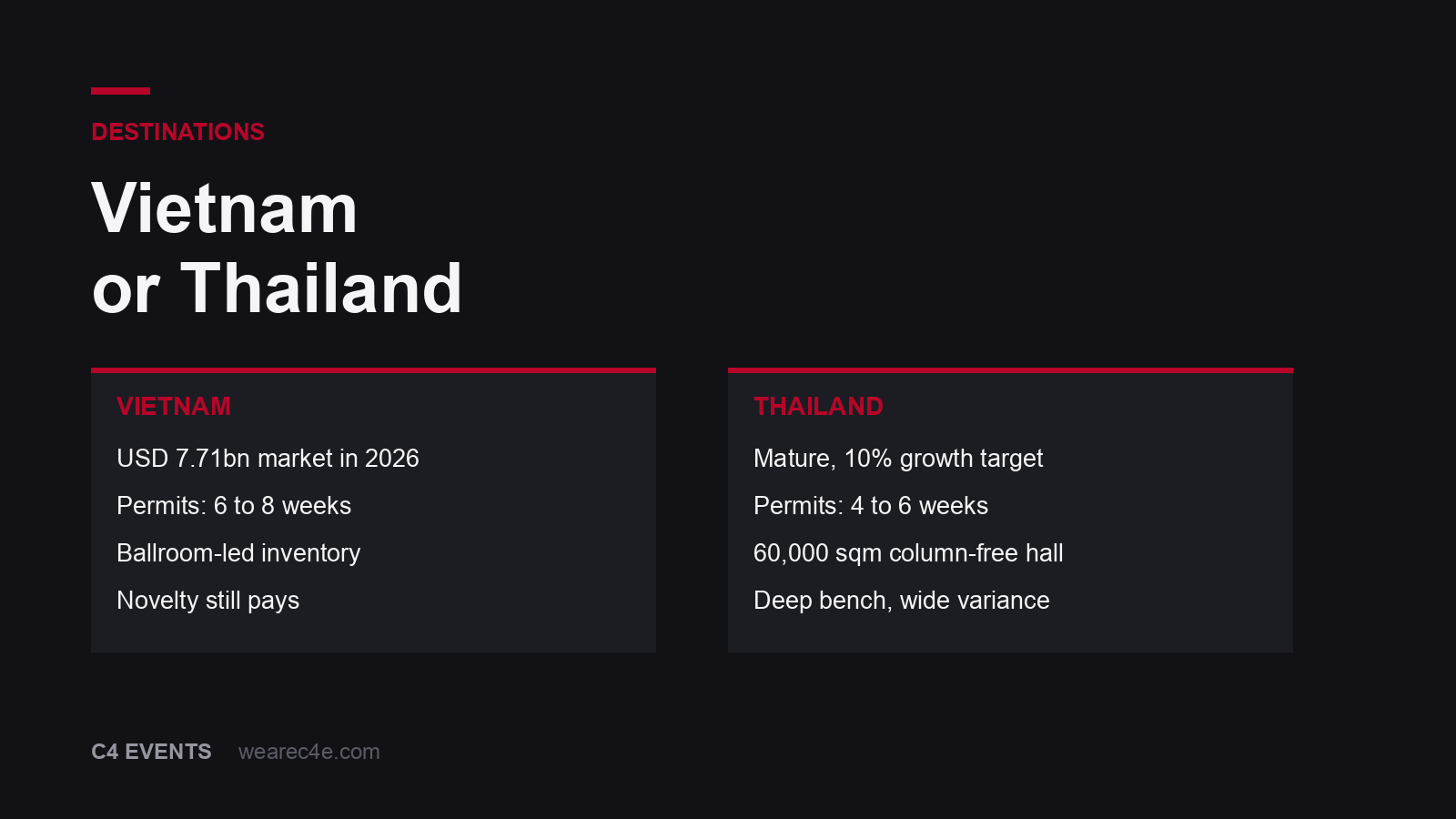
Vietnam’s business events market is sized at USD 7.71 billion in 2026, growing to USD 10.31 billion by 2031. Thailand’s tourism authority is targeting 10 percent growth in business events and one million Singaporean business travellers by the end of this year.
Two markets going the same direction at different stages. That difference is the whole comparison.
The short answer
Thailand is the finished market. More venues, more crew, shorter permits, more operators who have run your exact event before. You pay a small premium for that and you sleep better.
Vietnam is the market where arriving early still buys you something: a destination the audience has not seen, ground costs that come in under Thailand, and a hospitality sector building hard. You pay for it in lead time and in the depth of the vendor bench.
| Vietnam | Thailand | |
|---|---|---|
| Market size | USD 7.71bn in 2026, 5.97% growth rate | Mature, with a stated 10% growth target |
| Permit lead time | 6 to 8 weeks | 4 to 6 weeks |
| Convention hall depth | Hotel and resort ballrooms lead | IMPACT: 60,000 sqm column-free, plus QSNCC |
| Crew bench | Thin at the top, deep enough below it | Deep, with wide quality variance |
| Ground and room cost | Lower | Low, and higher than Vietnam |
| Production cost | Close to Thailand at the top end | Regional benchmark |
| Novelty for delegates | High | Low, and dependable |
| Where it hurts | Permits, freight, single points of failure | Vendor variance, and traffic in Bangkok |
The lead time is the real difference
Everyone opens this comparison on cost. The line that changes your plan is the permit clock.
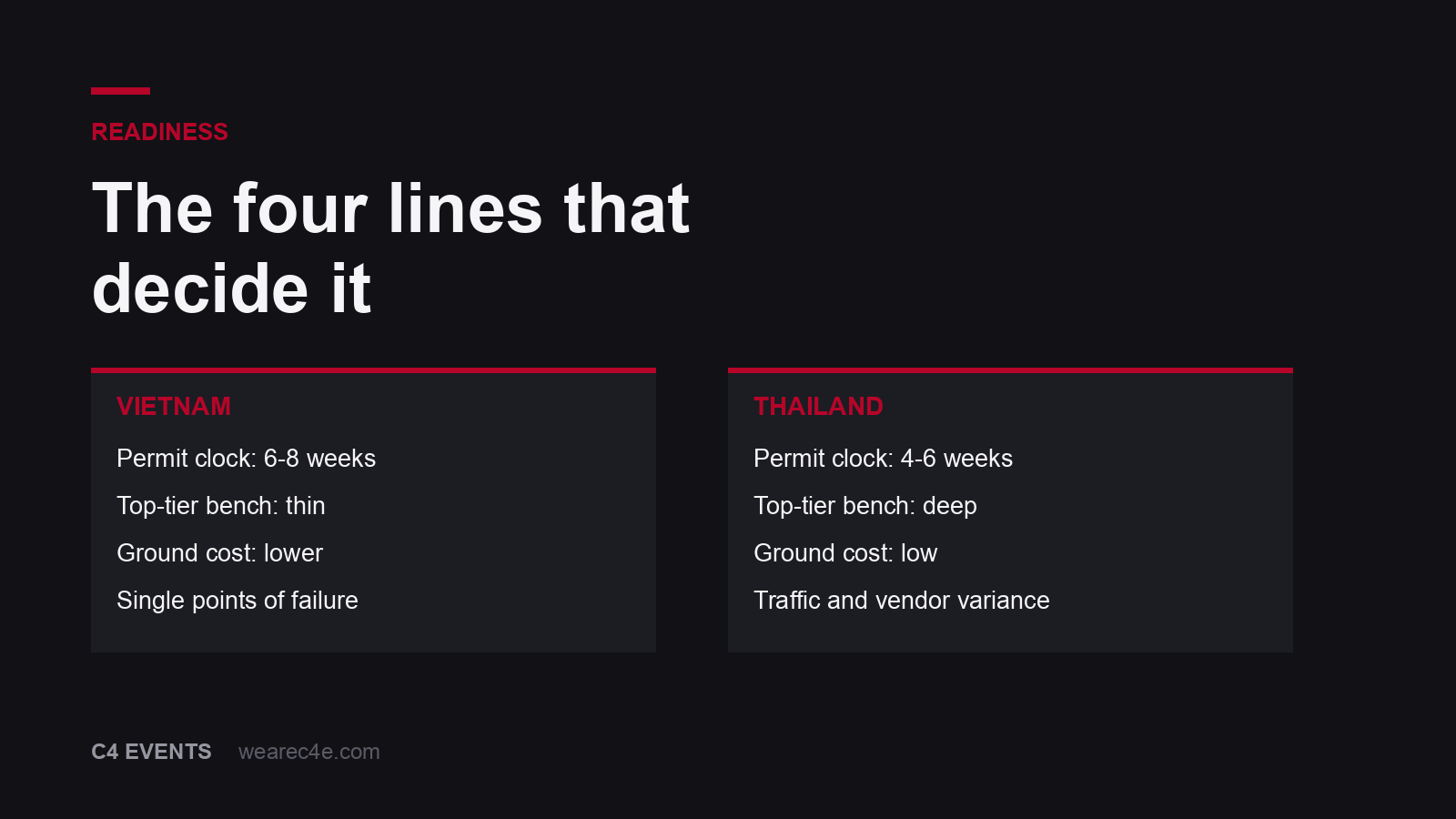
Vietnam runs six to eight weeks for event approvals. Thailand runs four to six. Two weeks sounds like nothing until the creative changes in month three, the new idea needs an approval the old one did not, and the resubmission lands inside the window.
So in Vietnam the permit conversation happens in week one, alongside the creative rather than after it. Read the trigger list against the concept the day you have a concept: public space, alcohol outside a licensed venue, drones, pyrotechnics, foreign performers, imported material. Our permit lead times guide has the full set by market.
Which city takes which brief
Vietnam is three markets wearing one flag, and treating them as one is the most common error.
Ho Chi Minh City takes scale and anything commercial: dealer meets, launches, sales conferences, the big room. Hanoi takes institutional and government-facing work, and the tone of an event there is different in ways that show up in the guest list. Da Nang takes the resort programme that still needs a real conference room, which is a combination the country does better than its reputation suggests. Our Vietnam guide works through all three.
Thailand splits along a different line. Bangkok takes conferences and dealer meets at scale, with two airports and hall inventory nothing else in the region matches. The beaches take the incentive and the reward: Phuket for access, Krabi for small and premium, Samui for the audience that will forgive a harder flight. Our Thailand guide and the Phuket against Bali comparison cover the beach half.
What each one costs
Vietnam comes in under Thailand on rooms, food, transfers and staffing. That is the part everyone gets right.
The part people get wrong is production. The best Vietnamese suppliers are fewer, busier and priced against the international clients they already serve. A heavy stage build in Ho Chi Minh City will not undercut Bangkok by much, and in a peak week it may not undercut it at all.
So the saving depends on the shape of the event, the same way it does in the Bangkok against Singapore comparison. Resort programme with three nights and one gala dinner: Vietnam saves you money. One-day conference with a 30-metre screen: it does not.
Freight, and the thing that catches people
Anything shipped into Vietnam needs a customs plan with a named broker, a date and a buffer that survives one delay. The same is true of Thailand, and the tolerance is wider there.
The practical rule we work to: nothing on the critical path arrives by sea, and nothing arrives in the same week as the show. Build the set in country where you can, and treat imported material as a decision rather than a default. It is cheaper to rebuild a set in country than to explain an empty stage.
The bench test
In Thailand, if your LED vendor fails in the week of the show, there is a second one who can take it. In Vietnam, in the top tier, there may not be.
That single fact should change how you contract. Two vendors quoted per category, not one. Payment terms honoured to the day so you are the client who gets rescued. A named person from each vendor on comms during the show, with a phone number rather than a company name.
It should also change who you hire on the ground. A partner with their own team in country, not a partner with a contact in country. The test is straightforward: ask who files the permit, in whose name, and who is at the loading dock at 6am. Our guide to choosing a destination partner has the rest of the questions.
Flights, and the arithmetic per market
Thailand has more inbound seats from more cities across the region, and two Bangkok airports with the second carrying most of the low-cost traffic. Vietnam’s three cities are well connected across Asia and thinner on long-haul.
The number that matters is not the average airfare. It is the airfare from each market on your delegate list. Build the list, sort it by origin city, and price the flight from each one to both destinations. On a 250-person programme drawing from six countries, the answer is often a split rather than a winner: cheaper from three markets, dearer from three others, and the totals land inside a few percent of each other.
Where the totals land close, pick on operations rather than on price. Operations means permits, crew and the depth of the bench behind your partner.
What the market data says, and what it does not
Southeast Asia is the fastest-growing MICE sub-region in Asia Pacific at a 12.41 percent compound rate, inside a regional market moving from USD 231.49 billion in 2026 to USD 352.25 billion in 2031. Vietnam’s own market sits at USD 7.71 billion in 2026, reaching USD 10.31 billion by 2031.
Growth numbers tell you where hotel and venue stock is being built. They tell you nothing about whether your event will work next March. A market growing at 6 percent a year still has one good LED vendor in the city you picked, and that is the fact your show day depends on.
Use the sizing to decide where to invest a relationship over three years. Use the bench test to decide where to run the event this year.
Where each market breaks
Vietnam breaks on single points of failure. One venue that suits the brief, one vendor who can build it, one approval that has to land. Any of those slipping takes the event with it, and the answer is redundancy bought early rather than heroics bought late.
Thailand breaks on variance and on traffic. The gap between the best and the worst supplier in any category is wide, a low quote is a warning rather than a win, and in Bangkok the distance between the delegate hotel and the venue is a scheduling input.
The novelty premium is real, and it expires
The Incentive Travel Index puts average per-person incentive spend at USD 5,100, with 70 percent of buyers wanting a destination they have not used before and 44 percent choosing shorter-haul trips. Those two numbers pull in the same direction, and they point at Vietnam.
An audience that has been to Phuket three times will value Da Nang at more than it costs. The same audience, three years from now, will have been to Da Nang. Novelty is a line in the budget that pays back once, and the market data says it is paying well at the moment.
For a conference, none of this applies. Nobody chooses to attend a sales conference because the city is new to them.
How to decide
1/ Count the weeks to your show date and check them against a six to eight week permit clock. If the margin is thin, Thailand. 2/ Split the budget into rooms and ground against stage and crew, and see which half is bigger. 3/ Ask whether the audience has been to Thailand three times. Novelty is worth real money on an incentive and nothing on a conference. 4/ Test the ground team in whichever market you pick, on their own team rather than their network.
In the end
Thailand is the safer answer and will stay that way for a while. Vietnam is the answer that makes an incentive trip feel like a reward again, and it asks you to plan earlier and contract harder.
Both work. Neither forgives a permit conversation that starts in month three.
What did I miss? If you have run a programme in either market and the trade-offs read another way from where you sit, tell us.
Frequently asked questions
Is Vietnam cheaper than Thailand for a corporate event?
On ground costs and rooms, in most cases yes. On production, no reliable gap exists, because the strongest Vietnamese suppliers are fewer and price like it. The saving is real on a resort programme and thin on a heavy stage build.
Which Vietnamese city should I use?
Ho Chi Minh City for scale and for anything commercial, Hanoi for institutional and government-facing work, Da Nang for a resort programme that still needs a conference room. Our Vietnam guide splits the three in detail.
How long do event permits take in Vietnam?
Six to eight weeks, against four to six in Thailand. That gap is the single most underrated line in the comparison, and it decides more schedules than cost does.
Does Vietnam have venues big enough for 1,000 people?
Yes, in all three main cities, in hotel and resort ballrooms. What it has less of is standalone convention hall inventory at the scale of IMPACT in Bangkok. Above about 1,500 delegates the shortlist gets short.
Which market is better for an incentive trip?
Thailand still, on flight access, resort depth and the number of operators who have run the exact programme before. Vietnam wins when the audience has been to Phuket three times and the novelty is the reward.
Is the language barrier worse in Vietnam?
Comparable to Thailand and handled the same way. Contract and plan in English, run the floor through a bilingual coordinator, and never let the run sheet exist in one language only.
How big is the Vietnamese market?
Vietnam’s MICE market is sized at USD 7.71 billion in 2026, reaching USD 10.31 billion by 2031 on a 5.97 percent compound rate. Southeast Asia as a whole is the fastest-growing MICE sub-region in Asia Pacific at 12.41 percent.
Can one agency cover both markets?
Some can, and the test is whether they have a ground team in each rather than a partner they email. Ask who files the permit, in whose name, and who is standing at the loading dock at 6am. If both answers are a phone number in a third country, keep looking.