
Every company in this industry describes itself as a full-service event partner. Five different businesses are hiding behind that phrase, and they charge on different logic, carry different risk and fail in different ways.
Here is the honest map, from the company that owns the whole outcome to the one that owns a room.
The five
| Kind | Owns | Charges | Hire when |
|---|---|---|---|
| Full-service agency | The outcome, brief to debrief | 10 to 20% management fee in the proposals we see, or pass-through plus fee | Cross-border, 300+ people, live production |
| Production house | The room: stage, screen, audio, lighting, crew | Quoted build, plus crew day rates | You have a lead and need the show built |
| DMC | One destination’s ground | Margin on ground services, or a fee | You know the event, not the city |
| PCO | An association congress, end to end | Fee, plus registration and sponsorship share | Abstracts, sponsors, a scientific programme |
| Venue-side team | The venue’s own event services | Inside the venue contract, or in-house AV rates | Simple format, single room, low production |
1. The full-service agency
The one company accountable for whether the event worked. Content, budget, venue, production, crew, delegate management, and the answer when three things break at once.
You hire an agency to stop carrying the seam between suppliers. That is the whole product. Everything else on their website is a capability they can buy on your behalf, and the thing you cannot buy anywhere else is a single accountable owner.
They charge a management fee on budget, at 10 to 20 percent in the proposals we see across the markets we work in, or costs passed through with a stated fee on top. Our fee model comparison covers what each choice does to both sides.
Where it goes wrong. An agency that sells strategy and subcontracts every execution line. The tell is the org chart: ask who from their team is on site on load-in day, by name, and what else that person has that week. If the answer is a producer you have never met, you are buying a broker.
2. The production house
The company that builds the room. Stage, set, screen, audio, lighting, rigging, vision mixing, crew, and the technical rehearsal that decides whether the keynote lands.
This is the most underrated hire in corporate events. A good production house has done a thousand shows in rooms like yours, will tell you when the creative deck cannot hang from the ceiling, and cares about the parts of the day the audience feels without noticing. Our production cost guide covers what they are quoting.
What they do not want is your content and your hotel block. Most will decline both, and the ones who accept are often the ones who should have declined.
Where it goes wrong. Hiring a production house and treating them as the agency. They will build a superb room and nobody will own registration, the run of show, the speaker wrangling or the moment the client changes the agenda on Wednesday.
3. The destination management company
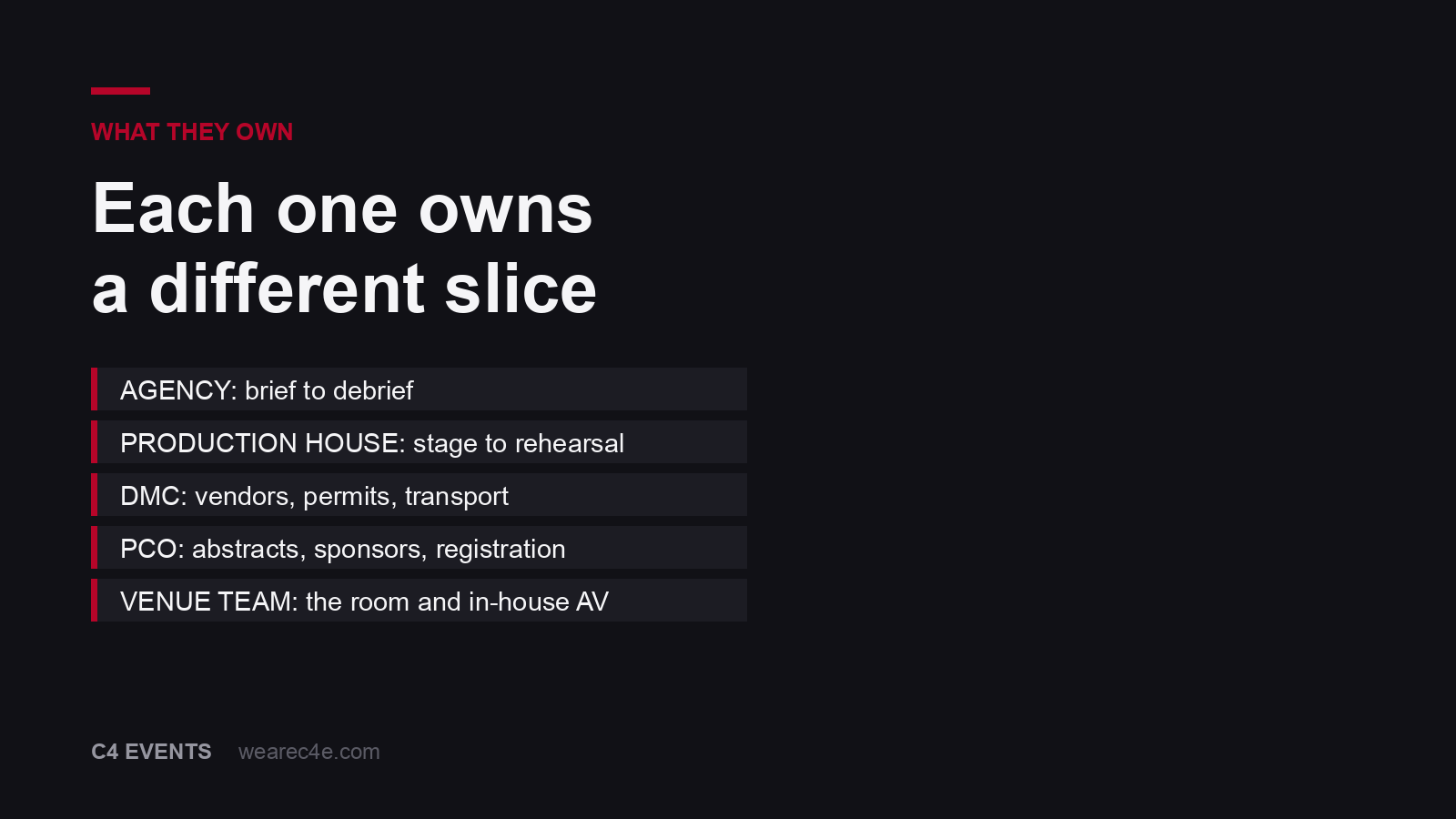
The ground in one city. Venues, transport, vendors, permits, staff and the relationships that decide who gets the last truck in a peak week.
Hire a DMC when your team can lead the event and the gap is local knowledge. Hire one underneath an agency when the event crosses a border. Our DMC, agency and PCO comparison takes that decision apart, and the destination partner guide has the questions to ask.
Where it goes wrong. Buying a DMC as a cost saving and keeping the coordination in-house without naming who does it. The saving is real. The work does not disappear, it moves to your team, and it arrives in the eight weeks you are busiest.
4. The professional congress organiser
The association specialist. Abstracts, scientific programmes, registration at scale, sponsorship and exhibition sales, and often the congress budget itself.
IAPCO defines a PCO as someone who “administers and brings to fruition the organisation of a congress, meeting, event or convention in a professional manner”, and its accreditation asks for proof of at least 10 international meetings plus a site inspection of a live congress.
Where it goes wrong. A corporate buyer hires a PCO because the deck looked serious, and pays for abstract handling and sponsorship machinery that a partner summit has no use for.
5. The venue-side team
The hotel or convention centre’s own event services, plus their in-house AV supplier. No separate company, no separate fee, and the least friction of any option here.
For a single room, a simple format and light production, this is the right answer and the industry does not like admitting it. A 120-person seminar in a hotel ballroom with a lectern, a screen and lunch does not need three suppliers.
Where it goes wrong. Their loyalty sits with the venue. When the venue’s interests and yours diverge, over the load-in window, over a shared pre-function space, over a room that got double-booked, the in-house team works for the building. Read the in-house AV exclusivity clause before you sign, and ask for a line-item quote rather than a package number.
The sixth option nobody lists
A freelance senior producer, hired direct for the event.
The best freelance producers in this industry have run more shows than most agency staff and cost a fraction of a management fee. For a company running two or three events a year with an in-house marketing team, one experienced producer plus a production house covers most of what an agency provides.
The limit is capacity and cover. One person cannot be in two rooms, carries no bench when they fall ill, and cannot absorb a scope change that doubles the work. Know that before you build a plan that has no slack in it.
How to pick, in four questions
1/ Does the event cross a border? If yes, you need either an agency or a DMC, and you need to decide which one owns the outcome. 2/ Is the production heavy enough that a bad rehearsal would embarrass someone senior? If yes, a production house is a line in your budget, whoever else you hire. 3/ Are there abstracts, sponsors or paid delegates? If yes, that is a PCO conversation. 4/ Who on your team runs the seam between suppliers, by name?
The fourth question is the one that gets skipped and the one that decides the show day. Whoever holds it needs the authority to overrule a supplier at 7am without calling anyone.
How the five get combined
Most real events use two or three of these, and the combinations that work are predictable.
Agency over production house is the common one, and it works because the slices do not overlap. The agency owns content, budget, venue and delegates. The production house owns the room. One contract, one seam, and the agency runs it.
Agency over DMC works the same way across a border. The agency owns the outcome, the DMC owns the ground, and the question to settle in the contract is whether the DMC contracts with you or with the agency. That answer decides who you can call when the DMC fails.
In-house lead over production house is the cheapest workable combination for a company running events at home. You keep the outcome, buy the room, and accept that the coordination lands on someone’s desk who also has a day job.
The combination that breaks is two suppliers of the same rank reporting to nobody. A DMC and a production company both hired direct, both senior, both correct about their own scope, and nobody holding the interface between the stage build and the venue release. That gap gets discovered at 6am on load-in morning.
What to ask all five
Ask for a reference from an event that went wrong. Not a case study, not a showreel, an event where something broke. Then ask what they did about it and what they changed afterwards.
Every company in this industry has a good showreel, because every company has had one good night. The ones worth hiring have a straight answer to what happened on the bad one, and the answer names a person rather than a circumstance.
Then ask who is on site at 6am on load-in day, and what else that person has on that week. Two questions, both cheap, both harder to fake than a deck.
In the end
Most bad supplier decisions come from hiring two companies that own the same slice, or none that own the slice that matters. The map above is not a hierarchy, and the expensive option is not the safe one.
Work out which slice you are missing. Hire for that, and hire nobody for the slices you already cover. Name the person who holds the seam between whoever you end up with.
Then check the hire the way the industry does not like being checked: a reference from a bad night, and a name for who stands at the dock at 6am.
Our RFP question set is where to take it next.
Reading this from the other side, as someone building one of these five? How to start an events business covers the cash flow that decides whether it survives the second year.
What did I miss? If you run one of these five and this description reads unfair from the inside, tell us.
Frequently asked questions
How many types of event company are there?
Five that matter to a corporate buyer: the full-service agency, the production house, the destination management company, the professional congress organiser and the venue-side team. Everything else is a variation on one of those five.
What is the difference between an event agency and a production company?
The agency owns the event and the audience outcome. The production house owns the room: stage, screen, audio, lighting, crew and the show itself. Good production houses run brilliant shows and do not want to write your content or negotiate your hotel block.
Which one is cheapest to hire?
The venue-side team, because you are not paying a separate company at all. It is also the one that carries the least of your risk, and their loyalty sits with the venue rather than with you.
Do I need a full-service agency for a 150-person event?
In most cases no. A hundred and fifty people in your home market is an in-house job with a production partner for the room. Hire an agency when the event crosses a border, passes about 300 people, or carries a live production you would lose sleep over.
Can a production house run my whole event?
Some can and most would rather not. Ask whether they have a producer who owns the client relationship or only a technical director who owns the stage. That answer tells you which company you are hiring.
What about freelance event producers?
A good freelance producer is the cheapest senior capability in this industry, and the right answer more often than agencies admit. The limit is capacity: one person cannot be in two places, and they carry no bench when they get ill.
How do I check any of them?
Ask for a reference from an event that went wrong, and ask what they did about it. Every supplier has a showreel. Only the good ones have a straight answer to that question.
Should I hire more than one?
Yes, in most events, and only if one of them owns the seam between them. An agency over a production house works. An agency and a production house both reporting to you works only if you have named someone on your team to run the interface.